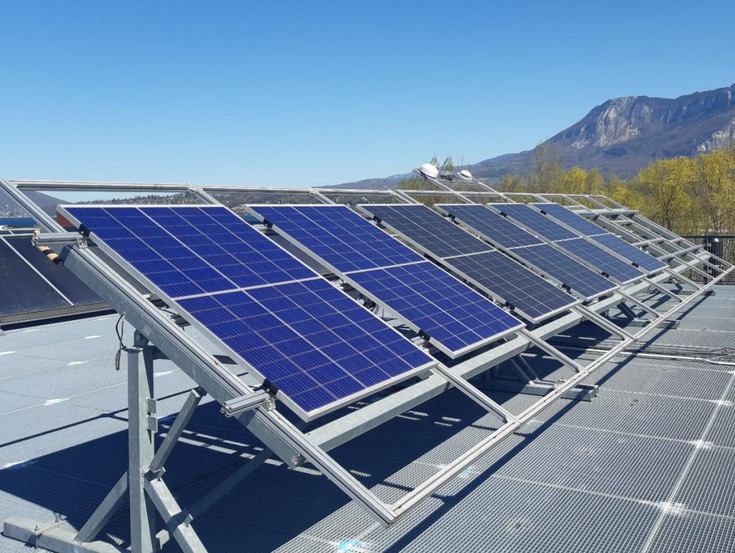
The new heterojunction solar panel concept is based on coextruded EVA/POE/EVA (EPE) encapsulant with UV downshifting (UV-DS) films, which convert harmful UV light into blue light, protect cells and slightly increase the short-circuit current by 1.5-1.75%.
Researchers from the French National Institute of Solar Energy (INES) – a division of the French Alternative Energy and Atomic Energy Commission (CEA) – and 3SUN, the PV module production unit of Italian renewable energy specialist Enel Green Power (Enel Group), have manufactured mini HJT PV panels based on a co-extruded EVA/POE/EVA (EPE) encapsulant containing ultraviolet (UV) downshifting films (UV-DS), which convert harmful UV photons into blue light.
“These encapsulants are designed as a preventive solution against UV-induced degradation, a crucial challenge for advanced photovoltaic technologies such as TOPCon and HJT,” said the study’s corresponding author Maxime Babics, pv magazine. “The sun’s ultraviolet (UV) rays are not only harmful to human skin, they are also harmful to photovoltaic panels, causing energy losses and premature deterioration of solar installations.”
The researchers explained that the EPE encapsulant is a coextruded multilayer EPE film composed of a polyolefin elastomer (POE) core sandwiched between two layers of ethylene vinyl acetate (EVA), with clear interfaces and no mixing after lamination. It contains a benzotriazole-based UV downshifting (UV-DS) additive at 0.5–2 wt%, which absorbs UV photons between 250–400 nm and re-emits visible light from 380–550 nm, with a photoluminescent quantum yield of approximately 95%.
These properties allow the encapsulant to protect solar cells from UV damage while slightly increasing the short-circuit current by 1.5-1.75% compared to conventional UV cut films, the research team said. The EPE structure also provides mechanical robustness, with high adhesion and gel content, and remains intact after moist heat and thermal cycling tests.
The multi-layer EPE encapsulant was laminated between glass layers on both the front and back sides of half-cut cell-based mini-HJT panels.
Mechanically, the modules were found to be robust and exhibit high adhesion between encapsulant layers, glass and backplate, with no delamination observed even after moist heat and thermal cycling. The modules also showed a power gain of approximately 7 W per module compared to those with conventional UV-cut encapsulants, with the open-circuit voltage and fill factor remaining largely unchanged.
The outdoor tests also showed that energy gains are highly dependent on UVA radiation; this amounts to 2 to 2.5% in the summer months and decreases in winter. Furthermore, the modules maintained optical and additive stability, although some high-energy UVB photons still penetrate and additive migration may occur at the edges over time, which is mitigated by a good seal.
“The short-circuit current gain was more than 1.5% compared to conventional UV-Cut encapsulants under standard test conditions (STC),” says Babic. “The impact of the light source on the power gain is discussed, as different equipment with different light spectra can produce different results. Outdoor monitoring over several months confirms the energy gain and shows that it is highly dependent on the daily UVA content, with higher gains observed during the summer months when the UV content in the solar spectrum is at its peak.”
“The study focused on critical reliability and industrial aspects such as the adhesion of the encapsulant before and after aging, the lamination time and temperature that influence the gel content and production capacity of the encapsulant, and the potential savings from lower EPE prices compared to pure POE,” he continued. “Notably, the presence of UV-DS additives did not cause any new types of degradation in humid heat for up to 3000 hours, and the presence of EVA in the EPE structure in contact with the solar cells did not affect reliability compared to pure POE encapsulant.”
The research team is optimistic about the future applications of UV-DS encapsulants, especially in regions with high UV radiation, where their benefits are most pronounced. “We are now working on an energy yield model based on local spectral conditions, ensuring accurate predictions of annual outdoor performance gains,” Babic concluded.
The new mini-modules were described in “Performance and reliability of PV modules made with a new co-extruded encapsulant containing UV downshift compound”, published in Progress in photovoltaics.
This content is copyrighted and may not be reused. If you would like to collaborate with us and reuse some of our content, please contact: editors@pv-magazine.com.
Popular content