

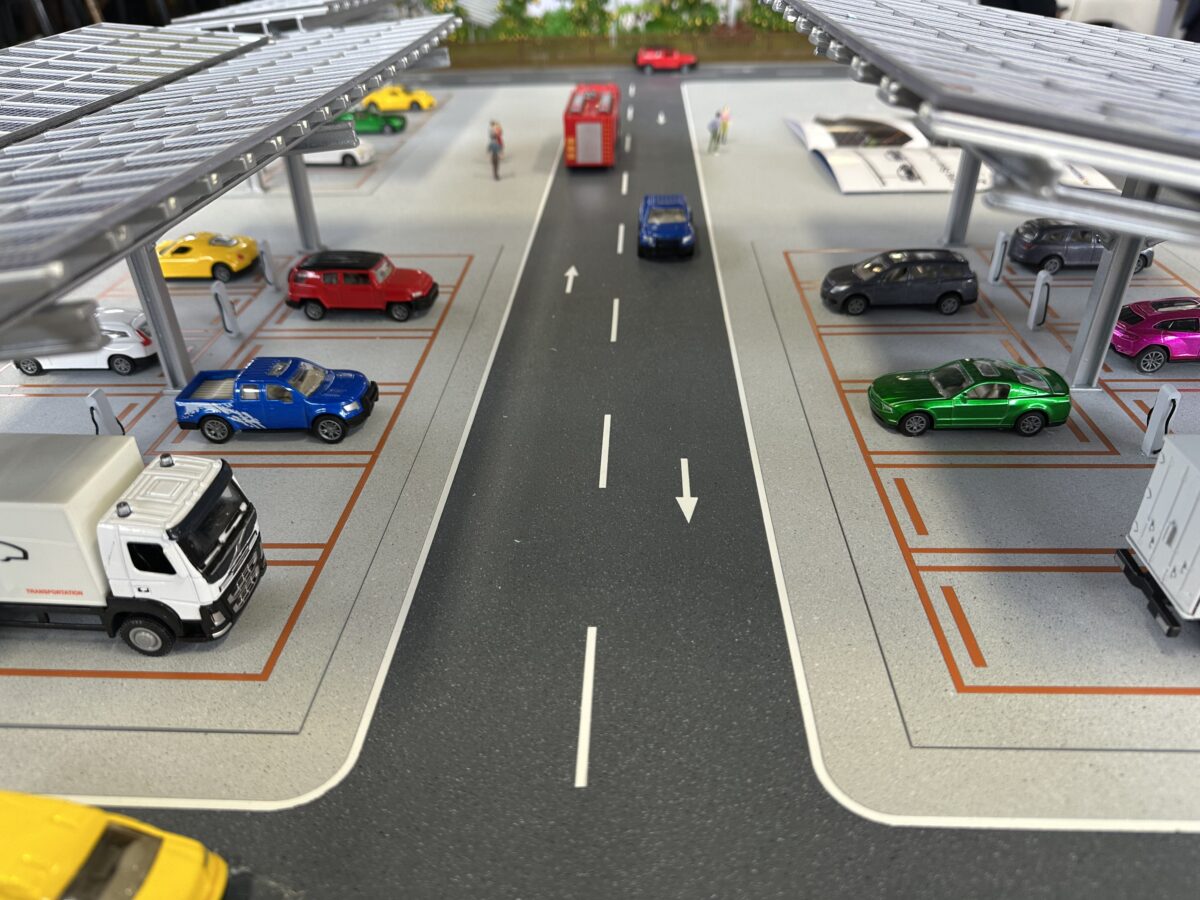
A new report from the International Energy Agency Photovoltaic Power Systems Program (IEA PVPS) Task 17 outlines how photovoltaic systems can be effectively integrated with electric vehicle charging infrastructure through optimized sizing, intelligent control and site-specific design.
The report, “Solar charging stations: sizing, optimization and control“analyses workplace charging locations, microgrid configurations, vehicle-to-grid (V2G) operation, battery swapping concepts, and electric bus charging infrastructures. As the authors explain, matching charging demand with solar energy production is critical to maximizing self-consumption and reducing costs.
Six years of workplace charging data
One of the report’s key case studies evaluates a workplace charging facility in southern France based on six years of empirical data. The dataset includes more than 32,000 charging transactions from more than 350 EV users spread over approximately 80 charging points.
Using this real-world data, researchers developed a modular sizing methodology to assess different charging strategies. The analysis compared uncontrolled charging with smart solar charging.
The results show that optimized charging significantly improves the match between PV generation and EV demand. Smart solar charging reduces the required PV peak capacity compared to uncontrolled charging, while increasing self-PV consumption and reducing grid exchange. The modular structure of the methodology allows operators managing multiple sites to efficiently replicate sizing procedures once the core relationships between PV production and charging demand have been established.
Grid-connected systems perform better than off-grid
The report also examines PV-powered charging stations based on microgrids, combining PV arrays, battery storage systems and grid connections. Using mixed integer linear programming, systems were optimized over a 25-year lifespan based on levelized energy costs (LCOE) and life cycle emissions (LCE).
The results indicate that cities with high solar radiation exhibit lower LCOE and LCE compared to cities with low solar radiation. It is also noted that the ranking of cities based on average solar radiation does not necessarily correlate with the ranking of LCOE and LCE.
The analysis also highlights the importance of seasonal variability. Higher annual solar radiation does not automatically translate into lower system costs. Monthly and seasonal mismatches between production and charging demand can increase required system capacity.
A comparison between Dijon and Poitiers illustrates this effect. Although Dijon has a higher annual irradiation, the weaker solar energy availability in winter and autumn reduces self-PV consumption and increases the required system size compared to Poitiers, where demand and production are better matched.
Vehicle-to-grid potential
The report evaluates the operation of V2G through simulation of charging schedules. In optimized scenarios, EVs charge during periods of high PV generation and discharge during peak demand, while still meeting the required state of charge upon departure.
The results show that intelligent scheduling can reduce energy costs compared to unattended charging. However, the authors point out several implementation issues, including battery degradation from additional cycles, the need for robust communications systems, and the importance of long-term simulations to evaluate operational impact over time.
Annual simulation frameworks are recommended to better understand degradation effects and long-term system performance.
Changing batteries increases flexibility
Battery swapping concepts are also modeled in the report. In this configuration, the batteries are charged independently of vehicle use and remain connected to the grid for extended periods. This allows charging to be scheduled during periods of high PV production.
A modeled region with approximately 200,000 inhabitants was used to compare swapping with conventional charging approaches. The results indicate that battery swapping can increase PV integration and reduce electricity demand on the grid, because stationary batteries provide more flexibility in tailoring charging to solar availability.
Considerations when charging electric buses
The electrification of public transport is examined through a case study of the bus network in Compiègne, France. Three charging strategies have been modeled: depot charging only, terminal charging and opportunity charging.
Large on-board batteries of 422 kWh are required for depot charging only. Opportunity charging significantly reduces the required battery capacity, but creates a high demand for peak power. Simultaneous charging events may require grid connections of up to 1,200 kW.
A 100 kWp PV installation can exceed total bus consumption during the summer months, but falls short in winter, highlighting the need for seasonal balancing and potentially stationary storage.
The study concludes that the choice of charging strategy directly affects battery size, grid voltage and potential for integrating renewable energy sources.
Data-driven design and multi-objective optimization
Across all use cases, the report highlights that empirical data improves system sizing accuracy and that charge control strategies have a material impact on self-consumption and economic performance.
Rather than relying on annual averages, the authors emphasize the importance of hourly and seasonal analyses. Multi-objective optimization – balancing costs, emissions and operational constraints – is considered essential for large-scale implementation.
The report also highlights ongoing challenges, including computational scalability for large EV fleets, improved battery degradation modeling and standardization of communications protocols.
Overall, Task 17 concludes that PV-powered charging stations are technically feasible and economically viable when supported by intelligent control, detailed data analysis and site-specific system design.
Author: Bettina Sauer
This article is part of a monthly column from the IEA PVPS programme. It was contributed by IEA PVPS task 17. The main goal of this working group is to accelerate and structure the use of PV in the transport sector.
The views and opinions expressed in this article are those of the author and do not necessarily reflect those of the author pv magazine.
This content is copyrighted and may not be reused. If you would like to collaborate with us and reuse some of our content, please contact: editors@pv-magazine.com.
