

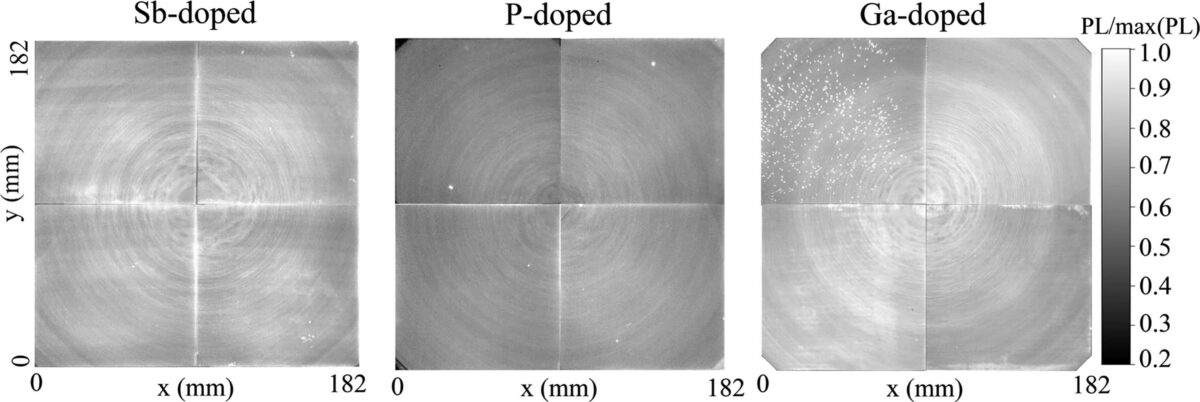
Researchers from the Australian National University and Longi used photoluminescence imaging to analyze the distribution of dopants in RCz-grown silicon wafers doped with antimony, phosphorus and gallium, finding highly uniform radial concentration profiles suitable for high-efficiency solar cells. The study also found that antimony-doped wafers provide more stable axial doping along the rod, highlighting their potential for next-generation photovoltaic manufacturing.
A research team from the Australian National University and Chinese solar module manufacturer Longi used high-resolution steady-state photoluminescence (PL) imaging to assess doping concentration in Czochralski (RCz) silicon wafers and found that antimony (Sb), phosphorus (P) and gallium (Ga) all exhibit highly uniform radial concentration profiles, a key factor in achieving high solar cell efficiency.
“Our findings indicate that the lateral, radial dopant distributions across the wafers are well within the tolerances required for high-efficiency solar cells.”, the lead author of the study, Afsaneh Kashizadeh, narrated pv magazine. “The results also show that antimony is acceptable in terms of lateral doping uniformity across a wafer and is superior in terms of axial uniformity along the length of the rod. Our previous work has shown that antimony-doped wafers exhibit excellent axial uniformity and excellent bulk quality. These characteristics could make antimony a strong candidate to become the dominant dopant in the industry in the future.”
The research team used wafers from the central sections of blocks grown by the RCz method during separate growth runs and doped Sb, P, Ga. To ensure a fair comparison between dopant types, wafers were taken from similar relative positions along each bar. The pseudo-square wafers were then cut into quarters with a laser to facilitate laboratory-scale processing and measurements.
PL imaging was used to assess the distribution of dopant concentrations under low injection, high surface recombination conditions, where PL intensity was proportional to the wafer dopant concentration and allowed spatially resolved analysis. To prepare the samples, wafers were chemically treated with tetramethylammonium hydroxide (TMAH) and hot deionized water to remove sawing damage and improve surface recombination.
PL images were acquired using a BT Imaging LIS-R1 system under 808 nm laser illumination and detected with a CCD camera. Multiple images were captured and averaged to improve the signal-to-noise ratio. For quantitative analysis, the PL intensities were calibrated against the doping concentrations measured with a Sinton WCT-120 eddy current tester.
Radial doping uniformity was evaluated by multiple line scans from center to edge across quarter wafers. Additional annealing experiments were also performed to determine whether the observed stripes originated from variations in dopant concentration or from thermal donor effects, and to test the sensitivity of PL imaging to thermal donor formation and destruction.
The PL images revealed clear structural asymmetries near the wafer centers, while the remaining regions showed largely uniform circular doping patterns. These central irregularities are most likely related to buoyancy-induced convection in the melt during crystal growth.
During seed pulling, interacting toroidal convective cells in the melt can induce flow instabilities that induce vortex-like dopant asymmetries in RCz grown silicon wafers. Sb-doped wafers exhibit the strongest central inhomogeneities, likely due to the high evaporation rate and low segregation coefficient of Sb
To verify whether the observed variations were caused by dopants or by oxygen-related thermal donors (TDs), additional annealing experiments were performed. Benchmark wafers were annealed at 1,050 C, a temperature high enough to eliminate TDs. The absence of resistance changes confirmed that the doping variations observed in the PL images originated from the dopants themselves and not from thermal donors.
Further experiments deliberately generated TDs in a representative Sb-doped wafer by annealing at 450 C for 72 h, increasing the concentration of the majority of the carriers. A subsequent annealing step at 650 C removed the thermal donors and restored the original carrier concentration, confirming that the transient changes were solely due to TD formation and subsequent destruction.
“Radial dopant concentrations had standard deviations of less than 10% from the center of the wafer to the edge, a level of variation expected to have negligible impact on solar cell performance,” the academics explained. “Of the dopants examined, P-doped wafers showed the highest radial uniformity, with standard deviations of less than about 4%, compared to about 5% for Sb-doped and 8% for Ga-doped samples.”
“In contrast, axial profiles along the length of the rod showed a stronger dependence on dopant type,” they continued. “Sb-doped wafers maintained relatively stable axial distributions of less than 10%, while P-doped wafers showed a marked increase in towards the tail of the rod.”
The researchers concluded that the RCz technique can produce silicon wafers with very low radial doping variation. In particular, Sb-doped wafers exhibit a more uniform doping profile along the rod, highlighting their potential for next-generation high-efficiency photovoltaic devices.
In November, the same research group published another paper demonstrating why antimony-doped n-type silicon rods can achieve a uniform resistance distribution despite antimony’s very low segregation coefficient.
This content is copyrighted and may not be reused. If you would like to collaborate with us and reuse some of our content, please contact: editors@pv-magazine.com.
