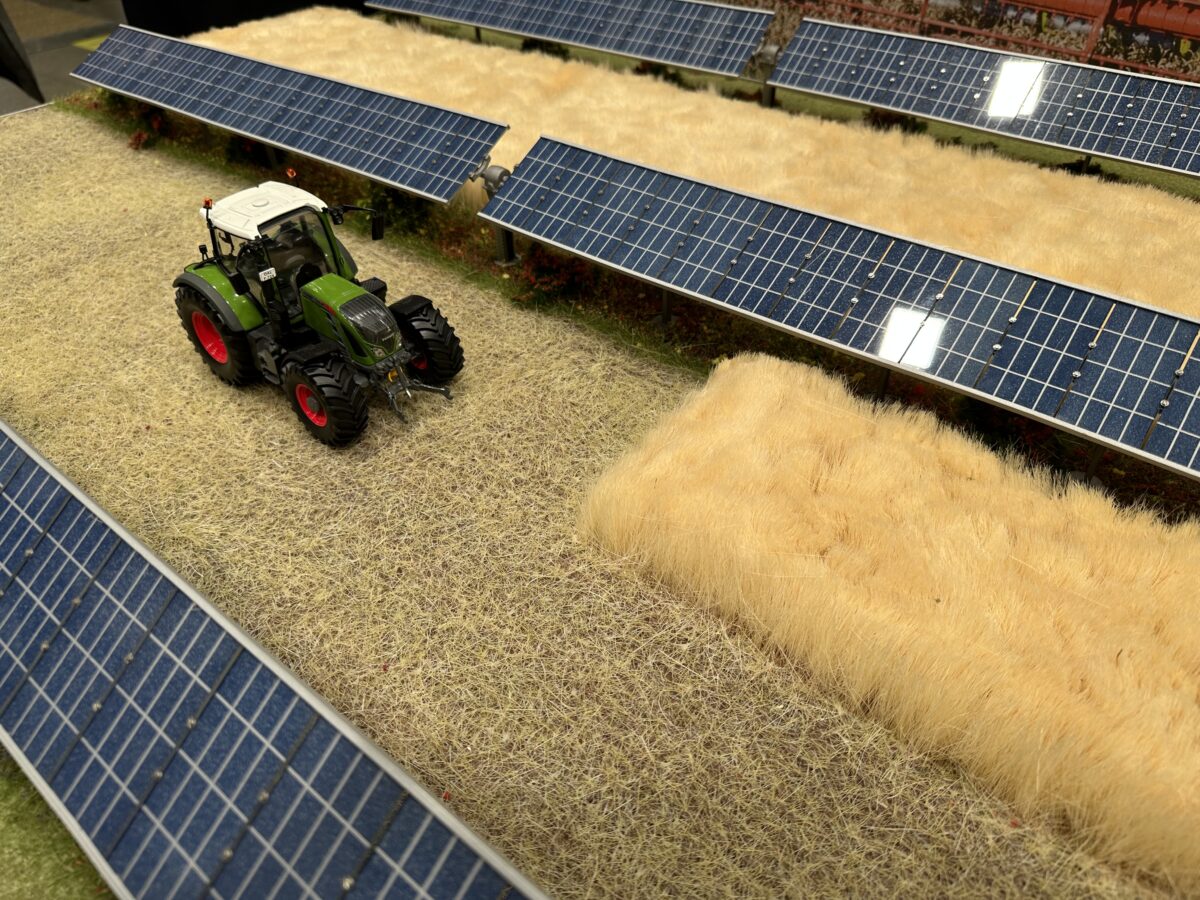
US researchers have developed a framework showing that increased spacing between solar PV rows can make agrivoltaic systems economically viable for large-scale mechanized agriculture. Their simulations in Colorado showed that optimized row spacing maintains crop production while improving combined agricultural and energy revenues.
A research team led by Colorado University has analyzed whether increasing the spacing between PV rows could make agrivoltaic systems economically viable for large-scale mechanized agriculture.
“The main contribution of our paper is a framework to analyze the economics of wide-range agrivoltaic systems,” said corresponding author Brian Mirletz. pv magazine. “Previous work has focused primarily on under-panel agrivoltaics; we wanted to provide a way to explore this new technique for integrating PV and agriculture. It could enable the scalability of this technology in a way that promotes energy affordability as well as the continuation of mechanized agricultural production at scale.”
However, Mirletz emphasized that the main limitations of the work are the assumption that one entity owns the land, owns the PV and does the farming. “We are currently working to address this by developing a model that views these as separate entities to provide greater flexibility in representing different ownership and leasing arrangements,” he added. “We are also completing a more comprehensive study of the capital costs associated with solar agrivoltaics more broadly.”
The team’s framework first defines different scenarios for the row spacing of PV systems, which determines the installed PV power. The model then incorporates farming equipment limitations specific to the chosen crop and thereby calculates crop income. At the same time, the PV model estimates electricity generation and the resulting electricity revenues from the sale of power under a power purchase agreement (PPA). Agricultural and energy revenues, along with system costs, are then used to calculate metrics such as net present value (NPV) and levelized energy costs (LCOE).
Image: National Laboratory of the Rockies, Agricultural Systems, CC BY 4.0
To demonstrate the framework, the team simulated a 64.75-acre project in Colorado, which was installed on a square plot of land for 25 years. A utility-scale PV configuration was assumed, with panels mounted 4 to 5 feet above the ground and able to rotate up to 50 degrees as they tracked the sun throughout the day. Several harvesting scenarios were considered: potatoes, which require 9.66 m of solar separation for agricultural equipment; onions, with the same requirement; sugar beets, with a minimum distance of 12.71 m; and wheat, with a distance of 18.81 m.
The different space and crop scenarios were run with PPA prices ranging from $0/kWh to $0.07/kWh in $0.0005 increments, and outdoor crop profits ranging from $-1,000 to $1,000 per acre in $50 increments. Additionally, a sensitivity analysis examined the impact of Capex and tested different farm sizes ranging from 80 to 640 acres and geographic locations across 64 Colorado counties.
“One thing we noticed was the sensitivity of the results to the size of the equipment,” Mirletz said. “The break-even points for each system cluster around the number of possible equipment are such that, depending on crop profits, a difference of 5 ft (1,524 m) could change the PPA price required to break even by 5% or more. This becomes even more complex when you consider things like crop rotation.”
The analysis showed that, in some circumstances, broader agrivoltaic solutions that enable continued mechanized crop production could provide economic benefits over a traditional utility-scale PV system.
For most crops studied, approximately $200/acre in agricultural profit justified placing the panels at least 30,000 feet (9,662 m) to accommodate agrivoltaic versus PV-only configurations. Additionally, the potential for increased agricultural income with agrivoltaic systems allows PV project economics to tolerate a wider range of capex variability while remaining economically viable compared to PV-only configurations.
The results appeared in “Spacing: An economic framework to examine the impact of PV panel spacing on large-scale agriculture in Colorado”, published in Agricultural systems. Scientists from Colorado’s National Laboratory of the Rockies, Colorado State University and Colorado Department of Agriculture participated in the study.
This content is copyrighted and may not be reused. If you would like to collaborate with us and reuse some of our content, please contact: editors@pv-magazine.com.
Popular content