

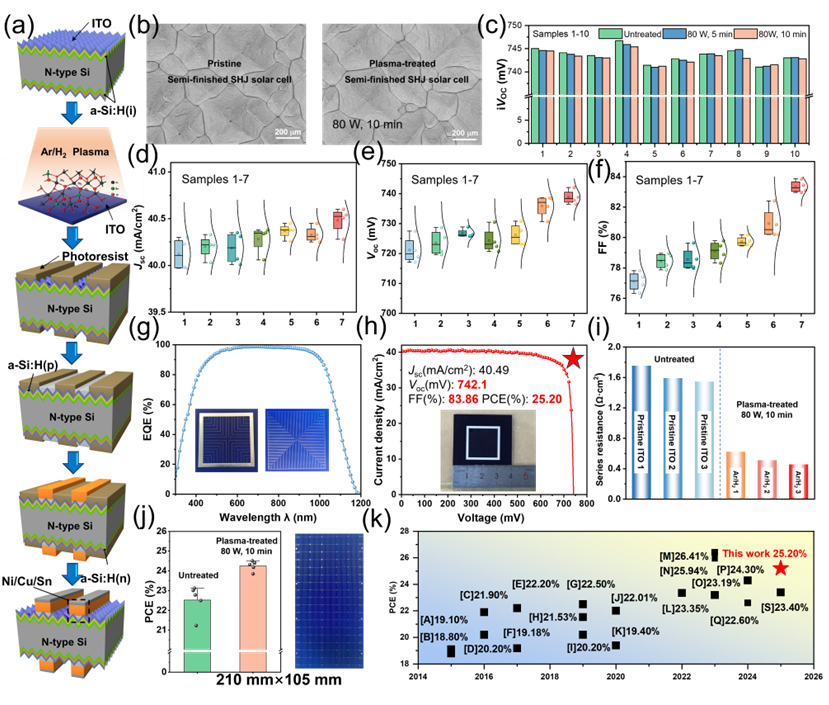
The research team developed a plasma interface engineering method to improve indium tin oxide layers and solve adhesion, contact resistance and stability problems in copper plating. The optimized process enabled uniform metallization of copper and increased the device efficiency to 25.2%, significantly outperforming untreated reference cells.
Researchers from Nankai University in China have fabricated a copper (Cu)-metalized heterojunction (HJT) solar cell using a novel interface engineering strategy aimed at addressing poor interfacial adhesion and high contact resistance in the transparent conductive oxide (TCO)-based indium tin oxide (ITO).
The ITO layer is crucial for the performance of HJT solar cells because it forms an ohmic contact between the thin amorphous silicon layers (a-Si:H) and the metal electrodes, allowing efficient carrier extraction. It also protects the delicate passivation layers from damage during deposition of the metal lattice, ensuring the integrity of these sensitive interfaces. In addition, ITO contributes to optical improvement by acting as an anti-reflective layer; by carefully tuning the thickness and refractive index, it reduces reflection loss and improves light coupling in the silicon absorber.
“We have developed an argon-hydrogen (Ar/H2) plasma-induced interface engineering strategy for ITO, which effectively addresses the critical challenges in the electroplating metallization of HJT solar cells, including poor adhesion, high contact resistance and limited stability, thereby enabling ultra-high-performance copper electroplating on ITO,” said the corresponding author. Guofu Hou told pv magazine. “The synergy of physical sputtering and hydrogen-reactive species introduces interstitial hydrogen into the ITO lattice and increases the oxygen vacancy concentration, while simultaneously hydroxylating the ITO surface to achieve superhydrophilicity.”
“We combined calculations from systematic density functional theory (DFT), finite element method (FEM) simulations and Python/OpenCV-based quantitative analysis of nucleation to elucidate the underlying mechanism,” says co-author Taiqiang Wang. “DFT results revealed that ITO hydroxylation significantly enhances the adsorption of nickel ions (Ni²⁺), with the adsorption energy decreasing from −0.753 eV to −2.18 eV. FEM simulations also indicated that plasma-induced improvements in the electrical properties of ITO lead to a more uniform surface current distribution during the plating process, effectively suppressing local overplating. Consistent with these findings, image-based statistical analysis confirmed a higher germination density and the formation of a denser, finer-grained and more uniform nickel (Ni) seed layer.”
The scientists deposited the ITO films on pre-cleaned glass substrates using physical vapor deposition (PVD). Before plasma treatment, the samples were successively ultrasonically cleaned in acetone, ethanol, and deionized water for 20 min, followed by drying under nitrogen and air. Plasma treatment was performed in a plasma-enhanced chemical vapor deposition (PECVD) system equipped with a 4-inch radio frequency (RF) electrode, using RF power between 0 W and 200 W or 0-2.5 W/cm².
The chemical composition, surface chemistry, and electronic structure of ITO films were analyzed using X-ray photoelectron spectroscopy (XPS), electron spin resonance (ESR), Kelvin probe force microscopy (KPFM), ultraviolet photoelectron spectroscopy (UPS), and UV-Vis spectroscopy. For cell fabrication, n-type crystalline silicon wafers were textured in potassium hydroxide (KOH) solution, followed by deposition of a-Si:H layers via PECVD and sputtered ITO.
The group explained that optimized Ar/H₂ plasma treatment simultaneously tailors the chemical composition, electronic structure and surface energy of ITO, improving electrical conductivity, reducing work function and improving interfacial properties, while excessive treatment leads to material degradation and performance degradation. In addition, it effectively removes surface carbon contamination and sharpens the peaks at the core level, thereby improving the surface cleanliness and wettability of the electrolyte and enabling uniform electroplating.
Based on the optimized plasma interface technique, the process was integrated into the fabrication of an HJT solar cell with bifacial copper-electroplated metallization. HJT precursors were photolithographically patterned and metallized via sequential nickel/copper/tin (Ni/Cu/Sn) electroplating. The nickel layer serves as both a seed layer and a diffusion barrier to suppress copper-induced defects, followed by a thick copper layer for charge transport and a tin capping layer for oxidation protection and improved solderability.
Tested under standard lighting conditions, the HJT cell achieved an energy conversion efficiency of 25.2%, an open-circuit voltage of 742.1 mV, a short-circuit current density of 40.49 mA/cm2 and a fill factor of 83.86%. A reference device built without plasma treatment achieved an efficiency of only 21.10%, an open-circuit voltage of 724.1 mV and a fill factor of 71.5%, with no short-circuit density value released.
“Our results indicate the feasibility of applying Ar/H2 plasma-induced interface engineering to electroplated copper metallization for high-performance SHJ SCs, providing a promising route to reduce dependence on low-temperature silver pastes and mitigate the cost and supply risks associated with global silver scarcity,” Hou said, noting that the observed performance improvements are scalable for large-area devices, with the first samples achieving efficiency of more than 24%.
The new solar cell concept was introduced in “Plasma-induced interface engineering enables high-efficiency Ag-free silicon heterojunction solar cells with galvanized metallization”, which was recently published in the Journal of Energy Chemistry.
This content is copyrighted and may not be reused. If you would like to collaborate with us and reuse some of our content, please contact: editors@pv-magazine.com.
