An international research team has improved the performance of triple-junction solar cells by improving the growth of perovskite crystals, increasing light absorption in the center cells and adding reflective nanoparticles.
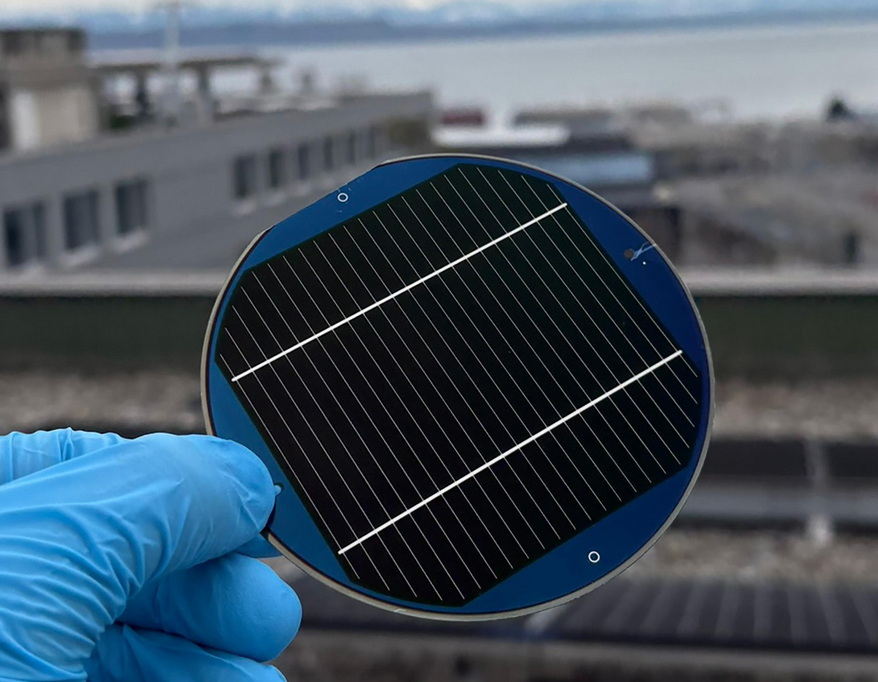
Researchers from the The Swiss Center for Electronics and Microtechnology (CSEM) and the École polytechnique fédérale de Lausanne (EPFL) claim to have achieved energy conversion efficiency of more than 30% for three-junction solar cells that combine two thin-film perovskite cells and one silicon cell on one device.
The scientists said the new result represents a world record for this cell technology, beating the previous record of 27.06% set by a research team led by University of Sydneyy Adjunct Professor Anita Ho-Baillie. However, they did not specify whether the result was confirmed by an independent third party.
The researchers report that they have addressed two major challenges in triple-junction solar cells: low voltage in the top perovskite layer and limited current in the middle layer. They addressed these issues through three major adjustments to the device’s materials and optical design.
First, they introduced a molecule that guides the growth of perovskite crystals and passivates defects, allowing the top cell to reach voltages of 1.4 V under sunlight. They then developed a new three-step manufacturing process for the center cell, which improved the absorption of near-infrared light. Finally, they integrated silicon oxide nanoparticles (SiOx) between the bottom silicon cell and the middle perovskite layer to reflect additional sunlight back to the middle cell, further amplifying the current.
Image: EPFL
“We show that with smart design and processing we can approach the performance levels traditionally reserved for the most expensive III-V multi-junction solar cells used in space, which are composed of multiple semiconductor layers,” said Kerem Artuk, the lead author of the study. “These can achieve efficiencies of up to 37% and cost approximately 1,000 times more than terrestrial cells per watt. Our approach opens the door to a new generation of industrially viable, high-efficiency multi-node photovoltaics.”
“Our first demonstration in 2018 had an efficiency of only 13%, so achieving more than 30% efficiency in a triple-junction device today is a remarkable achievement,” adds Christophe Ballif, head of the PV Lab. “Triple-junction solar cells have an even higher efficiency potential compared to single-junction and tandem – well above 40%.”
The new mobile device was introduced in the study “Triple-junction solar cells with improved carrier and photon management”, published nature.
The research team included academics from Germany’s Fraunhofer Institute for Solar Energy Systems ISE and Australia’s University of Queensland.
This content is copyrighted and may not be reused. If you would like to collaborate with us and reuse some of our content, please contact: editors@pv-magazine.com.
Popular content