

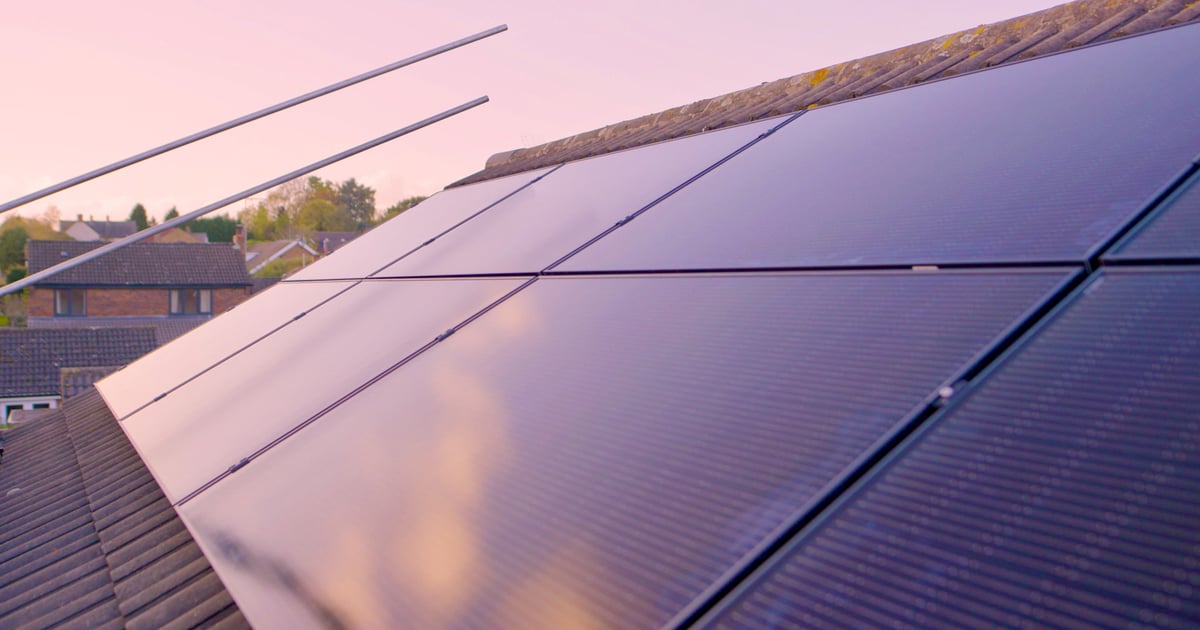
The UK Government has today introduced new rules to implement the Future Homes Standard (FHS), which requires all new homes in Britain to be built with on-site renewable generation.
The government expects that this will mainly be solar PV on roofs. The mandate to update England’s building regulations also includes improved insulation and heat pump installations.
If confirmed last summerThe FHS will state that if developers cannot meet requirements to install rooftop solar PV coverage equal to 40% of a building’s floor area, a “reasonable amount” of coverage is still required.
It was expected that the standard would come into effect in 2027, but the new Housing Regulations now apply to homes built from March 2028.
The government said today it will also confirm the technical details of the Home Energy Model (HEM), a new, quality-assured methodology that will be implemented to demonstrate compliance with the FHS.
It said the HEM will support innovation in new construction products, best practices for heat pump installation and recognize smart, zero-bills technologies. This leaves some room for clean energy installations that are not solar PV.
The government’s solar effort in response to the Middle East conflict
There are of course some exceptions to the FHS, including high-rise buildings. The Government has today announced progress in this area, in addition to the introduction of the FHS, to close this gap commitment to ‘plug-in’ solar PVwhich is said to be available in stores “within months.”
The company said it is working with retailers such as Lidl and manufacturers including EcoFlow to bring the technology, which is already common in European countries including Germany, to the UK market.
This requires a change to the BS 7671 wiring rules and the G98 code, which governs the smallest connections to the mains electricity supply. In this way, systems up to 800W will be available for use.
The Department for Energy Security and Net Zero (DESNZ) said “bespoke safety standards” will be introduced “within months”. This allows people without access to standard roof installations to connect solar panels to the electricity grid using a standard electrical plug.
Chris Hewett, CEO of Solar Energy UK, said the group does not see plug-in solar competing with conventional roof systems, but that it makes solar “more popular and accessible, especially for flats”.
The plug-in solar news builds on an announcement from Energy Secretary Ed Miliband last week in response to rising energy prices due to conflict in the Middle East.
Making today’s announcement, Miliband said: “The war in Iran has shown once again that our drive for clean energy is essential to our energy security, so that we can escape the grip of fossil fuel markets over which we have no control.
“Whether it’s installing solar panels as standard on new homes or making it possible for people to buy plug-in solar in stores, we’re committed to rolling out clean energy so we can give our country energy sovereignty.”
Despite the government’s claim that energy bills will actually fall by £117 in April – which is the next period of price caps, with the cap set based on observations of the energy market before the US-Israeli invasion of Iran – forecasts are that they will rise to £1,972.53 (from £1,641 April-June) in the next period.
According to the government, the FHS measures could save households up to £830 per year on their energy bills, compared to a standard home with an EPC rating of C. These savings will only be visible after the FHS comes into effect.
Discounted energy in the curtailment reduction trial
Another measure announced today is a ‘Discounted Energy’ scheme which in theory will reduce energy discounts and further reduce household energy bills. The government said it will seek to enable suppliers and flexibility service providers to offer households and businesses in areas with limited renewable generation energy discounts during these periods.
It will mainly apply to areas in Scotland and the east of England. This is very similar to one initiative launched by Octopus Energyled by Greg Jackson, who currently sits in the British Cabinet Office in an advisory role.
Commenting on today’s news, Jackson said: “It’s great that the government wants to give homes and businesses cheap electricity on windy days instead of paying wind farms to switch off. Once this is permanent, businesses and households will be able to invest in electric vehicles, batteries and heat pumps with confidence – knowing they will be cheap to run.”
Future Homes Standard ‘finally’ launched
Dhara Vyas, CEO of trade body Energy UK, called the FHS publication “a milestone for clean energy in Britain”.
Jess Ralston, head of energy at the Energy and Climate Intelligence Unit (ECIU), responded to the news: “Finally good news for new build owners!”
The FHS was a core manifesto promise of the current government, elected in 2024, after the previous Conservative government had already put forward as an idea for it.
However, almost a year after the government’s commitment to the roof revolutionthe policy that seemed certain from the start was still a distant promise. It was likely that the updated building regulations would take longer to complete than expected, due to another manifesto pledge to build 1.5 million new homes in England by 2030.
Housing Minister Steve Reed said: “Building 1.5 million new homes also means building high quality homes that are cheaper to run and warmer to live in.”
According to Ralston, “homebuilders have resisted standards for years to prevent homes from wasting so much energy, and in a time of another gas price crisis, this takes on a whole new perspective.
“The delay in setting standards is an energy security problem and therefore a national security problem.”
Storage not required by FHS
Some, like Mohamed Gafaar, CEO and co-founder of Gryd Energy, a provider of fully financed smart solar and storage systems for new construction homes, have noted that battery storage is missing from the regulation.
Calling it a ‘missed opportunity’, Gafaar added: ‘Costs have fallen dramatically in recent years – the technology is now affordable, proven and essential to unlocking the full value of rooftop solar.’
The The government never said that domestic battery energy storage would be included in the FSH.
Earlier this year, some headlines suggested that the government was backtracking on the FHS by not including any provision for energy storage systems (ESS). However, as SEUK’s Hewett noted at the time, the standard has been evolving since 2019, when the battery market looked very different in terms of availability, cost and capacity.
However, it has also launched a call for evidence on the next steps for the £5 billion Warm Homes Fund, as part of the rollout of the £15 billion Warm Homes Plan. published earlier this year. Funding is available for modernization and upgrades; the options for which government will work with industry and which could include ESS.
The increase in demand for installers and suppliers that the FHS will create is a boon for the industry, although green skills shortages in Britain will dampen that excitement.
That said, the government has recently launched numerous initiatives to boost green jobs creating a new Learning Unit ‘Installation and maintenance of solar PV’.
