Researchers in China have shown that integrating energy tower heat pumps with evaporator-side boilers, air source heat pumps or solar systems can significantly improve winter heating efficiency and economic performance in commercial buildings. Of the four configurations tested, the evaporator-side boiler and solar-assisted systems delivered the highest performance and energy savings, providing a sustainable, low-carbon alternative to conventional heating.
Researchers from China’s Hunan Institute of Engineering, Chinese Environmental Engineering Company Hunan Diya Environmental Engineering and Electromechanical Technology Hunan Zunfeng Electromechanical Technology
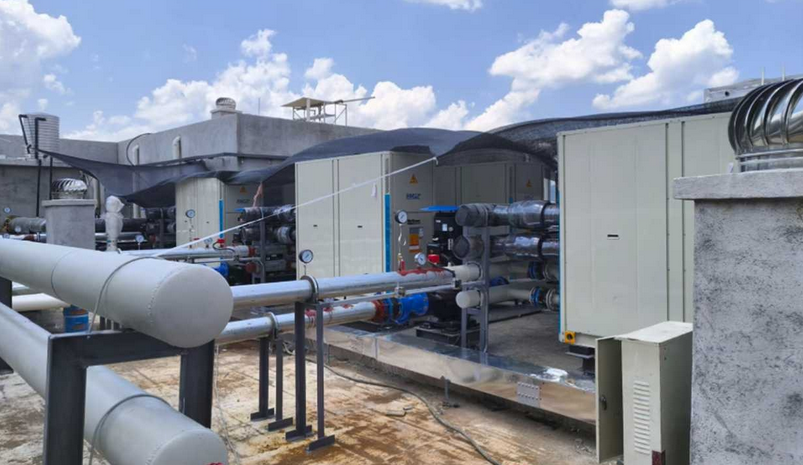
The new system was deployed at a hotel in Huaihua city, Hunan province, providing a real-world demonstration of its operation in winter. “The proposed system designs are only for building retrofits,” the study’s lead author Xianglong Liu told pv magazine.
The study evaluated four heating configurations to assess efficiency and performance under winter conditions. The first combined an energy tower heat pump with a boiler on the condenser side, providing additional heat directly to the condenser output. The second placed the boiler on the evaporator side and provided additional heating at the evaporator inlet. The third combined an air heat pump with conventional boilers, integrating two complementary heat sources. The fourth supplemented the energy tower heat pump with photovoltaic thermal energy (PVT), using solar water heating to reduce dependence on fossil fuels.
To optimize performance in winter, four operational modes have been developed. In condenser side boiler mode, the boiler increases the condenser outlet temperature to 45°C to meet the heating demand. The evaporator side boiler mode adds heat directly to the evaporator inlet, keeping the refrigerant at the correct temperature. The air-to-water heat pump configuration uses a reduced capacity boiler for flexible supplementary heating. Finally, solar heat pump mode includes solar water heating, reducing dependence on natural gas or electricity and improving overall efficiency.
Image:
Hunan Institute of Engineering, Energy Reports, CC BY 4.0
In all system configurations, chillers operate year-round, with switches managing cooling and heating modes. During winter, the energy tower heat pump provides primary heating, supplemented as necessary with boilers, air heat pumps or solar boilers to maintain evaporator outlet temperatures between 1–6 C and condenser outlets at 35–45 C.
Through thermodynamic analysis, the scientists found that the energy tower heat pump with an evaporator-side boiler and the solar-assisted system achieved the highest average coefficients of performance (COPs) of 1,904 and 1,891, respectively, compared to 1,595 for the condenser-side boiler system. The exergy efficiency followed a similar trend, with the solar and evaporator side boiler systems reaching 11%, while the condenser side boiler system achieved only 4.4%.
Techno-economic analyzes have shown significant energy savings. The energy tower heat pump with an evaporator boiler saved CNY 185,100 ($26,902) in natural gas compared to a conventional tower heat pump, while the air heat pump with boilers saved CNY 184,800, and the solar-assisted energy tower heat pump saved CNY 187,300. Electricity consumption increased slightly due to the operation of the pump, but the natural gas savings more than outweighed these costs.
Furthermore, the PVT-assisted system was found to offer significant long-term savings, but requires careful planning due to high installation costs, potential space limitations and variable solar energy output.
“Our research shows that energy tower heat pumps in combination with solar or supplementary boilers provide a sustainable, economically viable solution for winter heating in commercial buildings,” said Liu. “By leveraging system-level coordination, energy managers can significantly reduce fossil fuel use while maintaining indoor comfort – an important step toward net-zero construction activity.”
The tower heat pump system was described in “A new system of energy tower heat pump combined with boilers and solar energy”, published in Energy reports.
This content is copyrighted and may not be reused. If you would like to collaborate with us and reuse some of our content, please contact: editors@pv-magazine.com.
Popular content