

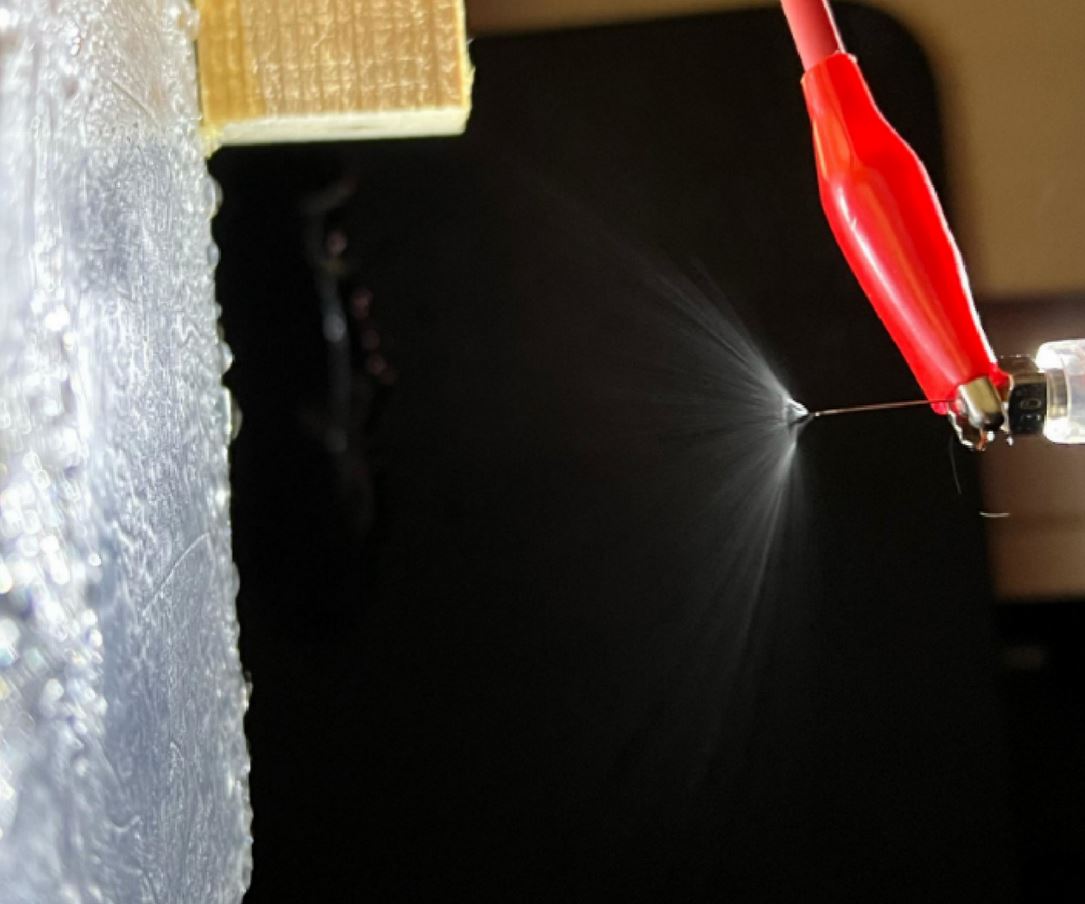
Researchers in Turkey optimized electrospray cooling for PV panels, achieving optimal power output with minimal water consumption and a compact, energy-efficient setup. Their research identified irradiation, flow rate, voltage and nozzle spacing as ideal parameters.
A research team from Turkey’s Artvin Çoruh University has investigated the optimal parameters for cooling PV panels with electrospray.
This cooling technology, demonstrated by the same team in an earlier study, uses high voltage to convert liquid into fine, charged droplets that efficiently remove heat from a surface. That is, because the electric field breaks the liquid into ultrafine droplets, it spreads more evenly while requiring less water.
“Our approach provides high cooling efficiency with minimal water consumption; up to 100 times less coolant is used compared to traditional spray cooling, while maintaining effective thermal control,” said corresponding author Fatin Sönmez. pv magazine. “Our system features low energy consumption and simple installation that does not require mechanical pumps or complex circulation systems, making it an energy-efficient and compact alternative.”
However, Sönmez emphasized that the requirement for a high-voltage source increases the initial installation complexity and introduces safety considerations, potentially impacting implementation costs. “Our extensive optimization study determines the influential parameters and their optimal values for cooling PV panels using electrospray. Such a study had not been found in the literature before,” he added.
The research was based on the response surface method (RSM), a statistical approach that conducts a limited number of experiments to create a continuous mathematical model for all variables. The variables were measured under controlled laboratory conditions, using a 500 W halogen lamp projector as the light source, placed 350 mm from the PV panel. The 530 W PV panel was placed at a 90° angle to the horizontal.
Each variable was measured at three levels: radiation severity was 800 W/m2, 900 W/m2 or 1,000 W/m2; the coolant flow rate was 20 ml/h, 60 ml/h or 100 ml/h; the electrical voltage generated between the nozzle and the PV panel was 17 kV, 19 kV or 21 kV; and the distance between nozzle and PV panel was 3 cm, 5 cm or 7 cm.
Through their analysis, the scientists identified the optimal operating parameters for the PV panel as an irradiance of 1,000 W/m², a flow rate of 94.34 ml/hour, a voltage of 17 kV and a distance between nozzle and panel of 5.5 cm. Under these conditions, the panel achieved an output power of 657.18 W. Two consecutive validation runs yielded output powers of 665.42 W and 672.89 W, confirming the reliability of the optimized parameters.
“We found that increasing the distance between the nozzle and the PV panel positively affected the maximum power output only up to about 5 cm, after which it started to have a negative effect due to the decreasing voltage between the nozzle and the panel,” says Sönmez. “We also observed a saturation point in the coolant flow rate; increasing the flow rate increased the power to approximately 90 ml/h, but further increases had no additional effect on the amount of heat absorbed.”
According to the researchers, the most surprising result was that the electrical voltage between the nozzle and the PV panel had no influence on the resulting power parameter. “We plan to extend these findings by investigating the cooling performance of electrospray on industrial-scale panels under real outdoor conditions and varying solar irradiance throughout the day,” he concluded.
The research work was presented in “Determination of optimal parameters in photovoltaic panels with electrospray cooling”, published in Ain Shams Engineering Journal.
This content is copyrighted and may not be reused. If you would like to collaborate with us and reuse some of our content, please contact: editors@pv-magazine.com.
