

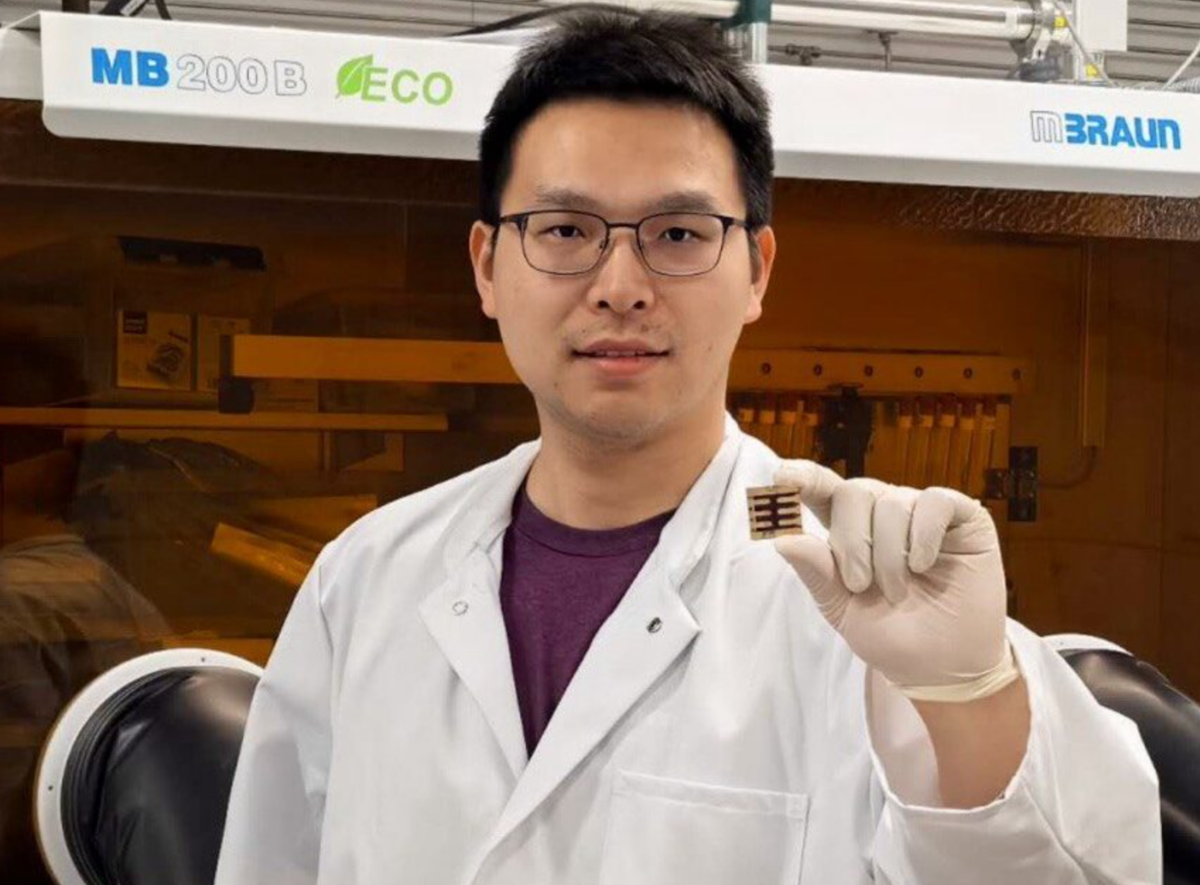
Researchers from the Technical University of Munich (TUM), together with partners from the Karlsruhe Institute of Technology (KIT), Deutsches Elektronen-Synchrotron (DESY) and the KTH Royal Institute of Technology in Sweden, have investigated why perovskites in tandem solar cells lose their performance under temperature changes. Two recently published papers show, on the one hand, how rapid temperature cycles affect crystal structure, and on the other hand, which organic molecules can stabilize perovskite structures.
The first study focuses on perovskites as commonly used in perovskite-silicon tandem solar cells. The researchers used cells with an efficiency of 24.31%. The temperature was varied at a rate of 10°C per minute between 5°C and 85°C.
The authors note that these rapid cycles do not correspond to standard certification conditions. IEC testing uses significantly longer cycles of 100 degrees Celsius per hour. The method used in the experiment was intended to accelerate aging processes for material screening.
Wide-angle X-ray scattering and photoluminescence measurements were used for the analysis. This allowed the researchers to observe in real time how the crystal lattice expands and contracts under temperature changes and how photovoltaic parameters change in parallel.
The main observation of the first article is a two-stage degradation. First, a pronounced “burn-in phase” takes place. In this initial phase, the cells lost approximately 60% of their relative performance under rapid solar thermal cycling. This was followed by a slower degradation phase, in which the parameters partially followed the temperature profile.
The authors identify the cause as a combination of temperature-induced mechanical stress, phase transformations and increasing non-radiative recombination. Simply put, the perovskite layer expands differently under temperature changes than the adjacent layers and the substrate, creating tension in the material. These stresses change the structure and deteriorate the electrical properties.
Lead author Kun Sun from the TUM Chair in Functional Materials said the performance loss is caused by competing forces within the material at the microscopic level, where internal stresses build up and change the structure, ultimately reducing performance.
Strikingly, the degradation under these cycling conditions was largely independent of the passivation strategy tested, the study said. Uncoated cells, cells with EDAI2 passivation, and cells with double passivation of 3-F-PEAI and EDAI2 were examined. Although passivation initially improved cell efficiency, thermal degradation could not be prevented. The authors therefore conclude that common passivation approaches do not automatically lead to better thermal operational stability.
Another result relevant to tandem applications: perovskite-silicon tandem cells showed improved temperature robustness at lower temperatures; after more than 200 minutes under thermal cycling, 94% of the original efficiency was retained. This suggests that integration in a tandem configuration can change behavior.
The second study examined possible solutions. In the experiment, the perovskite layer was supplemented with organic molecules intended to better buffer thermally induced expansion. Two spacer cations were compared: butylammonium (BA) and 1,4-phenylenedimethylammonium (PDMA).
The conditions were similar: 5 C to 85 C with a temperature change rate of 10 C per minute and a cycle time of 15 minutes. BA-based layers showed obvious phase separation and structural degradation after only three cycles. In contrast, PDMA-based layers were significantly more stable and remained largely structurally intact.
Prof. Peter Müller-Buschbaum from the TUM School of Natural Sciences argued that the future of solar photovoltaics is increasingly focused on tandem architectures. He said that by understanding the underlying microscopic mechanisms, researchers will enable a new generation of solar panels that combine high efficiency with durability sufficient for decades of outdoor use.
The research results have been published in two scientific journals. The first article, “Understanding the operational stability of wide bandgap perovskite and tandem solar cells under fast thermal cycling”, recently appeared in Nature communication. The second investigation “Halide Segregation in Wide Bandgap Quasi-2D Perovskites under Fast Thermal Cycling”, was published in ACS Energy Letters.
