The Dutch research institute has presented what it describes as the world’s first perovskite-based roof tile, which achieves efficiency of up to 13.8% when used as self-contained modules and 12.4% when installed on a curved surface. The flexible modules were produced using TNO’s experimental roll-to-roll platform,
The Netherlands Organization for Applied Scientific Research (TNO) today unveiled a building-integrated photovoltaic (BIPV) tile based on perovskite solar cell technology.
The new product is billed as the world’s first perovskite solar tiles.
“This demonstrator is supported by the Province of North Brabant through the project ‘Solar Industry to Brabant, Solliance 2.0’. Additional funding has been received for the Luminosity project from the European Union’s Horizon Europe program,” TNO said in a statement. “The work was partly financed by the National Growth Fund program SolarNL.”
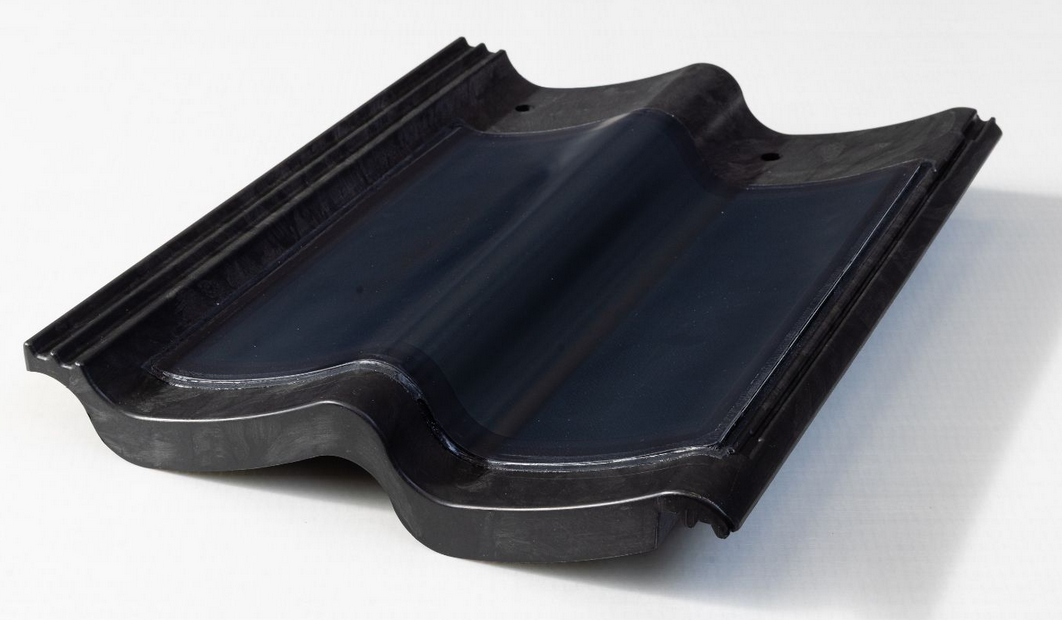
The Dutch research institute worked with Netherlands-based BIPV specialist Asat BV to deploy 10cm x 10cm perovskite solar panels, built on flexible foil, on a curved composite roof tile. Testing shows that bending the modules to fit the curved surface has minimal impact on their performance.
Stand-alone modules achieved an energy conversion efficiency of up to 13.8%, while the modules maintained an efficiency of 12.4% after installation on the curved roof tile.
Image: TNO
The perovksite modules were encapsulated with an experimental roll-to-roll production platform developed by TNO itself. Roll-to-roll production – similar to the process used in newspaper printing – enables continuous production of solar cells on long rolls of flexible material. The technique is widely seen as a potential route to lower production costs and large-scale production of emerging thin-film technologies such as perovskites.
More technical details about the solar tile have not been disclosed. TNO said it will be marketed through its spin-off Perovion Technologies, which was launched last month.
TNO’s recent research into perovskite solar cells includes the development of roll-to-roll and spatial atomic layer deposition (SALD) processes for the deposition of functional materials, solar cell layers and flexible films.
In July, Solarge, a Netherlands-based manufacturer of lightweight silicon PV modules, and TNO unveiled a lightweight prototype perovskite solar panel measuring 32 cm x 34 cm.
A month earlier, Japan’s Sekisui Solar Film, part of Sekisui Chemical, the Brabant Development Company (BOM), which serves the Dutch province of North Brabant, and TNO signed a letter of intent in Osaka, Japan to explore cooperation in the field of flexible technologies for perovskite solar PV modules.
If pv magazine has reported that Sekisui Solar Film is developing technology for the production of lightweight, flexible perovskite solar panels using an advanced roll-to-roll process. The company is working on a 100 MW plant in Japan for large-scale production, conducting field demonstrations and has signed a perovskite-solar-related memorandum of understanding with Slovakia.
This content is copyrighted and may not be reused. If you would like to collaborate with us and reuse some of our content, please contact: editors@pv-magazine.com.
Popular content