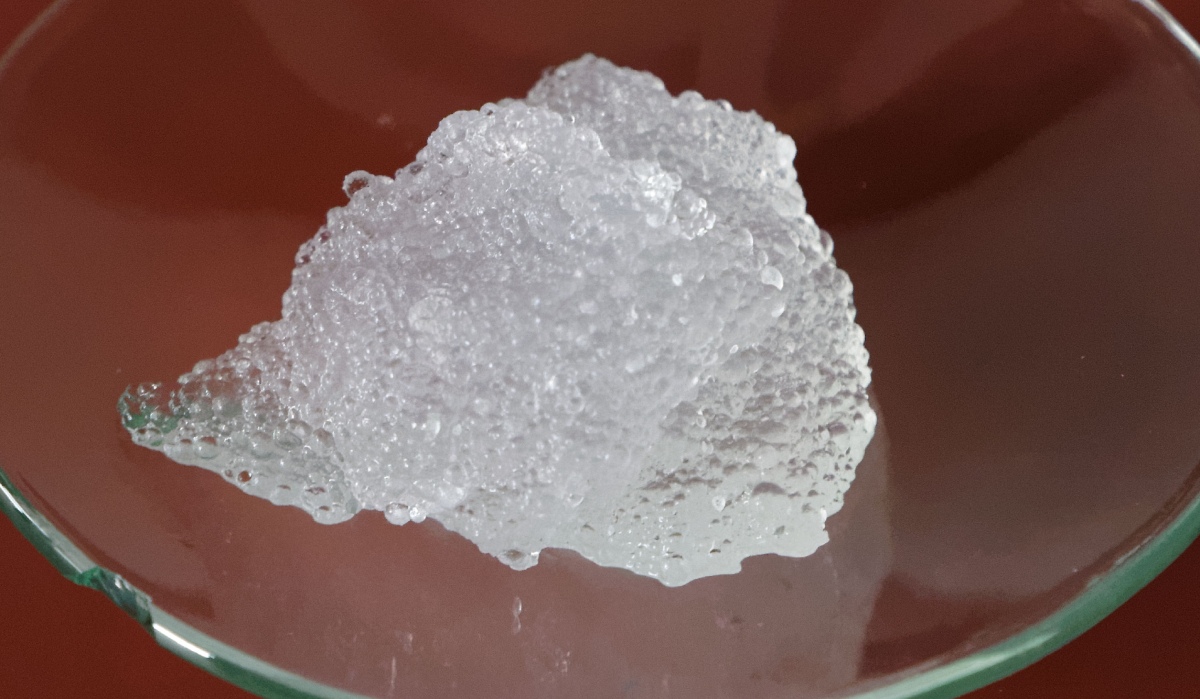
Image: Petra Klawikowski, Wikimedia Commons, CC-BY-SA 3.0
By ESS news
Battery research in industry and academia continues to advance ideas in electrodes and electrolytes, covering materials, design, safety, efficacy and green credentials. In most cases, the use of potentially flammable organic electrolytes for lithium-ion batteries used in stationary storage is an ongoing safety risk that the industry is continually countering through often complex mitigation efforts, and expensive and destructive research.
A new review article providing a systematic review of hydrogel research from 2008 to 2025, including 186 published studies over a 17-year period, argues that conductive hydrogels are a credible candidate for electrolytes. The article notes that this is especially true for flexible and portable applications, but stationary storage and lithium and sodium are potential winners. The paper was published this week in the Journal of Electroanalytical Chemistry by researchers from the University of Limpopo in South Africa.
The safety argument is perhaps the most obvious: hydrogel electrolytes are water-based, eliminating the thermal runaway contribution of conventional organic electrolytes, and their structure means they also don’t leak and can repair themselves.
Although the commercial aspects are not yet clear at this stage, the performance picture is promising, although this varies considerably between chemicals. For lithium-ion, a silicon nanoparticle-polyaniline composite electrode using an in situ polymerized hydrogel achieved 1,600 mAh/g over 1,000 deep cycles, with an average coulombic efficiency of 99.8% from the second cycle. The efficiency in the first cycle was about 70%, a known problem for silicon anodes.
To read further, visit our ESS news website.
This content is copyrighted and may not be reused. If you would like to collaborate with us and reuse some of our content, please contact: editors@pv-magazine.com.
Popular content