

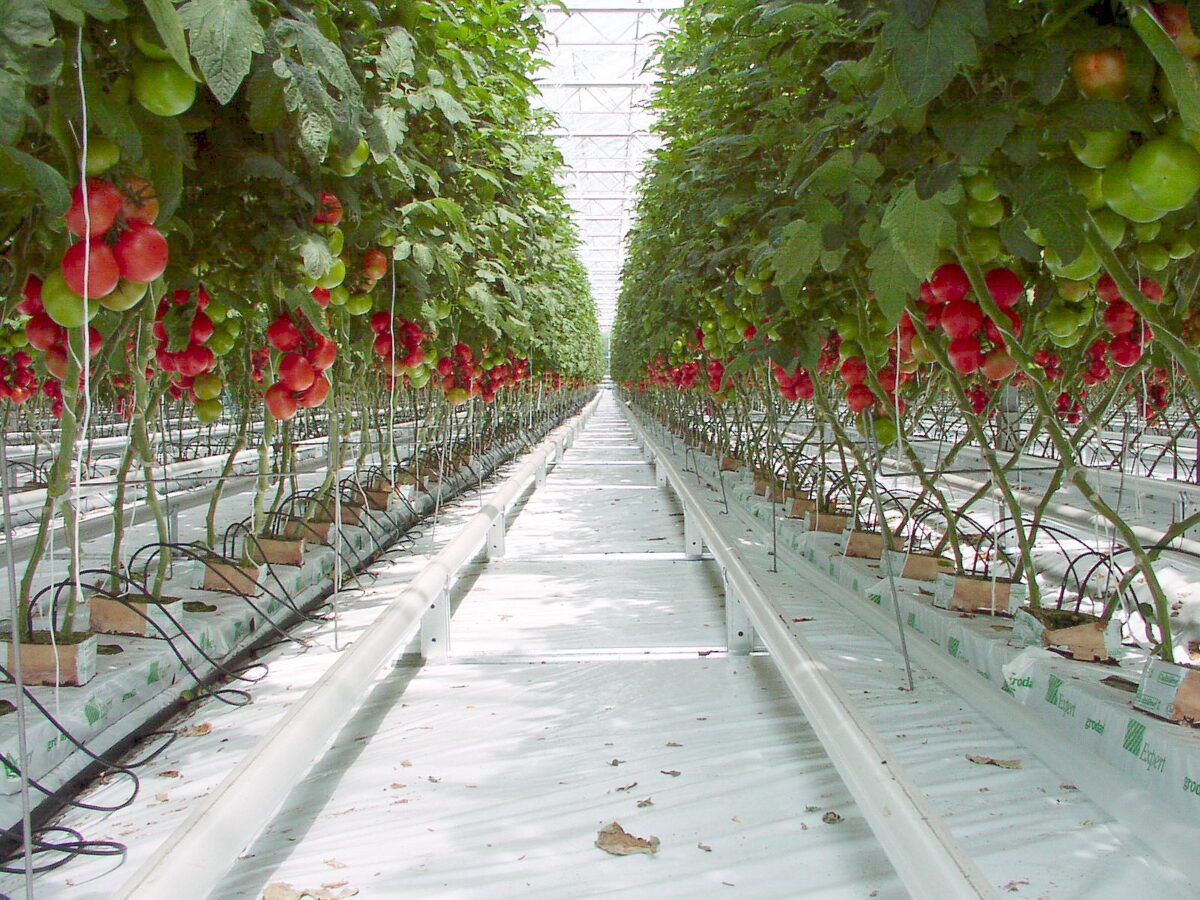
Spanish researchers found that semi-transparent silicon PV greenhouses increased tomato fruit weight by 25% while generating 726.8 kWh over two seasons, outperforming cadmium telluride PV and shaded controls. The PV-Si system balanced sunlight, temperature and energy and showed strong agrivoltaic potential.
Researchers led by Spain’s Murcian Institute for Agricultural and Environmental Research and Development (IMIDA) have evaluated the impact of different agrivoltaic system designs on tomato crops to determine what level of shade will most benefit the plants.
“The use of four independent, identical greenhouses allows a robust assessment of their respective impacts on microclimate, crop performance and energy generation,” the team said. “The study specifically aimed to evaluate the agronomic and energy performance of two commercially available semi-transparent PV technologies, with different light transmission patterns, compared to control and shade net treatments.”
The researchers tested a semi-transparent monocrystalline silicon (PV-Si) greenhouse and a cadmium telluride thin film (PV-TF) greenhouse against a control greenhouse and one with a shade net.
The research took place in Murcia, Spain, during two tomato growing seasons: a 120-day winter-spring season from December 2023 to April 2024, and a 98-day spring-summer season from April to July 2024. Murcia’s semi-arid Mediterranean climate has average summer and winter temperatures of 30 C and 12 C, respectively. In both seasons, the team used polyethylene greenhouses 3.9 m long x 2 m wide x 3.1 m high.
The materials being assessed were installed on the roof and south facade of each greenhouse. The control greenhouse used only the standard polyethylene film, while the shading control greenhouse added a shade net to selected areas. One solar greenhouse contained monofacial silicon PV modules with 50% transparency, and the other used cadmium telluride (CdTe) modules, also with 50% transparency. Each solar greenhouse had 18 modules – half on the roof, half on the facade – with a nominal power of 59 W for PV-Si and 40 W for PV-TF.
The microclimatic conditions in each test greenhouse were monitored at two-minute intervals. Measurements included air temperature, relative humidity, solar radiation and photosynthetically active radiation,” the team explained. “In addition, soil temperature and humidity were measured at five-minute intervals at depths ranging from 10 to 60 cm in 10 cm increments.”
The tests showed that the PV-Si technology generated an average daily energy yield of 3.92 kWh in winter-spring and 4.07 kWh in spring-summer. PV-TF, meanwhile, produced 2.58 kWh and 2.79 kWh respectively. The total energy generation over both seasons was 726.8 kWh for PV-Si and 488.4 kWh for PV-TF.
The daily light integral (DLI), which represents the total photosynthetically active light received by plants each day, averaged 18.1 mol m⁻² in winter-spring and 25.4 mol m⁻² in spring-summer in the Si greenhouse. In the TF greenhouse the DLI was on average 10.8 mol m⁻² and 17 mol m⁻² respectively.
“During the winter-spring cycle, only the control and PV-Si greenhouses maintained DLI values above the minimum threshold required for optimal crop development,” the researchers reported. “Despite a similar number of fruits, the PV-Si greenhouse produced fruits with an average weight 25% higher than the control group, which was attributed to more favorable night-time air temperatures and higher soil moisture.”
In winter-spring, the Si greenhouse produced 21 fruits with an average weight of 74 grams, while the TF greenhouse produced 18 fruits with an average weight of 50 grams. During spring-summer, the Si greenhouse produced 30 fruits weighing an average of 93 g, compared to 23 fruits weighing 79 g in the TF greenhouse.
“Overall, the PV-Si system effectively balanced solar radiation management, thermal regulation and energy production, demonstrating its potential as a suitable technology for agricultural voltaic applications,” the team concluded.
The research results are presented in “Comparative evaluation of semi-transparent monocrystalline silicon and cadmium telluride solar photovoltaics for tomato cultivation in Mediterranean agrivoltaic greenhouses”, published in Smart agricultural technology. Researchers from Spain’s IMIDA, Miguel Hernández University of Elche and Italy’s University of Bari Aldo Moro contributed to the study.
This content is copyrighted and may not be reused. If you would like to collaborate with us and reuse some of our content, please contact: editors@pv-magazine.com.
