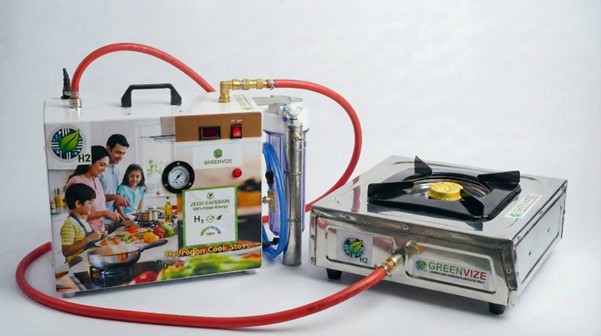
Indian cleantech startup Greenvize has launched a compact hydrogen-based cooking system designed for residential and commercial kitchens. The system integrates a proton exchange membrane (PEM) electrolyser directly into a cooking unit, allowing hydrogen to be generated on-site from water without the need for storage or distribution infrastructure.
Indian clean technology startup Groenvize has launched a compact hydrogen-based cooking appliance designed for residential and commercial kitchens. The system integrates a proton exchange membrane (PEM) electrolyser directly into a cooking unit, allowing hydrogen to be generated on-site from water without the need for storage or distribution infrastructure.
Unlike conventional hydrogen supply chains that rely on pressurized cylinders or pipelines, the Greenvize system produces hydrogen gas on demand via water electrolysis. Hydrogen production begins immediately when the user turns the knob, delivering fuel in real time.
During electrolysis, water molecules are split into hydrogen and oxygen. Hydrogen is used as a cooking fuel and produces only water vapor as exhaust gases, while releasing oxygen into the environment, improving air quality in enclosed kitchen areas.
Sanjeev Choudhary, founder of Greenvize Energy Solutions, claims that the device requires about 100 ml of distilled water or reverse osmosis (RO) water and about 1 kWh of electricity to cook continuously for up to six hours. The system can also be combined with rooftop solar, allowing off-grid cooking, powered entirely by renewable energy.
As major energy companies continue to invest in large-scale, centralized infrastructure for the production, storage and transportation of green hydrogen – primarily aimed at industrial applications – Greenvize claims to have miniaturized hydrogen generation into a plug-and-play system for use in homes and commercial kitchens.
Hydrogen vs. induction in commercial kitchens
At a time when LPG is subject to price volatility and supply constraints, Greenvize is positioning its hydrogen system as an alternative to both LPG and induction cooking, especially in high-demand environments such as hotels and communal kitchens.
“Although both induction cooktops and the Greenvize hydrogen cooking system use electricity, their efficiency, flexibility and usability in the real world are fundamentally different, especially for hotels, communal kitchens and high-demand cooking environments,” said Sanjeev.
According to Sanjeev, a typical induction cooktop uses about 1.5 to 2 kW per burner, which equates to about 9 to 12 kWh for six hours of use. For comparison, the Greenvize system requires about 1 kWh of electricity to generate enough hydrogen for six hours of cooking.
“In the standard configuration, the electrolyser is linked directly to the cooking unit, generating and consuming hydrogen in real time, eliminating the need for storage. However, the system can also be configured with hydrogen storage, allowing production during off-peak or periods of solar generation and then use during peak demand.”
“For such applications, hydrogen can be stored in compressed gas cylinders (typically 200-300 bar) or in low-pressure buffer tanks for short-term balancing,” Sanjeev said. “GreenVize can customize the system based on operational needs and applications. We can also provide hydrogen storage solutions based on customer requirements. This also includes storage cylinders/cascade systems.”
Sanjeev added that induction cooktops require compatible magnetic cookware and may not support certain traditional cooking techniques, limiting their adoption in some commercial and rural settings. Hydrogen-based systems, on the other hand, can work with standard utensils and existing cooking practices, making them more suitable for rural, commercial and traditional cooking.
The single burner hydrogen stove costs approximately INR 1,05,000 ($1,128) + GST and the dual burner hydrogen stove INR 1,50,000 + GST.
This content is copyrighted and may not be reused. If you would like to collaborate with us and reuse some of our content, please contact: editors@pv-magazine.com.
Popular content