

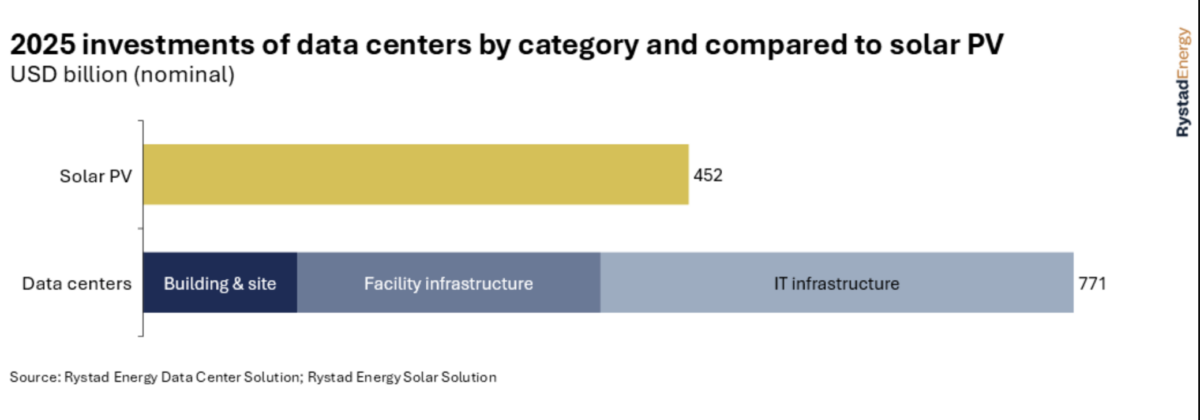
Rystad Energy says capital expenditures for data centers will reach $770 billion by 2025, matching the level of investment in photovoltaic infrastructure and surpassing upstream oil and gas.
According to Rystad Energy, global investment in data center infrastructure reached $770 billion by 2025, surpassing upstream oil and gas spending and reaching levels comparable to the broader energy sector.
The analysis highlights a structural shift in global energy investment flows, with data centers emerging as a major new source of demand. Since 2024, capital expenditures on data centers have exceeded solar investments, positioning the sector as a capital-intensive asset class with direct impacts on energy generation, networks and supply chains.
Rystad said data center investments are split between IT infrastructure and energy-related systems. Servers and computer hardware account for around 40% of total expenditure, while energy infrastructure – including cooling systems, power distribution and thermal management – now represents investment volumes comparable to global PV investments.
The expansion of data centers also drives additional investments in the energy sector, including power generation, network infrastructure and industrial equipment. This multiplier effect is accelerating at a pace that Rystad believes will outpace previous industrial expansion cycles driven by digitalization and artificial intelligence.
Large-scale facilities with a capacity of more than 100 MW are becoming the dominant format. These projects require infrastructure-level investments comparable to large energy assets, but with significantly shorter timelines for grid connection and commissioning, creating challenges in permitting, network planning and equipment availability.
Investments are increasingly concentrated among large technology companies and artificial intelligence developers, following the patterns seen in the upstream oil and gas sector, where large companies dominate capital allocation.
Geographically, the effort remains concentrated. The United States accounted for 42% of installed capacity in 2025, about double that of China, while India came in third. However, Rystad expects broader geographic diversification as demand for energy from data centers exceeds 10% of national electricity consumption in some markets, creating constraints on grid access, land availability and infrastructure capacity.
Countries with strong energy resources and stable regulatory frameworks, including Finland, Portugal and Thailand, are emerging as potential hubs for future data center investments by 2030.
Rystad said the impact is already visible across supply chains, with rising demand for equipment such as gas turbines, transformers and fuel cells supporting growth among original equipment manufacturers.
Artificial intelligence is expected to remain the main driver of demand in the short to medium term, although Rystad said the market could move towards a more balanced alignment of investment, capacity and demand as it matures.
This content is copyrighted and may not be reused. If you would like to collaborate with us and reuse some of our content, please contact: editors@pv-magazine.com.
