

In a new weekly update for pv magazineOPIS, a Dow Jones company, provides a brief overview of the major price trends in the global PV industry.
Free-On-Board (FOB) China TOPCon spot charging modules dropped lower this week. Trading activity has slowed sharply since the New Year holidays, with buyers left on the sidelines amid significant price volatility in China’s module market in the first quarter of 2026.
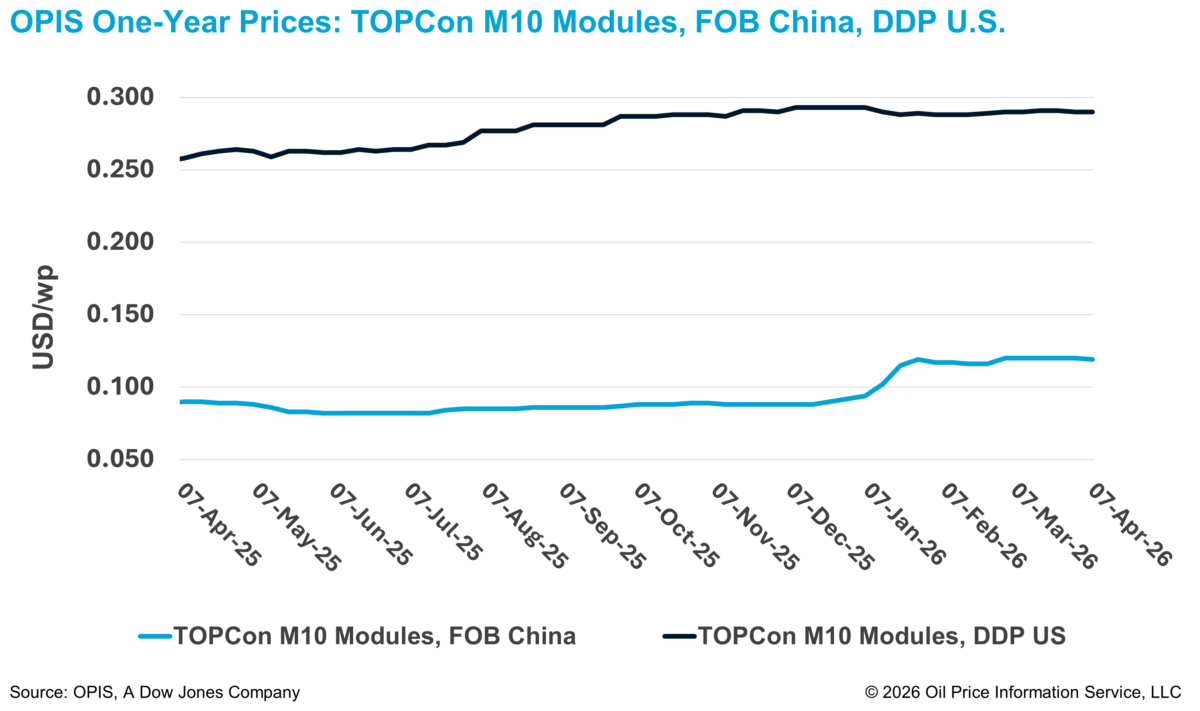
According to the OPIS Global Solar Markets Report released on April 7, the Chinese Module Marker (CMM), the OPIS benchmark rating for TOPCon modules from China, fell 0.83% to $0.119/W FOB China.
Meanwhile, the forward curve indications of the FOB China TOPCon module were weakened for later delivery periods as market participants increasingly anticipated weaker demand following the cancellation of the export tax credit.
Fourth quarter 2026 freight loading prices were assessed at $0.121/W, down 0.82% on the week, while first quarter 2027 freight rates were assessed 2.42% lower to $0.121/W. Second quarter 2026 and third quarter 2026 freights were $0.120/W and $0.121/W, respectively.
Softer indications for spot cargo were driven by modules held in bonded warehouses, which sources said are unaffected by the recent cancellation of the export tax rebate.
China has abolished export tax credits on PV products, including solar panels, cells, modules and glass, from April 1. It had previously cut export tax credits from 13% to 9% in December 2024 on a range of products including photovoltaic materials, refined oil, batteries and mineral products.
Market sources said the removal could force manufacturers to absorb some of the additional export costs, potentially pushing up minimum FOB price levels. A source from a leading manufacturer told OPIS that some market participants had moved modules to bonded warehouses ahead of the April 1 deadline, allowing them to take advantage of the 9% discount and price more competitively.
Another producer source told OPIS that they internally expect to be able to absorb the lost export tax credit given weak foreign FOB demand in the second quarter of 2026, which has strengthened buyers’ bargaining power.
Sources added that the shift could further widen the gap between stronger and weaker players, with manufacturers with stronger technology and tighter cost controls expected to gain even more benefits, while those with aging capacity or weaker module performance may face faster consolidation.
While China’s module market is grappling with the fallout from the elimination of rebates, the U.S. market is facing a different set of pressures as buyers await clearer guidance on multiple trade and policy fronts.
According to the same OPIS report, US DDP prices for TOPCon modules remained at $0.290/W this week. Forward-looking indications for the DDP price of TOPCon modules in the first quarter of 2027 were estimated at $0.278/W. Sources say recent price guidance will be subject to adjustment given ongoing tariff investigations and continued policy uncertainty.
With First Solar’s Section 337 petition in its early stages, market players continue to speculate about the company’s end goal and how the process might proceed. A distributor source said it is too early to switch suppliers for fear of the 337 lawsuit, while a purchasing source said the case could block competitors or push them toward licensing deals.
Some Foreign Enty of Concern (FEOC) guidelines also remain outstanding, and as the deadline for securing 48E projects approaches this summer, some manufacturers are still working to produce modules with a significant level of domestic content.
Yet modules with significant domestic content still fetch a premium over comparable equipment assembled with imported cells. The distributor source said availability timelines remain uneven, with some manufacturers not expecting such modules until 2027.
OPIS, a Dow Jones company, provides energy prices, news, data and analysis on gasoline, diesel, jet fuel, LPG/NGL, coal, metals and chemicals, as well as renewable fuels and environmentally friendly feedstocks. It acquired assets with pricing data from Singapore Solar Exchange in 2022 and now publishes the OPIS APAC Solar Weekly Report.
The views and opinions expressed in this article are those of the author and do not necessarily reflect those of the author pv magazine.
This content is copyrighted and may not be reused. If you would like to collaborate with us and reuse some of our content, please contact: editors@pv-magazine.com.
