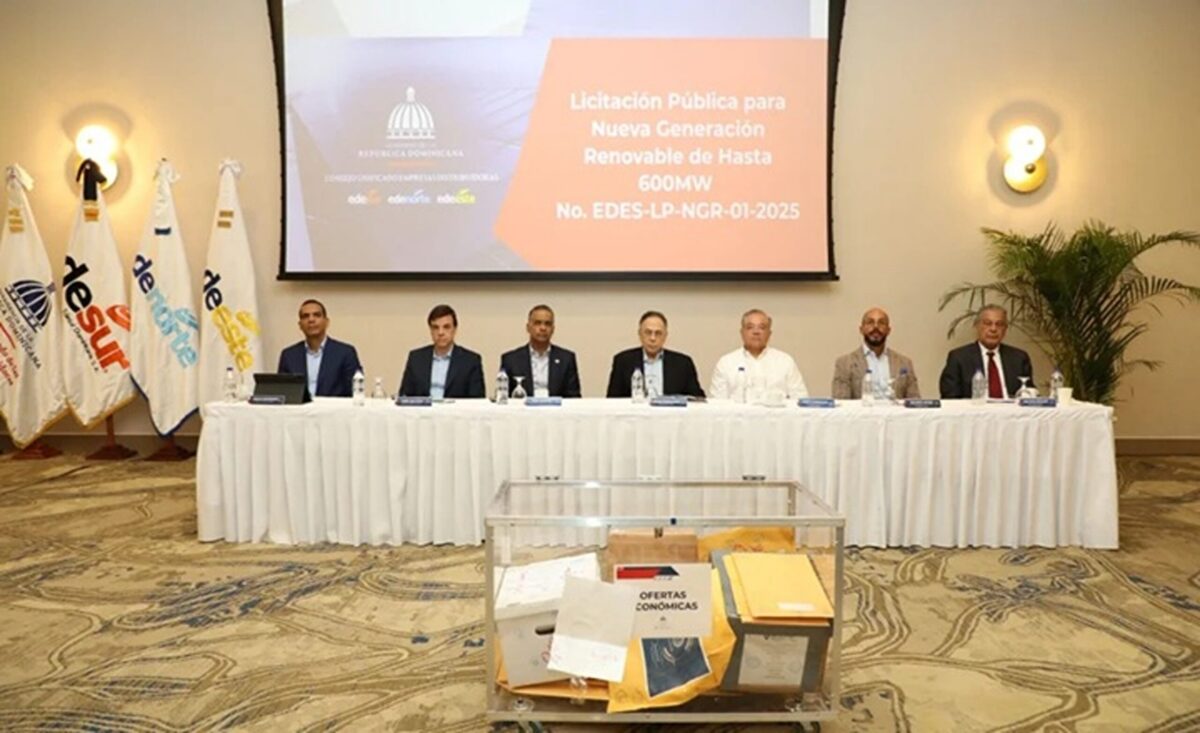
The Dominican Republic and its Unified Council of Distribution Companies (CUED) have released the financial bids for a major public tender aimed at integrating up to 600 MW of new renewable generation into its national electricity grid. The purchasing process is distinguished by requiring strong capacity and network stability through mandatory energy storage.
Officials reviewed 20 proposals from qualified developers seeking to build utility-scale photovoltaic wind and solar farms ranging from 20 MW to 300 MW. The process aims to integrate new renewable capacity to meet the energy needs of the North, South and East regional distribution networks. The tender mandated that all participating projects must include four-hour battery energy storage systems (BESS).
According to the tender specifications, any long-term power purchase agreement (PPA) awarded must become operational within 24 months of signing. The contracted energy is distributed across the regional grids as follows: North 30%, South 35%, East 35%.
During the unveiling of the bid, Dominican energy officials emphasized the broader strategy of diversifying the national energy mix. The country has already achieved a 25% share of renewable energy within its national interconnected electricity grid, with a target milestone of 30% by 2030. They also stressed the importance of keeping the bidding process highly competitive to reduce costs.
The tender, initially launched last August, has attracted significant global interest, with 32 international and regional companies presenting their credentials at the end of last year. To attract foreign investment, the long-term PPAs will be settled in US dollars and supported by end-user tariffs. This offers a safe, profitable revenue model for developers who are willing to meet the strict requirements for energy storage.
This content is copyrighted and may not be reused. If you would like to collaborate with us and reuse some of our content, please contact: editors@pv-magazine.com.
Popular content