

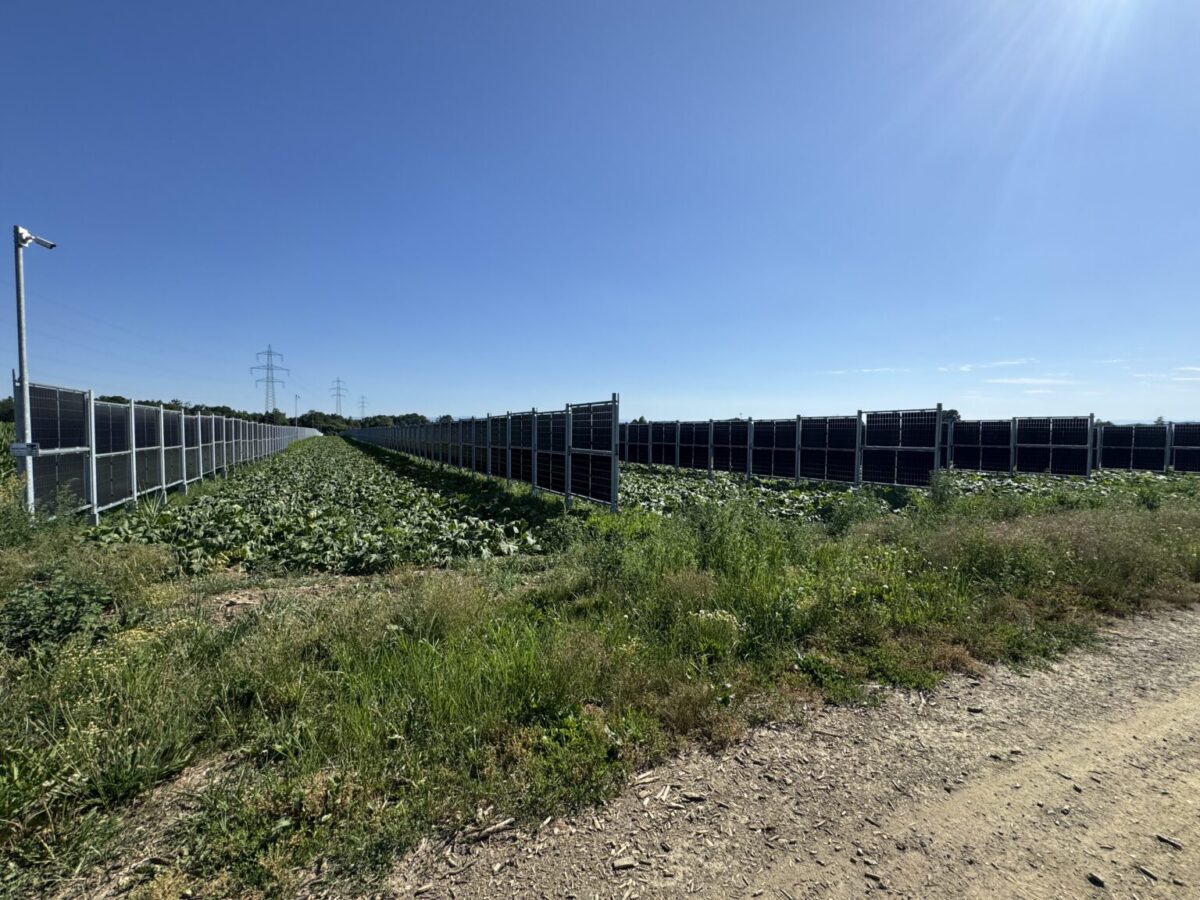
PV -Magazine Visited a 1.9 MW Agrivoltaic plant in Austria, where pumpkins and soy are grown under vertically mounted PV structures supplied by Next2Sun.
German vertical PV specialist Next2Sun built a 1.9 MW Agrivoltaic facility in 2022 on 5.1 hectares in the Austrian municipality of Neudorf an der Mur.
PV -Magazine Visited the site, owned by a local farm and currently supports the cultivation of pumpkins and soy.
Plant owners Peter Gsell and Josef Gründl said that vertical configurations generally do not interacted significantly with weather conditions. Dryness or excessive rainfall has similar effects in areas with and without panels.
The vertical structures were installed between crop rows that rotate annually, adjacent to conventional agricultural fields planted with the same crops. The lateral poles are buried at a depth of 2.5 meters, while the central poles that support the panels are buried 1.5 meters deep. Rows of panels are at a distance of 9.4 meters to reduce the shade.
An opening of 0.5 meters is maintained between the panels and the plants, of which Next2Sun said they can be used to grow flowers.
“The harvest time in areas with panels is comparable to those in areas without panels for crops such as pumpkin, but up to 20% longer for soybeans,” Gsell said during the visit.
Gsell showed his phone with real -time production data: 1.28 MWh at 4 p.m., with peaks of 1.3 MWh in the morning and in the evening. According to Next2Sun, the factory produces an average of 12.5 to 13 MWh per day at the end of June and early July.
The Austrian government provided the support of the owners for 15% of the total investments, based on the double use of the country. The owners, who estimate the investment at € 1.7 million ($ 1.98 million), chose not to install systems mounted on the ground.
“I am against the use of photovoltaïschens on agricultural land. In terms of advanced raised agrivoltaïschens, however, shadow can be problematic in North Europe,” Gsell told a group of Italian farmers who visited the system, and added that he had not seriously considered Panivoltaic’s alternative.
Gsell said that the vertical configuration helps to keep the panels clean, which eliminates the need for manual cleaning. Since 2022, the owners have not cleaned the panels, helped by frequent rainfall and soil that is less dry than in Italy.
He said the installation took five to six months, mainly due to delays of material delivery. During that period the country remained building.
Gsell added that inspections are not required on the Neudorf one of the Mur site, because there are no hanging cables and the installed cameras are sufficient to prevent insurance problems.
“We have a total of 4,500 panels, and currently only seven this kind of mechanical damage due to the cultivation of the agricultural country,” said Johannes Huber, Agrivoltaic Project Developer in Next2Sun, during the visit to the area with temperatures up to 40 C.
Huber pointed to a module with visible cracks at the start of the second row. He said that the photovoltaic panels used in the installation have a bifacial coefficient of 90%, while newer panels now exceed more than 95%.
He added that optimizing the frames to reduce the shade can increase electricity production by 1% to 2%, while the use of bifacial panels increases the generation by approximately 10% compared to monofacial modules.
“To this we have to add the production profiles of the panels that allow production precisely at times when the electricity price is highest. These two factors, bifaciality and production profiles, lead to an overall increase in the value of the electricity production of 25%,” Huber said.
The new projects contain modules of the Chinese hetero junction -panel manufacturer Huasun, including covers for electric cables and connecting boxes near the horizontal crosspiece. Huber said that the configuration is also compatible with wheat, barley, rice and beans, as well as other crops that do not regularly exceed the height of the photovoltaic modules.
Gsell estimated the costs of the structures at around € 200,000/MW. In Austria, Gsell and Huber said that traditional photovoltaic systems for agricultural use usually cost around € 110,000/MW. Next2Sun noted that the costs of the final structure depend on various technical and commercial factors, including soil type, corrosiveness, wind load and test results on location.
This content is protected by copyright and may not be reused. If you want to work with us and reuse part of our content, please contact: editors@pv-magazine.com.
