

The US solar sector reached a historic milestone in late 2025, officially surpassing 10 GWdirect current of cumulative national installations, according to a new report issued by Wooden Mackenzie in collaboration with the Coalition for Community Access to Solar Energy (CCSA).
While the market experienced a 25% contraction in 2025 due to a slowdown in mature markets such as New York and Maine, national installed capacity is expected to recover with 12% growth in 2026. The market installed 1,435 MW in 2025.

“Overall, we expect national installed community solar capacity to shrink by an average of 5% annually through 2030 across existing state-level programs,” said Caitlin Connelly, senior analyst and lead author of the report. “The segment’s near-term growth is anchored by a strong project development pipeline that now exceeds 8 GW, with 29% reportedly under construction. Developers are navigating a complex federal policy landscape and interconnection queue backlogs to ensure their current pipelines are built as efficiently as possible to meet the start of construction and commissioning deadlines required to secure the ITC.”
According to the report, the market contraction in 2025 was mainly driven by low installation volumes in New York and Maine. This year, capacity additions in the Illinois and Mid-Atlantic markets will drive national annual growth.
The long-term growth of traditional community solar is increasingly dependent on the creation of new state markets. Developers have already established strong pre-development pipelines for proposed programs in states including Ohio, Iowa, Pennsylvania and Michigan.
“So far in 2026, there are signs that the value proposition of community solar is gaining new attention in several states,” says Connelly. “Adopting legislation in these markets could potentially add more than 1.5 GW through 2030; however, the elimination of the ITC in 2030 will complicate the new program design and timelines.”
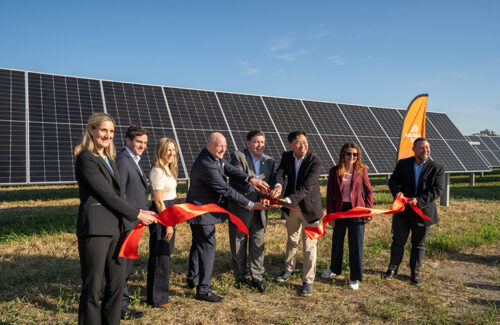
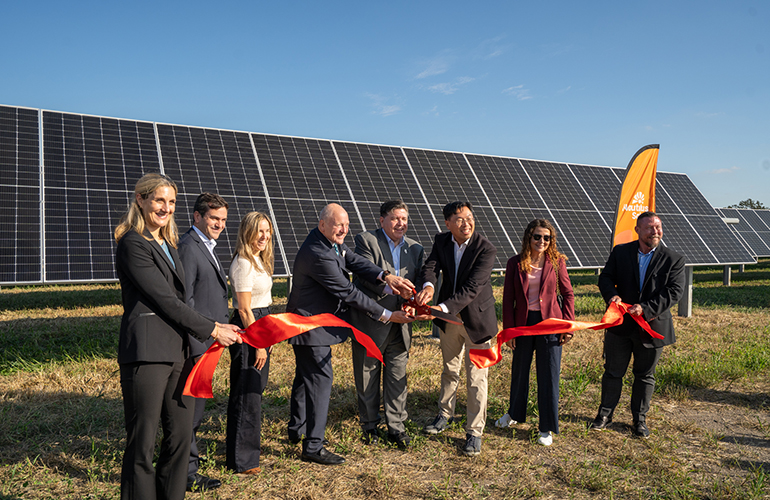
A community solar project in Illinois, completed in 2025. Credit: Nautilus Solar Energy
In addition to traditional, legislatively enabled community solar programs, developers are increasingly expanding their business models to capture the growing opportunities for “community-scale” resources, which the report defines as solar resources up to 20 MW in size. Community solar developers are primarily focusing on Ohio and Pennsylvania for these types of developments, driven in part by the region’s need for new generations to meet rapidly growing demand.
“Utilities are beginning to prioritize ‘community-scale’ resources in their long-term planning, which typically include smaller utility-scale projects connected directly to the distribution grid,” Connelly said. “These resources can be deployed more quickly than larger utility-scale projects and, especially when combined with storage, can improve the flexibility and reliability of the electric grid.”
“Exceeding 10 GW is a milestone for the solar industry and a testament to the industry’s resilience. We’ve saved hundreds of thousands of homes and businesses on bills, even as federal policy headwinds have created real uncertainty,” said Jeff Cramer, president and CEO of CCSA. “But reaching this milestone is just the beginning. The expansion of mid-scale, front-of-the-meter solar and storage into new markets signals that our industry is diversifying and adapting in ways that will serve customers and the grid for decades to come. The pipeline is strong and states establishing new programs are proving that community and distributed clean energy remains one of the most compelling tools we have to put affordable, accessible energy within the reach of all.”
The costs of acquiring subscribers decreased by 12% on average for all customer segments compared to 2024. Reducing subscriber acquisition costs has become a focus for developers looking to optimize project revenue after the removal of the ITC. Despite state-specific market challenges, Wood Mackenzie expects average costs to continue to gradually decline through 2030 due to broader adoption of consolidated billing and digital marketing tools. LMI subscribers remain the most expensive to purchase at $100/kW.
The subscription management landscape is also experiencing rapid consolidation. In February 2026, Perch Energy acquired the Solstice platform, following Perch’s previous merger with Arcadia. By the end of 2025, four major subscription management platforms and vertically integrated developers will control 55% of the community’s total operational solar capacity.
At the end of 2025, cumulative community solar installations reached 10.1 GW. Wood Mackenzie has developed high-case and low-case scenarios to address market uncertainties:
- Highest scenario: An increase of 16% over the five-year forecast in the base case due to favorable changes in state policies and efficient interconnection reform, adding approximately 1.2 GW
- Low scenario: a 14% contraction due to complex tax credit qualification guidelines and limited state intervention, lowering the outlook by around 1 GW
News item from Wood Mackenzie
