

A Spanish-Chilean research team has found that microbial biofilms in the Atacama Desert can significantly contribute to the contamination of photovoltaic modules, reducing short-circuit current by up to about 30% under accelerated laboratory conditions. The study highlights microorganisms as active agents in PV pollution and suggests that they may influence optical losses, cleaning efficiency and future mitigation strategies in arid, highly exposed solar regions.
A Spanish-Chilean research team has investigated the role of microorganisms in the contamination of photovoltaic surfaces in the Atacama Desert and found that microbial biofilms can significantly affect the performance of solar panels.
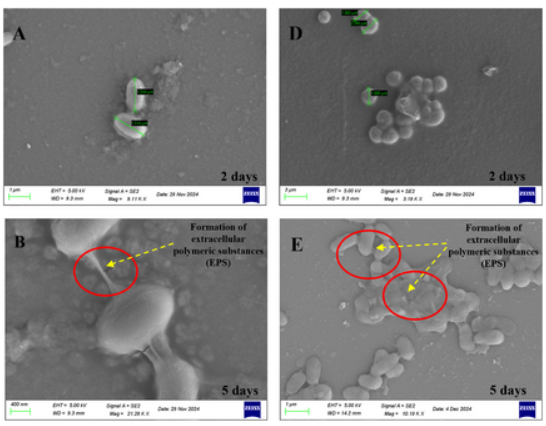
“Our work shows that microbial communities isolated from photovoltaic modules in the Atacama Desert exhibit high tolerance to desiccation and extreme irradiation,” said the study’s corresponding author, Aitor Marzo. pv magazine. “In addition, they form biofilms and produce extracellular polymeric substances (EPS), a matrix composed of polysaccharides, proteins, nucleic acids and lipids that promote cell adhesion, retention of mineral particles and encrustation on the surface. FE-SEM microscopy images confirmed the presence of dense, three-dimensional matrices that encapsulate cells and mineral particles.
The researchers also discovered carotenoids in strains of a genus known as Dietziawith spectral features consistent with lutein-like compounds or related xanthophylls. According to the authors, these pigments may contribute to microbial photoprotection against extreme ultraviolet (UV) radiation and partially overlap with the spectral conversion range of monocrystalline silicon PV modules, indicating a potential additional mechanism of optical interference.
To assess the electrical impact, the researchers performed accelerated biofilm formation tests on PV glass under controlled laboratory conditions. In these experiments, seven days of colonization were associated with short-circuit current losses ranging from 15.20% to 30.66% in samples from the University of Antofagasta, and from 11.01% to 20.12% in samples from the Atacama Desert Solar Platform, in addition to an increase in surface biomass. Increased EPS deposition was found to improve cohesion within the biofilm and reduce the effectiveness of conventional cleaning methods, such as dry brushing and rinsing, which may be partially ineffective against the protective matrix.
However, the authors emphasized that these assays were designed as accelerated experiments to reproduce the initial stages of biofilm adhesion and consolidation within a limited laboratory time frame. As such, the maximum observed losses represent an upper limit of biological impact and should not be directly interpreted as typical field values, where colonization occurs more gradually and is influenced by environmental factors such as irradiation, humidity, dust deposition and nutrient availability. Nevertheless, the data confirm that high irradiance selects resistant taxa capable of forming persistent layers.
Overall, the study concluded that microorganisms are not a passive component of pollution, but active substances that contribute to the consolidation of deposits, reduce optical transmission and reduce the effectiveness of conventional cleaning methods.
The authors added that the results highlight the need to include the biological dimension in pollution predictive models and mitigation strategies for PV systems in arid areas. Pigmented at the same time Dietzia strains present potential biotechnological applications in coatings and self-cleaning technologies, opening new avenues for future research.
Their findings can be found in the article “Microbial contribution to pollution and its impact on pollution of photovoltaic modules in arid zones of the Atacama Desert”, published in Advanced sustainable systems. The research team included academics from the University of Granada in Spain and the University of Atacama in Chile.
Atacama has become the largest solar energy hub in Chile and Latin America, with dozens of large-scale solar power plants coming online there in the past decade. The country has exceptional conditions for solar energy production, and in fact the installed solar energy capacity in this region represents more than 90% of the total installed capacity in Chile.
This content is copyrighted and may not be reused. If you would like to collaborate with us and reuse some of our content, please contact: editors@pv-magazine.com.
