

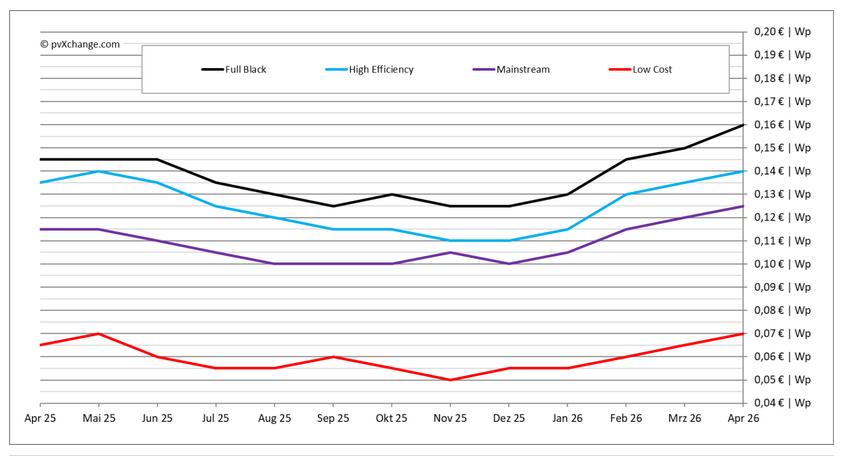
Photovoltaic module prices have risen for the fourth month in a row, driven by strong demand for energy independence, despite falling upstream costs such as polysilicon. At the same time, production cuts in China and tighter supply conditions are limiting availability, amplifying price increases for all technologies.
For the fourth month in a row, prices for photovoltaic modules have increased across all technologies. Although the pace of increase has slowed compared to the beginning of the year, the upward trend remains intact. Between March and April, average prices rose by 5.5%, with all-black modules recording the strongest increases.
This development contrasts with various signals on the supply side. Polysilicon prices have been falling for weeks due to weak global demand, and the elimination of China’s export tax credits, effective April 1, is generally expected to put downward pressure on module prices.
Market dynamics are instead shaped by a combination of resilient demand and limited supply. Uncertainty in the global economy and energy market continues to support investments in energy independence, maintaining demand for photovoltaic and storage systems. Installers report strong order books, while developers and investors continue to pursue large-scale projects even in the absence of subsidies.
At the same time, supply has tightened due to production adjustments in China. In early 2026, several manufacturers reduced capacity to avoid renewed price competition, closed older lines or operated at lower occupancy rates. As a result, the previous situation of oversupply in Europe has decreased, including the accumulation of module inventories in ports such as Rotterdam.
Today, modules are largely delivered on a just-in-time basis or under contracted volumes, limiting flexibility in responding to demand peaks. This has led to longer lead times and upward pressure on prices. The residential segment is particularly affected, as it is heavily dependent on high-power all-black modules, the supply of which is limited and often sold out quickly. In some cases, price adjustments to existing contracts are accepted to secure delivery.
Overall, rising demand driven by energy security concerns, combined with tighter supply, is creating a tense market environment. Future price developments will depend on geopolitical conditions and the industry’s ability to adapt to the current market phase.
Module prices per technology from April 13, 2026, including monthly variations:
 About the author: Martin Schachinger studied electrical engineering and has been active in the field of photovoltaics and renewable energy for almost 30 years. In 2004, he founded the online trading platform pvXchange.com. The company has standard components in stock for new installations and solar panels and inverters that are no longer produced.
The views and opinions expressed in this article are those of the author and do not necessarily reflect those of the author pv magazine.
This content is copyrighted and may not be reused. If you would like to collaborate with us and reuse some of our content, please contact: editors@pv-magazine.com.
Popular content

