

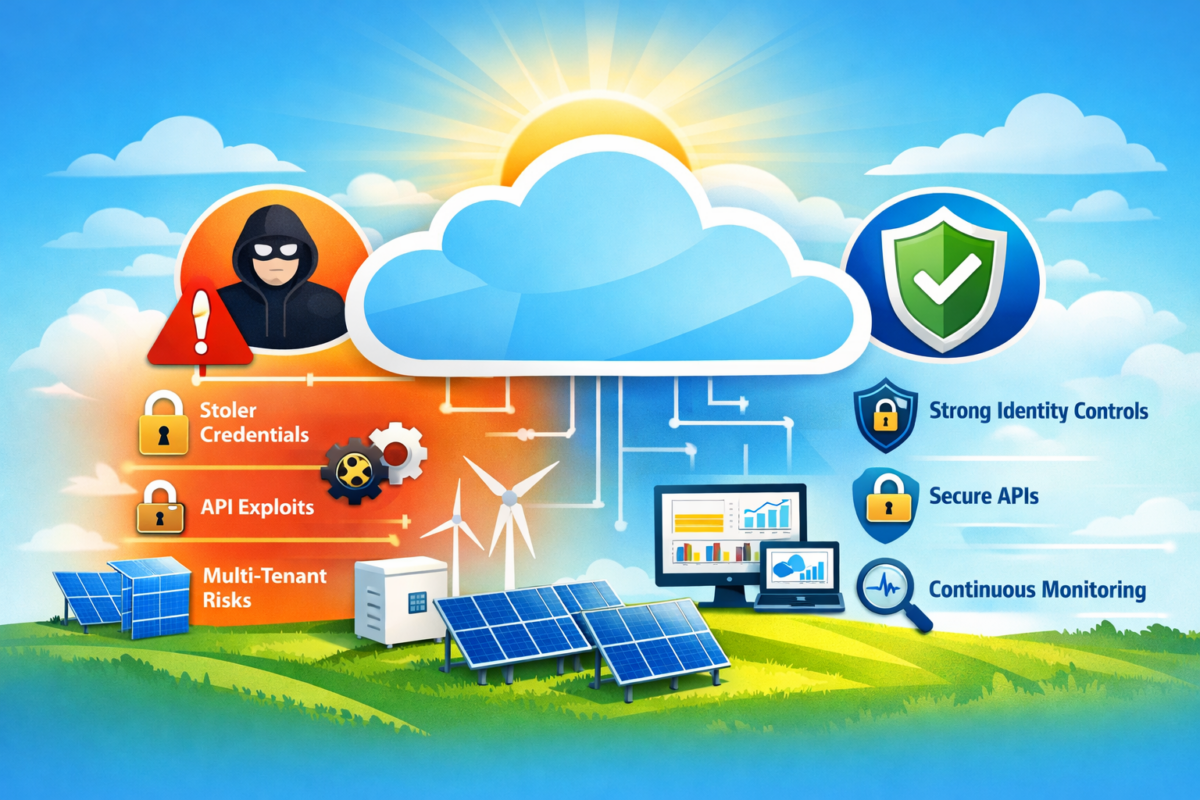
Cloud and SaaS platforms are now central to PV installation operations, but their centralization creates a high-impact cybersecurity risk, where a single compromise could expose or disrupt entire installation fleets. Attackers exploit weaknesses such as stolen credentials, insecure APIs, multi-tenant flaws, and platform vulnerabilities, implementing strong identity checks, secure APIs, and continuous monitoring of critical defenses.
As PV installations become increasingly digitalized, cloud platforms and software-as-a-service (SaaS) solutions have become central to their operations. These platforms collect performance data, enable remote monitoring, manage asset fleets and increasingly support control functions for distributed energy resources. However, this centralization also creates a valuable target for attackers. If a single cloud environment is compromised, it can expose or disrupt thousands of PV installations simultaneously.
Attacks on cloud platforms and SaaS exploitation aim to exploit weaknesses in these centralized systems rather than directly targeting individual PV assets. Instead of hacking every inverter or data logger, attackers try to compromise the platforms that connect them all.
“If you are an Asset Owner and can monitor the power output of all your PV installations, it means they are connected to the cloud. That connectivity is an access point. By connecting inverters, loggers, batteries or trackers to their clouds, you turn each into a trusted path – and a potential backdoor to all your installations at once,” told Uri Sadot, Managing Director of SolarDefend and chair of SolarPower Europe’s Digitalization workstream. pv magazine.
Operational modes
Cloud and SaaS exploitation in PV environments typically occurs through several distinct operational modes, depending on how attackers gain access and which components of the platform are targeted.
One of the most common forms is credential access abuse, where attackers use stolen, leaked, or weak credentials to log into cloud monitoring portals or administrative dashboards. Once inside, they can access sensitive factory data, change configuration settings, or manipulate performance reporting across multiple assets.
A second mode is API exploitation, which focuses on the application programming interfaces used by PV platforms to exchange data between devices, third-party services, and user interfaces. Poorly secured or overly permissive APIs can allow attackers to extract large amounts of telemetry data, inject false measurements, or trigger unauthorized commands.
Another operational mode is multi-tenant abuse, which occurs when vulnerabilities in SaaS architectures allow one customer to access or interfere with another customer’s data. In PV contexts, this can be especially damaging for asset managers overseeing large portfolios spread across multiple locations or clients.
Another mode involves platform-level privilege escalation, where attackers exploit software vulnerabilities in the cloud application itself to gain administrative privileges. This can enable system-wide changes, including disabling monitoring features, changing alert thresholds, or changing aggregated performance data for entire fleets.
Finally, attackers can leverage the supply chain compromise of SaaS components, exploiting vulnerabilities in third-party libraries, update mechanisms, or integrated services to gain indirect access to the platform.
In all these modes, the defining risk is scale: the compromise of a single cloud environment can impact not just one PV installation, but entire fleets managed under a unified digital infrastructure.
Defense
Mitigating attacks on cloud platforms and SaaS exploitation requires a layered security approach that addresses both identity management and platform architecture.
A foundational control consists of strong identity and access management (IAM), including multi-factor authentication (MFA), least privilege access policies, and continuous monitoring of login behavior. This significantly reduces the risk of unauthorized access via stolen credentials.
Equally important is secure API design and management, including authentication tokens, rate limiting, input validation, and strict authorization controls. APIs should be treated as critical infrastructure components, not as additional functions.
To address multi-tenant risks, providers must implement strong tenant isolation mechanisms that ensure data segregation is enforced at both the application and database levels.
Another important defense is continuous security monitoring and anomaly detection, which can identify unusual access patterns, data exports, or configuration changes that could indicate a compromise.
Finally, secure software development and patch management practices are essential to reducing vulnerabilities in the platform itself, including regular updates, penetration testing, and dependency monitoring for third-party components.
In conclusion, attacks on cloud platforms and SaaS exploitation pose a systemic risk to modern PV operations. As the industry increasingly relies on centralized digital ecosystems, the security of these platforms becomes directly linked to the resilience of the energy infrastructure they support. A platform-level compromise is no longer just an IT incident; it is a potential incident on the energy system.
“Overall, this is about trust and verification. You have to trust every supplier you allow into your PV installations. That is the first step. And on top of that you add verification tools such as strong firewalls and an IDS (Intrusion Detection System). It is a bit like the way we protect our homes. We only give keys to people we trust, and on top of that you add an alarm or a security camera. This is not a big expense even for a 1 MW installation,” concludes Sadot.
This content is copyrighted and may not be reused. If you would like to collaborate with us and reuse some of our content, please contact: editors@pv-magazine.com.
