

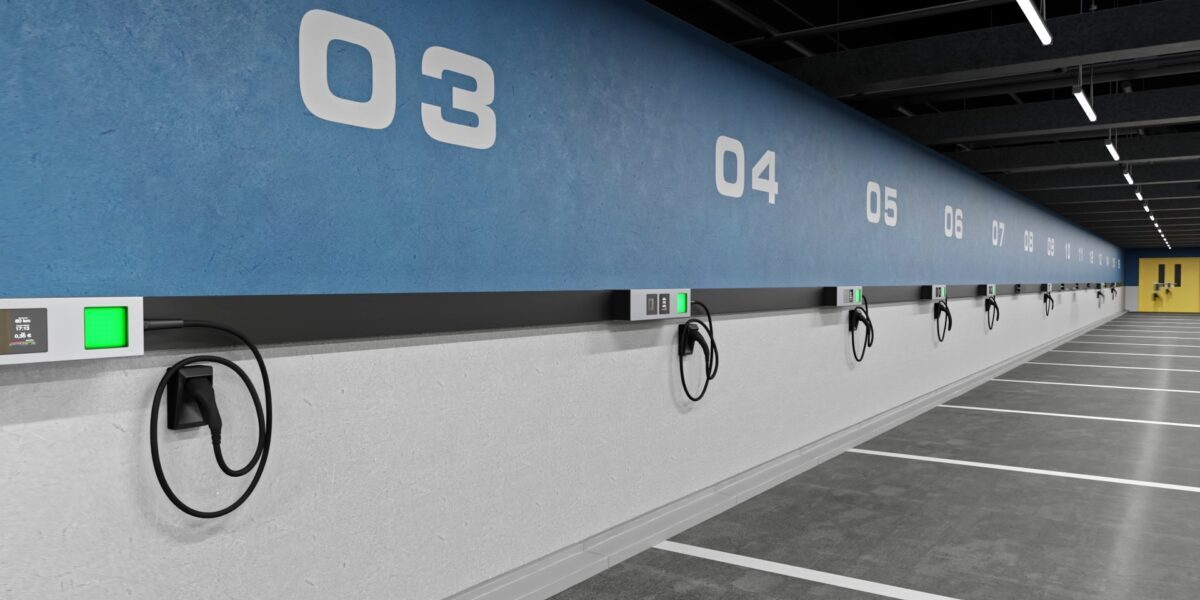
Lade GmbH has unveiled an AC system that supports charging up to 22 kW in both single-phase and three-phase configurations. The hardware is already designed to enable bi-directional charging in large-scale charging parks.
German startup Lade Gmbh has launched a scalable AC system that promises to enable the rapid implementation of large-scale charging infrastructure projects.
The AC system supports single and three-phase charging up to 22 kW and is prepared for bi-directional charging.
According to the company, the Lade One system integrates wallboxes, cabling, control units and energy management functions. It can be installed as a plug-and-play solution, which aims to reduce installation time, costs and complexity compared to rail or flat cable systems. The integrated cable routing is designed to simplify deployment in large parking facilities, with reduced installation efforts in terms of labor and materials, while additional wall boxes can be added to the system in minutes, the company said.
Multiple charging points can be supplied with power via one fused 63 A supply line. Integrated residual current circuit breakers with overload protection (RCBOs) eliminate the need for external components. A certified meter is supplied as standard.
In terms of hardware, Lade One is already prepared for bidirectional charging, according to the company. Once the relevant regulatory framework is in place, the feature can be enabled via a software update. Lade is a member of the BiFflex Industrie research consortium and works together with the Fraunhofer ISE and Fraunhofer IAO institutes, among others, on the development of technological foundations for grid-supporting and economically viable bidirectional charging applications.
Lade Genius’ energy manager manages the charging infrastructure, supported by the company’s AI platform Lana. In addition to dynamic charging management, the system is designed to determine charging requirements, generate charging schedules and take into account grid and storage capacity, renewable energy generation and variable electricity rates. According to Lade, this approach makes it possible to serve multiple customers, even on low-capacity grid connections, while reducing energy costs.
The company expects additional momentum from the German government for the expansion of the charging infrastructure. The government has allocated €500 million ($587.8 million) to support the development of charging hubs for residential and commercial property owners.
“We are currently seeing many projects that are laying the foundation for the next 10 to 15 years,” says Dennis Schulmeyer, general manager at Lade. “The combination of our scalable system and public financing can represent a major step forward towards climate-friendly mobility and a sustainable energy system.”
A variant of Lade One that meets regulatory metrology requirements is scheduled for release in the second half of the year. Open OCPP and Modbus interfaces are intended to ensure flexibility and vendor independence.
This content is copyrighted and may not be reused. If you would like to collaborate with us and reuse some of our content, please contact: editors@pv-magazine.com.
