An international research team has proposed integrating photovoltaic thermal (PVT) collectors, borehole thermal energy storage (BTES) and a dual-source heat pump (DSHP) into a single hybrid energy system designed to provide space heating for livestock sheds. The concept combines three complementary technologies to improve overall efficiency and reduce dependence on conventional fossil fuel heating.
“The integrated system makes it possible to heat livestock stables by virtually eliminating electricity consumption,” said the study’s lead author, Francesco Tinti, pv magazine. “The PVT provides electrical energy, but also thermal energy to be stored in the BTES; the BTES allows the recovery of thermal energy from the subsurface; and the DSHP uses the subsurface energy, but also, so as not to deplete the BTES, the air source when necessary.”
“Our analysis showed that the electrical energy consumed by the DSHP is almost entirely covered by the electricity generated by the PVT unit,” he continued. “However, the capital cost of the system remains significant compared to conventional fossil fuel systems or air source heat pumps. On the other hand, it is comparable to standard geothermal heat pumps in that the additional cost of the PVT and solar field helps reduce the required borehole length. Furthermore, a key advantage of the PVT-BTES-DSHP system is that it significantly reduces primary energy consumption.”
A prototype of the system was tested at the Golinelli pig farm in Mirandola, in Italy’s northern province of Modena, where 500 sows and 2,500 weaners are housed across several barns. Previously the nursery was heated by a 34 kW LPG boiler, supported by thermal lamps in each room.
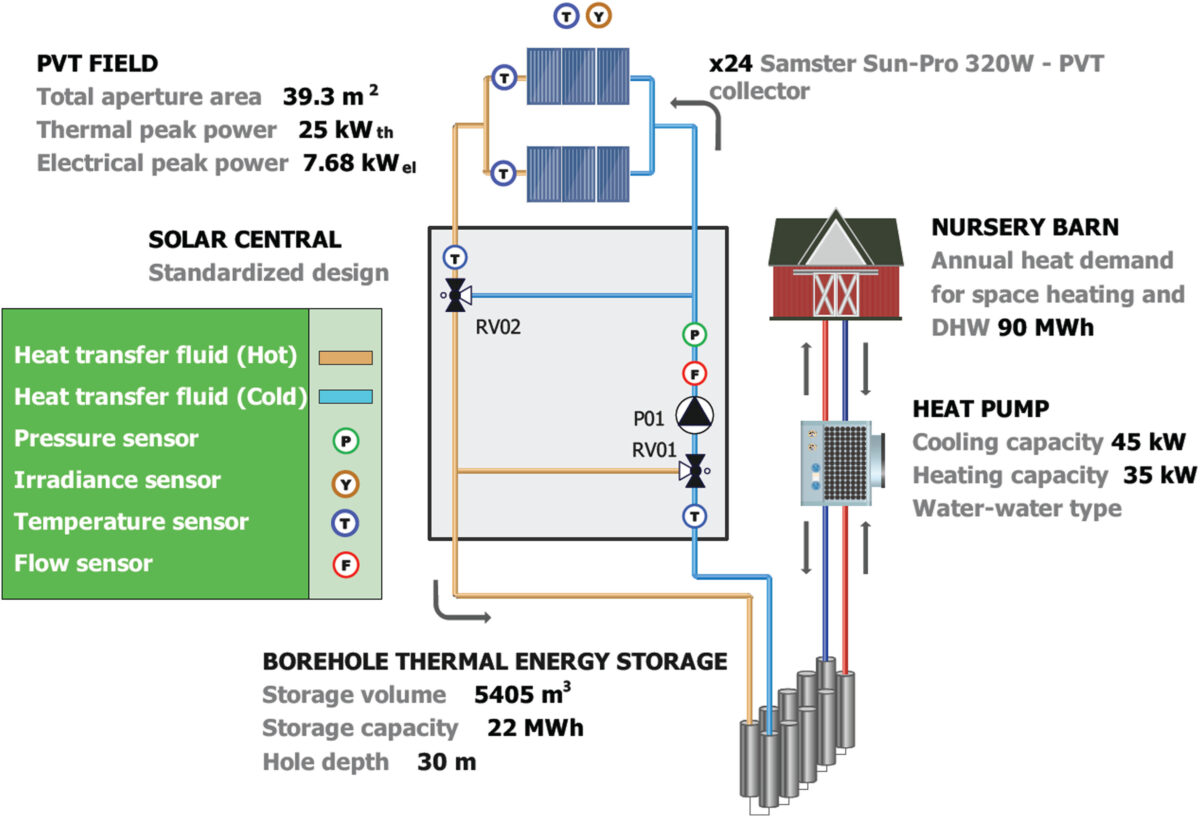
The PVT-BTES-DSHP system combines a 35 kW dual-source heat pump that can use air or ground as a heat source, an underground thermal energy storage (BTES) field with eight 30-meter deep boreholes, a rooftop photovoltaic-thermal (PVT) array of 24 collectors providing both thermal and electrical energy, and a centralized solar control station that manages energy flows between components.
Image: University of Bologna, Geothermal, CC BY 4.0
The PVT array is hydraulically coupled to the BTES, and a rules-based control system ensures efficient operation by activating circulation only when solar radiation is sufficient or when temperature gradients favor heat transfer, thus avoiding unnecessary energy losses. The DSHP is centrally controlled via PLC automation, maintaining a constant supply temperature of 50–55 C. The DSHP uses advanced compressor modulation and dual evaporator control to optimize performance, prioritizing the more efficient ground source when conditions permit.
The operational switch between ground and air sources is dependent on the glycol temperature thresholds, ensuring efficiency, freeze protection and reliable operation in winter, while additional systems control defrosting in extremely cold conditions. All system components are continuously monitored via a cloud-based platform, allowing real-time tracking of temperatures, pressures and performance indicators.
The system design was based on detailed calculations of monthly heating demand and solar energy injection load, balancing seasonal energy needs with long-term storage capacity in the ground and legal limits for underground temperatures. Overall, the integrated system is designed to reduce dependence on fossil fuels, improve seasonal energy storage and maximize the use of renewable energy for livestock heating applications.
During the first year of monitoring, the system showed stable thermal behavior in both the BEO and building supply circuits. Minimum BTES outlet temperatures remained above operational limits even in winter, confirming that solar-assisted heat injection effectively prevented ground overcooling and prevented thermal depletion of the storage field.
Maximum BTES temperatures gradually increased toward spring, indicating seasonal thermal recovery, driven by reduced heating demand and intermittent solar energy. On the building side, supply temperatures consistently met the heating needs of the children’s rooms without critical drops, while maximum values reflected peak demand periods. Temperature stability contributed to stable indoor conditions and supported animal welfare by avoiding thermal fluctuations.
The DSHP operated mainly between November and April, with a defrost rate of only 3.6% during this period, confirming its robust winter performance. Over the year, the system delivered 147,133 MJ of heat to the building while consuming 38,917 MJ of electricity, resulting in an overall seasonal performance factor (SPF) of 3.78.
The system also extracted 109,425 MJ of ambient energy, of which 38.6% came from land use only, 6.0% from air only operation and 55.4% from hybrid operation. This confirms that the air source mainly absorbs peak loads, while the ground remains the primary energy supplier. Seasonally, winter months were dominated by hybrid operation, while spring favored exclusive land use, demonstrating adaptive resource switching based on conditions.
The analysis also showed that the system achieved an average coefficient of performance (COP) of approximately 4.07, with values above 4 during favorable periods. Furthermore, the combination of PVT, BTES and DSHP significantly reduces borehole length requirements while achieving comparable output to conventional systems with significantly lower demand for geothermal infrastructure.
“The double-circuit BTES reduces the required borehole heat exchanger (BHE) length by about a third, because in the specific location and hydrogeological conditions the natural subsurface temperature is low, while the BTES makes it possible to increase it by about 5°C,” Tinti points out. “However, not all hydrogeological conditions allow the storage of solar heat, which can be removed by natural groundwater movements.”
“The proposed configuration is particularly suitable for farms with sufficient available land and favorable shallow geothermal conditions, and provides a practical pathway to reduce greenhouse gas emissions while increasing energy resilience,” he concluded.
The system was introduced in the study “Solar-assisted borehole thermal energy storage in combination with a cattle shed heat pump: results from a complete installation”, published in Geothermal. The research team included scientists from Italy’s University of Bologna, Greece-based heating and cooling specialist Psyctotherm G and Swedish engineering firm MG Sustainable Engineering AB.
This content is copyrighted and may not be reused. If you would like to collaborate with us and reuse some of our content, please contact: editors@pv-magazine.com.
Popular content