

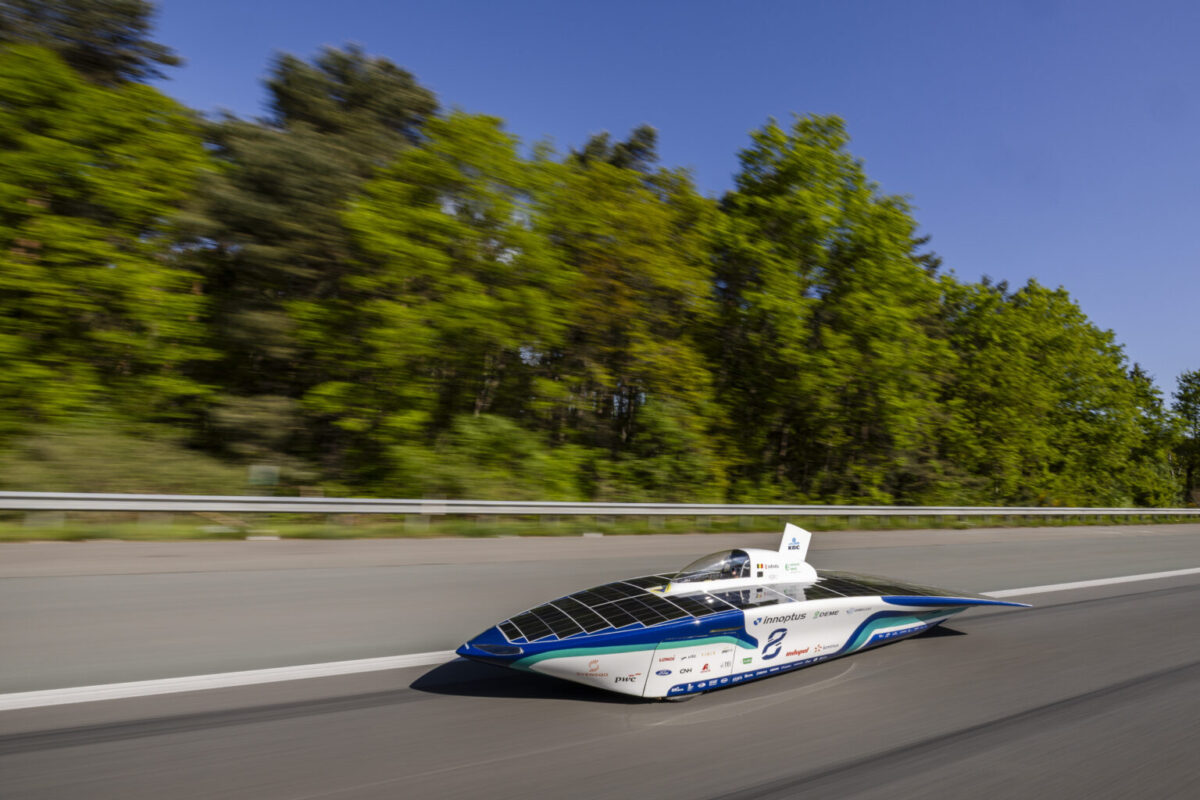
At the end of April, a 200 km urban road test was carried out in Belgium under real traffic conditions and different levels of solar radiation to evaluate system performance in complex operational environments. The test serves as final validation of the vehicle’s systems.
Innoptus Solar Team has completed a 200 km test drive in Belgium with its solar vehicle Infinite Apollo.
The vehicle is equipped with back-contact (BC) technology and vehicle-integrated solar photovoltaics (VIPV), developed by Chinese PV manufacturer Longi. The test serves as technical validation prior to the team’s participation in the American Solar Challenge, scheduled for July 2026.
The test was conducted under realistic urban driving conditions and different levels of solar radiation to assess the performance of the vehicle’s photovoltaic and energy systems in complex operational environments. The route covered six locations across Belgium, allowing analysis of the stability of energy generation under changing traffic conditions, solar orientation and variable cloud cover.
Infinite Apollo – the eleventh generation solar car developed by the team – was designed and built between 2024 and 2025. It features a 6 m² solar panel, reportedly the largest yet, with an efficiency of more than 27%. The vehicle also integrates two fixed aerodynamic fins for crosswind stability, a 3 kWh battery and an in-house developed high-efficiency motor.
Despite a solar panel that is approximately 50% larger than its predecessor, the vehicle weighs just 170 kg and can travel more than 300 km on solar power alone, according to the team.
The VIPV system supplied by Longi includes flexible solar cells with back contact, adapted for curved aerodynamic surfaces. The back-contact architecture eliminates the metallization on the front, moving all electrical contacts to the back of the cells. The cells are fabricated using TaiRay silicon wafers and flexible encapsulation materials designed for mobile applications.
According to the Chinese manufacturer, the components are designed to withstand vibration, thermal cycling and mechanical stress. The project also includes industrial collaboration with Sibelco, which supplies high-purity quartz sand used in the production of solar cells.
The vehicle was developed over approximately ten months and underwent several thousand kilometers of preliminary testing to optimize both the solar panel and the battery system.
The Innoptus Solar Team previously finished third in the Bridgestone World Solar Challenge, covering more than 3,000 km in six days between Darwin and Adelaide, Australia.
This content is copyrighted and may not be reused. If you would like to collaborate with us and reuse some of our content, please contact: editors@pv-magazine.com.
