
Close Menu
  • News
  • Industry
  • Solar Panels
  • Commercial
  • Residential
  • Finance
  • Technology
  • Carbon Credit
  • More
    • Policy
    • Energy Storage
    • Utility
    • Cummunity
What's Hot

Fraunhofer ISE develops colored film technology for patterned solar panels

April 23, 2026

Thermoacoustic heat pumps are on the verge of commercial breakthrough – SPE

April 23, 2026

The federal court has halted Trump administration orders that hinder solar and wind energy development

April 23, 2026
Facebook X (Twitter) Instagram
Solar Energy News
Thursday, April 23
  • News
  • Industry
  • Solar Panels
  • Commercial
  • Residential
  • Finance
  • Technology
  • Carbon Credit
  • More
    • Policy
    • Energy Storage
    • Utility
    • Cummunity
Solar Energy News
Home - Solar Industry - Recursive least squares algorithms to detect abnormal operation in PV systems
Solar Industry

Recursive least squares algorithms to detect abnormal operation in PV systems

solarenergyBy solarenergyJune 27, 2024No Comments3 Mins Read
Facebook Twitter Pinterest LinkedIn Tumblr Email
Share
Facebook Twitter LinkedIn Pinterest Email

Scientists in Spain have implemented recursive least squares (RLS) algorithms for detecting anomalies in PV systems and have found that they can provide a “more realistic and meaningful assessment” than traditional energy analyses.

June 27, 2024 Lior Kahana

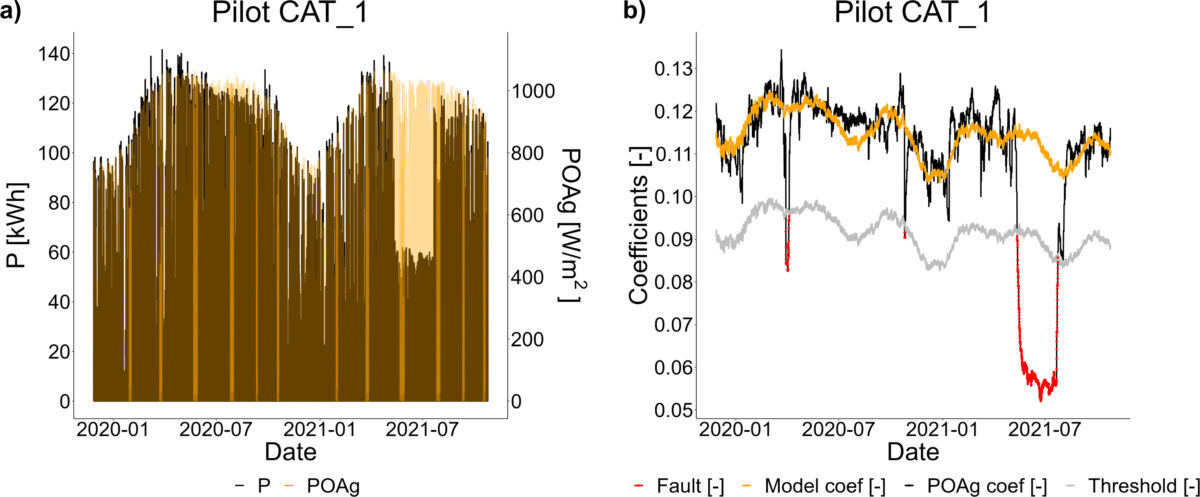
A group of Spanish researchers have developed two new methodologies for the detection of abnormal operation of photovoltaic systems, based on minimal data requirements. The first is intended to identify sudden short-term efficiency losses, while the second is a long-term technique designed to monitor the degradation of a plant.

“The manuscript introduces two different methodologies using supervised machine learning (ML) techniques,” the academics said. “Both methodologies are characterized by their dependence on minimal input variables, a conscious design choice to facilitate their application in facilities with limited data availability. This pragmatic feature allows the proposed approaches to be implemented in already existing solar power plants without the need to install additional equipment.”

In both approaches, the scientists implemented the recursive least squares (RLS) algorithm for anomaly detection. RLS is an adaptive filtering method used in signal processing and control systems to minimize the error between a desired signal and an estimated signal.

“The radiation data on the PV Plane of Array (POA) are necessary for both models because PV generation directly correlates with them,” the group added. “Irradiation components are collected by the Copernicus Atmosphere Monitoring Service (CAMS) using the PV location. However, no details of the PV installation are provided, apart from energy production, location and rated power, so the orientation and height of the PV panels are estimated.”

See also  Stem: Project van het jaar 2025 | Meer dan 10 MW

After designing the two fault detection algorithms, the research team tested them on a number of PV installations in different locations in Spain. They were located in different climate regions, with peak power generation between 33 kW and 295 kW. Some were brand new and some were over ten years old.

The short-term detection was tested on 22 PV installations and showed that the evolution of the coefficients resulting from the use of the RLS algorithm can be used for fault detection, according to the scientists. “By using only one coefficient and the radiation incident on the plane of the PV panels as input, the calculated coefficient evolves directly proportional to the efficiency of the PV installation,” they explained.

“The long-term model selects the most representative model of the PV plant for each operating month and compares them by predicting PV generation in a base year,” the researchers further noted. “This algorithm was used in this study for the five PV installations with higher historical data. The results tracked the expected average annual degradation of 1.5% in four of these installations and discovered an abrupt degradation pattern in one installation.”

Their findings were presented in “Detection of abnormal operation of photovoltaic systems with minimum data requirements based on recursive least squares algorithms,” published in Solar energy. The group consisted of academics from Spain International Center for Numerical Methods in Engineering (CIMNE) and the Technical University of Catalonia.

This content is copyrighted and may not be reused. If you would like to collaborate with us and reuse some of our content, please contact: editors@pv-magazine.com.

See also  Chinese PV industry Letter: Longi ships 17 GW on contact modules in 2024

Source link

abnormal Algorithms detect Operation Recursive squares systems
Share. Facebook Twitter Pinterest LinkedIn Tumblr Email
solarenergy
  • Website

Related Posts

Fraunhofer ISE develops colored film technology for patterned solar panels

April 23, 2026

Inside PV Manufacturing: Belga Solar’s module factory in Belgium

April 23, 2026

No evidence that PFAS leaks from solar panels, research shows

April 22, 2026
Leave A Reply Cancel Reply

Don't Miss
Residential

SunPower files for Chapter 11 bankruptcy

By solarenergyAugust 6, 20240

SunPower announced today that it has filed for Chapter 11 bankruptcy in the U.S. Bankruptcy…

Climate change drives the value of rooftop solar – SPE

May 3, 2024

Philippines accelerates world’s largest solar park with Green Lane certificate – SPE

August 16, 2024

NexPracker launches Robotics Division with Onsight Technology Acquisition

August 3, 2025
Stay In Touch
  • Facebook
  • Twitter
  • Pinterest
  • Instagram
  • YouTube
  • Vimeo
Our Picks

Fraunhofer ISE develops colored film technology for patterned solar panels

April 23, 2026

Thermoacoustic heat pumps are on the verge of commercial breakthrough – SPE

April 23, 2026

The federal court has halted Trump administration orders that hinder solar and wind energy development

April 23, 2026

Zendure launches battery ranges for residential PV – SPE

April 23, 2026
Our Picks

Fraunhofer ISE develops colored film technology for patterned solar panels

April 23, 2026

Thermoacoustic heat pumps are on the verge of commercial breakthrough – SPE

April 23, 2026

The federal court has halted Trump administration orders that hinder solar and wind energy development

April 23, 2026
About
About

Stay updated with the latest in solar energy. Discover innovations, trends, policies, and market insights driving the future of sustainable power worldwide.

Subscribe to Updates

Get the latest creative news and updates about Solar industry directly in your inbox!

Facebook X (Twitter) Instagram Pinterest
  • Contact
  • Privacy Policy
  • Terms & Conditions
© 2026 Tsolarenergynews.co - All rights reserved.

Type above and press Enter to search. Press Esc to cancel.