

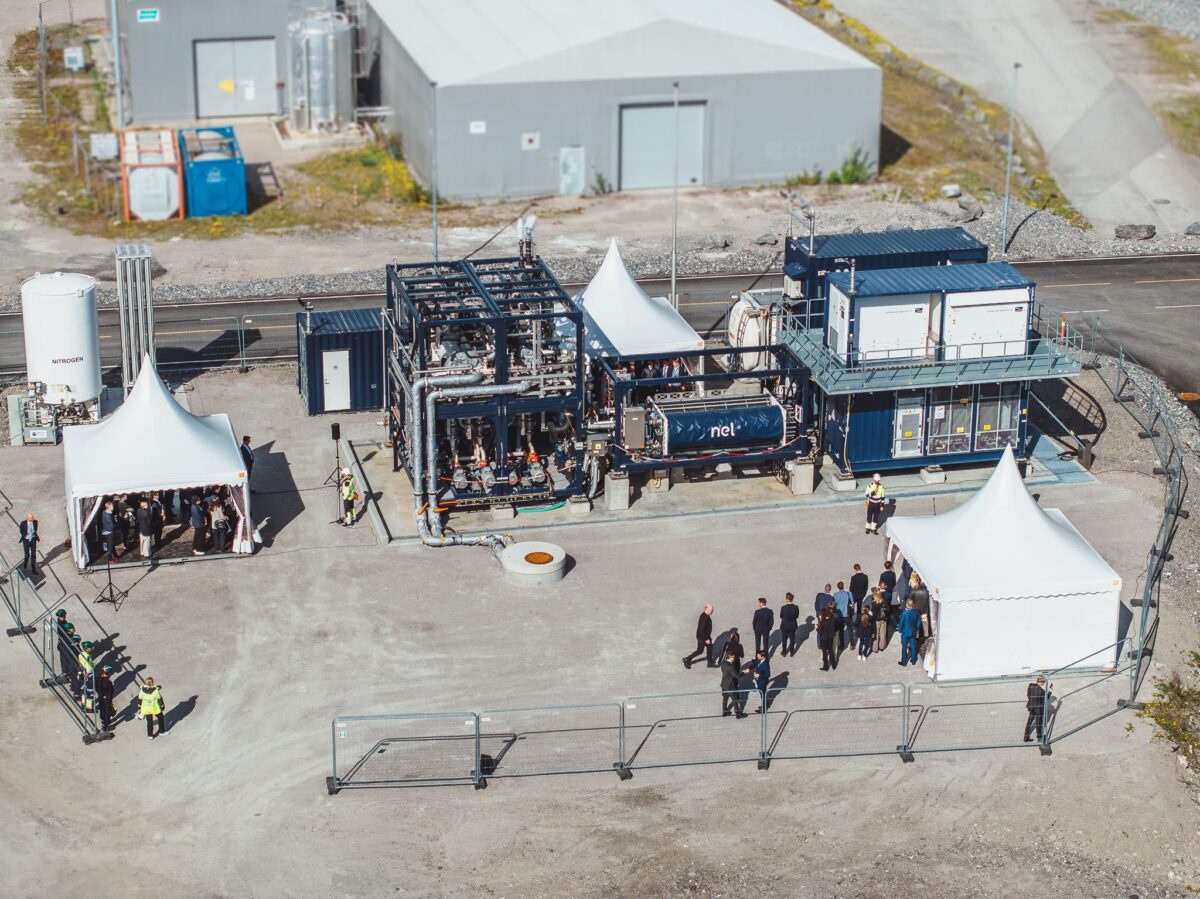
Nel ASA says its new electrolyzer can achieve an estimated turnkey full cost of less than $1,450 per kW for a 25 MW plant, with additional cost synergies expected at scale.
Nel ASA has launched its next generation alkaline pressurized electrolysis system. According to the Oslo-based company, the platform represents a new approach to hydrogen production, aimed at simplifying project execution while improving cost efficiency, operational performance and scalability. Nel says it can achieve an estimated full-scope turnkey cost of less than $1,450 per kW for a 25 MW plant, with additional cost synergies expected at scale. These estimates are based on hydrogen supplied at a pressure of 30 bar and a purity of 99.99%. The company also notes that many industrial hydrogen projects today typically reach total system costs of around $3,000 per kW. The new platform is designed as a modular system that reduces overall installation complexity through greater standardization of components. It aims to improve operational efficiency by improving stacking performance and simplifying the balance of installation requirements. Additionally, the pressurized design reduces or eliminates the need for downstream compression, which can reduce both installation costs and energy consumption. Nel also expects the system to shorten implementation times for large-scale renewable hydrogen projects for industrial applications. Overall, the launch reflects the company’s broader strategy to make alkaline electrolysis more cost-competitive and suitable for gigawatt-scale hydrogen production.
The Nora has received a first series of orders from the joint venture Thyssenkrupp nucera regarding the Moeve project in Andalusia, Spain, the largest green hydrogen project in Southern Europe. “De Nora’s scope of supply includes the supply of electrolytic cells for alkaline water electrolysis (AWE), with high-quality anodic and cathodic coating, for a total capacity of 300 MW. The potential value of the entire order is between 30 and 40 million euros,” said the Italian company.
The European Commission has approved €5 billion ($5.8 billion) under EU state aid rules to help companies in industrial sectors decarbonize their production processes. “Eligible projects must involve fundamental technological changes and replace fossil fuels or feedstocks with low-carbon alternatives such as electrification, hydrogen, carbon capture and storage (CCS), carbon capture and use (CCU), the use of biomethane, as well as heat recovery and storage.” said the European executive body, explaining that projects selected through a competitive bidding process will receive a two-way carbon contract for the difference with a term of 15 years.
In a separate development, the European Commission has awarded €11.2 million through 2030 to a consortium led by the University of Vaasa in Finland to demonstrate a large ship powered by a hydrogen engine (ICE). The project focuses on a new engine concept designed to run on hydrogen and biomethane, supported by a modern fuel mixing and delivery system and an advanced exhaust after-treatment approach. Partners include Wärtsilä, Wegemt, NTUA, TalTech, the American Bureau of Shipping, Deltamarin, the University of Oulu, Åbo Akademi University, Meric Wave Computanics, DLR, BALance Technology Consulting, Meyer Werft and Wasaline. “By combining full engine development with onboard demonstration and digital modeling, we can shorten the path from research to real-world impact for low-carbon and zero-carbon shipping,” said Anders Öster, General Manager Research Coordination & Funding at Wärtsilä Marine.
The University of Birmingham has presented new research into a low-temperature hydrogen production method that will allow both centralized facilities and smaller local factories to operate using waste heat from large industrial processes. According to the university, current catalysts typically split water at 700–1,000 C and require temperatures of 1,300–1,500 C for regeneration between water splitting cycles. Researchers led by Professor Yulong Ding from the university’s School of Chemical Engineering have now shown that these operating temperatures can be reduced by around 500C by using a perovskite catalyst. The work was carried out in collaboration with the University of Science and Technology Beijing (USTB). The University of Birmingham Enterprise, responsible for commercializing the technology in Europe, has filed a patent application for the use of BNCF catalysts and is seeking development partners to advance the process.
Meanwhile, a group of four researchers led by the Universidad Politécnica de Madrid has found that decisions about replacing electrolyzer stacks are highly dependent on production conditions. Their research shows that expanding stack operation can be economically beneficial in systems with low capacity factors and cheap electricity. “These findings highlight that no stack management strategy or EoL threshold is universally optimal. Instead, the economically optimal lifetime of an electrolyzer depends heavily on the operational context, particularly electricity price and system usage,” the researchers pointed out, attributing the uncertainty largely to the lack of clear international standards for electrolyser durability.
This content is copyrighted and may not be reused. If you would like to collaborate with us and reuse some of our content, please contact: editors@pv-magazine.com.
