

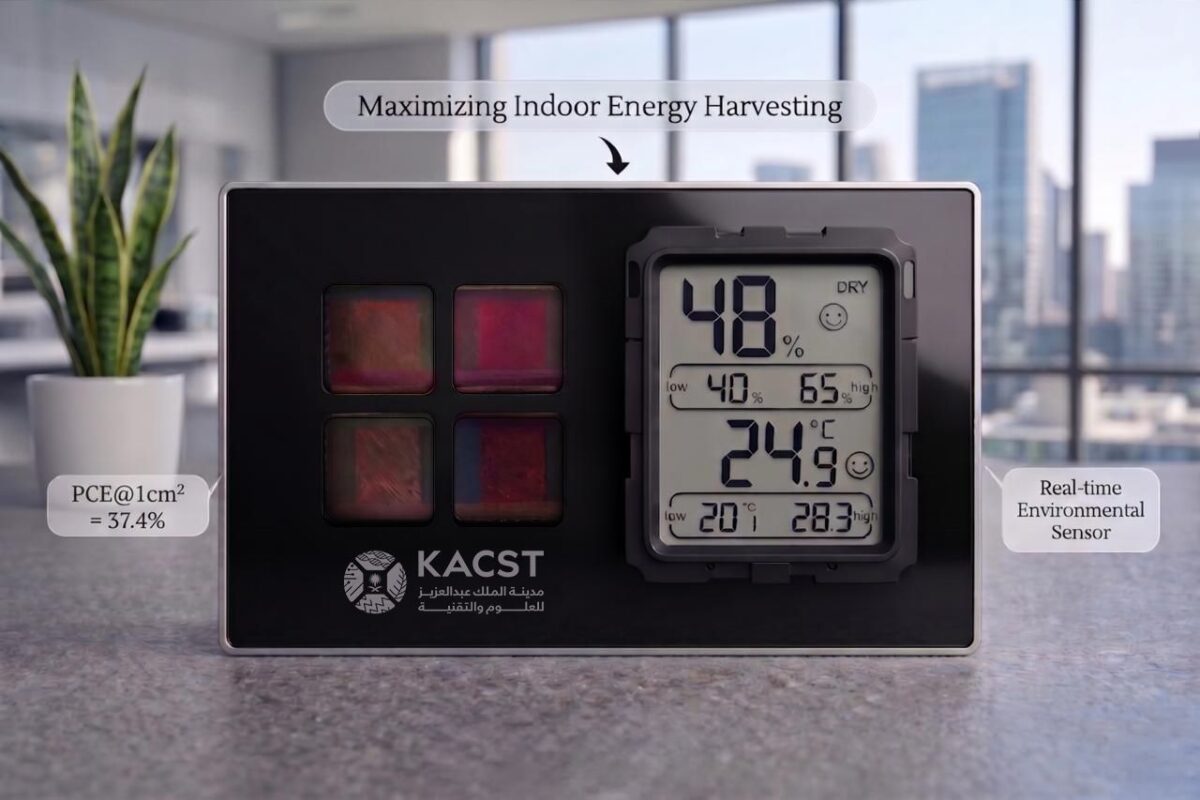
An international research team has improved the performance of indoor perovskite photovoltaics by tuning the absorber bandgap to better match the emission spectrum of indoor LED lighting. The approach enables improved spectral alignment under low-light conditions, with devices showing efficiency of up to 37.44%, in addition to long-term stability of more than 2,000 hours.
An international research team claims to have improved the performance of perovskite indoor solar photovoltaics (PIPV) by tailoring the band gap of the perovskite material to the typical operational conditions of indoor LED lighting.
Tuning the perovskite bandgap is critical in this context, as it allows better spectral matching with the narrow, lower intensity emission spectrum of indoor LED lighting, maximizing photon harvesting and device efficiency in low light conditions.
“This study provides a decisive shift in the field of indoor solar photovoltaics by going beyond conventional outdoor optimization paradigms and establishing a bandgap-by-design framework specifically tailored to indoor lighting,” said corresponding author Essa A. Alharbi. pv magazine. “Through precise composition engineering of methylammonium-free CsₓFA₁₋ₓPb(I₁₋yBry)₃ perovskites, we directly couple the absorber band gap to spectral matching under realistic white LED conditions (3,000–5,500 K, 250–1,000 lux).”
“The work goes beyond proof-of-concept devices by demonstrating high efficiency in a scalable mesoscopic nip architecture with an active area of 1 cm², in addition to operational stability of more than 2,000 hours under indoor lighting,” he added. “This combination of spectral optimization, scalability and sustainability provides a practical blueprint for the next generation of PIPVs.”
Three devices were fabricated using a conventional mesoscopic nip architecture. The structure consists of a fluorine-doped tin oxide (FTO) transparent conductive substrate, followed by compact titanium oxide (c-TiO₂) and mesoporous TiO₂ (m-TiO₂) electron transport layers. The perovskite absorber was deposited on top of the mesoporous scaffold and a Spiro-OMeTAD layer was used as the hole transport material. The stack is completed with a thermally evaporated gold (Au) back contact.
In all devices, only the composition of the perovskite absorber was changed by adjusting the iodide-to-bromide (I/Br) ratio, which controls the band gap and improves the match with indoor LED spectra. The first device used FA₀.90Cs₀.10Pb(I₀.98Br₀.02)₃, with only 2% bromide, giving a band gap of 1.55 eV. The second used FA₀.85Cs₀.15Pb(I₀.55Br₀.45)₃, with 45% bromide, resulting in a band gap of 1.72 eV. The third used FA₀.85Cs₀.15Pb(I₀.15Br₀.85)₃, with 85% bromide, producing the largest band gap of 1.88 eV.
Each of the three devices was measured under a range of light intensities and LED color temperatures: 1,000, 500 and 250 lux, and 3,000 K, 4,000 K and 5,500 K, respectively. Performance was evaluated in terms of energy conversion efficiency (PCE), open-circuit voltage (Voc), short-circuit current density (Jsc) and fill factor (FF) using JV measurements under all nine lighting conditions.
In addition, the devices were characterized using photoluminescence (PL) spectroscopy to confirm band gap, X-ray diffraction (XRD) to assess crystal structure and phase purity, scanning electron microscopy (SEM) and atomic force microscopy (AFM) to examine morphology and surface roughness, and long-term stability testing under indoor lighting for up to 2,000 hours.
“The most striking result is the emergence of the 1.72 eV composition as a universal performer, delivering consistently high efficiency over a wide range of light intensities and color temperatures. The reduced sensitivity to spectral variations challenges the conventional expectation that larger band gaps inherently lead to narrow operational windows,” said Alharbi. “Equally noteworthy is the exceptional peak efficiency of 37.44% achieved by the 1.88 eV device under low-intensity illumination (250 lux, 5500 K). Despite known recombination challenges in wide bandgap systems, this result shows that near-perfect spectral alignment outweighs intrinsic material limitations under specific indoor conditions.”
Most notably, the study reveals critical design insight, the researcher said. “There is no single ‘optimal’ bandgap for indoor solar. Instead, device performance is highly dependent on lighting, which exposes a major limitation in current PIPV design strategies and highlights the need for adaptive or application-specific optimization,” he explained.
In conclusion, Alharbi said the next phase of research will focus on one of the key bottlenecks in high-bandgap perovskites: trap-assisted recombination. “Through defect passivation and interface engineering, we aim to unlock the full efficiency potential of >1.8 eV absorbers while maintaining long-term stability under indoor conditions,” he said. “Importantly, the research will move from the laboratory to real-world implementation. We will integrate these devices into functional Internet of Things (IoT) systems, to validate continuous, maintenance-free operation under practical indoor conditions.”
The research work was published in “Bandgap technology for efficient perovskite solar cells under indoor lighting with multiple color temperatures,” in Materials progress. Scientists from King Abdulaziz City for Science and Technology (KACST), King Saud University and Taibah University in Saudi Arabia, as well as Greece Foundation for Research and Technology – Hellas (FORTH)Hellenic Mediterranean University (HMU) and the University of Crete participated in the study.
This content is copyrighted and may not be reused. If you would like to collaborate with us and reuse some of our content, please contact: editors@pv-magazine.com.
