

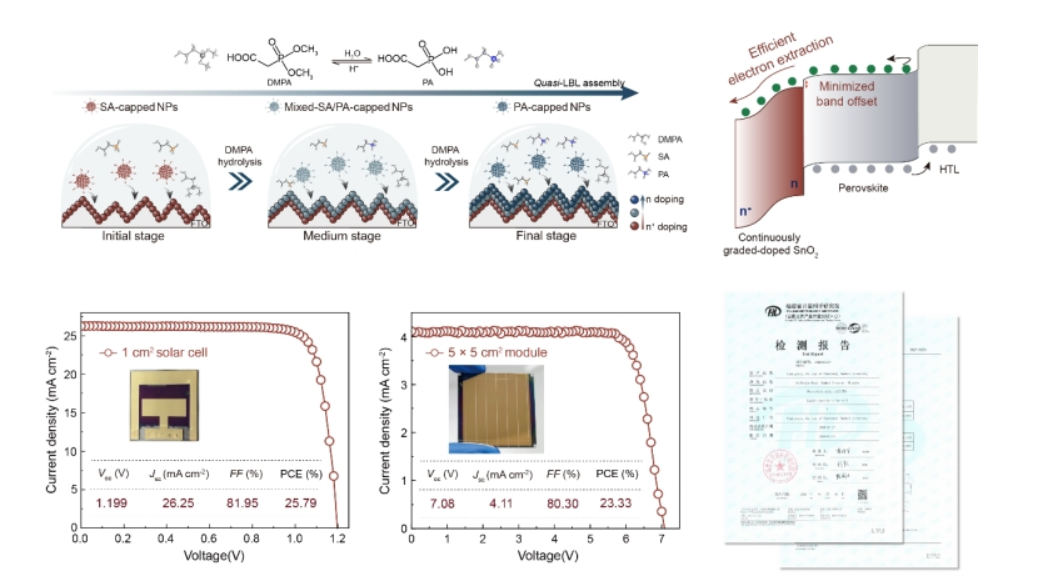
The proposed inverted perovskite solar cell design reduces band misalignment and electron accumulation, suppresses recombination losses, and enables high efficiency in both small-area devices and scalable modules.
Researchers from Nankai University and Beijing Institute of Technology in China claim to have achieved a world record energy conversion efficiency for an inverted architecture perovskite solar cell.
Inverted perovskite cells have a device structure known as “pin”, where hole-selective contact p is at the bottom of the intrinsic perovskite layer i with electron transport layer n at the top. Conventional halide perovskite cells have the same structure, but in reverse: a ‘nip’ arrangement. With nip architecture, the solar cell is illuminated via the electron transport layer (ETL) side; in the pin structure, it is illuminated by the surface of the hole transport layer (HTL).
Although inverted perovskite solar cells have shown rapid efficiency gains in recent years, these devices still lag behind NIP counterparts, due to persistent non-radiative recombination losses that occur at the textured interface between the ETL and the perovskite absorber. “Previous research struggled to identify the physical mechanisms that caused these losses,” the research team explained. “With our work, we have shown that energy band misalignment and electron accumulation at the buried interface work together to accelerate carrier capture and interfacial recombination, ultimately limiting the efficiency of the device.”
The scientists mainly investigated the interaction between an ETL made of tin oxide (SnO₂) and the perovskite interface. They found that lattice mismatch and electron accumulation jointly increase non-radiative recombination, decreasing cell efficiency.
The group then investigated the growth mechanism of chemically bath-deposited SnO₂ films and established links between the ligand chemistry, oxygen vacancy concentration and the energy band structure of the material. Based on these findings, they developed a ‘ligand competition and combination control’ strategy to fabricate a continuously gradient-doped SnO₂ ETL with a transition from a lightly doped region to a heavily doped region.
“This graded architecture simultaneously minimizes band offset and accelerates electron extraction, effectively suppressing cross-interface recombination,” the academics explained, noting that the proposed cell structure successfully transitions from a lightly doped n-region near the perovskite interface to a heavily doped region further away, simultaneously reducing interfacial mismatch and electron accumulation.
Tested under standard lighting conditions, the solar cell achieved a certified energy conversion efficiency of 27.17%, setting a new efficiency record for the inverted device architecture. The device also delivered a reverse scan efficiency of 27.50%, meaning it achieved even higher efficiency when the current-voltage measurement was performed by scanning from high voltage to low voltage. Researchers often report both forward and reverse scan values for perovskite solar cells because the technology can exhibit hysteresis, where measured performance varies depending on scan direction and measurement conditions.
The researchers also achieved an energy conversion efficiency of 25.79% for a 1 cm² single-junction device, indicating that the interface engineering approach remains highly effective at the laboratory scale. They also fabricated a larger perovskite module with an opening area of 16.02 cm², yielding an efficiency of 23.33%.
“Our research has dispelled the long-standing ‘performance fog’ surrounding formal structural devices at the mechanistic level, opening a universal and effective new avenue for the rational design of electron transport layers in inverted perovskite devices,” the academics concluded. “This development is expected to provide technical support for the high stability and scalable production of perovskite photovoltaic modules.”
The new solar cell design was presented in “Continuously doped SnO2 for efficient n – i – p perovskite solar cells”, published in nature.
This content is copyrighted and may not be reused. If you would like to collaborate with us and reuse some of our content, please contact: editors@pv-magazine.com.
