

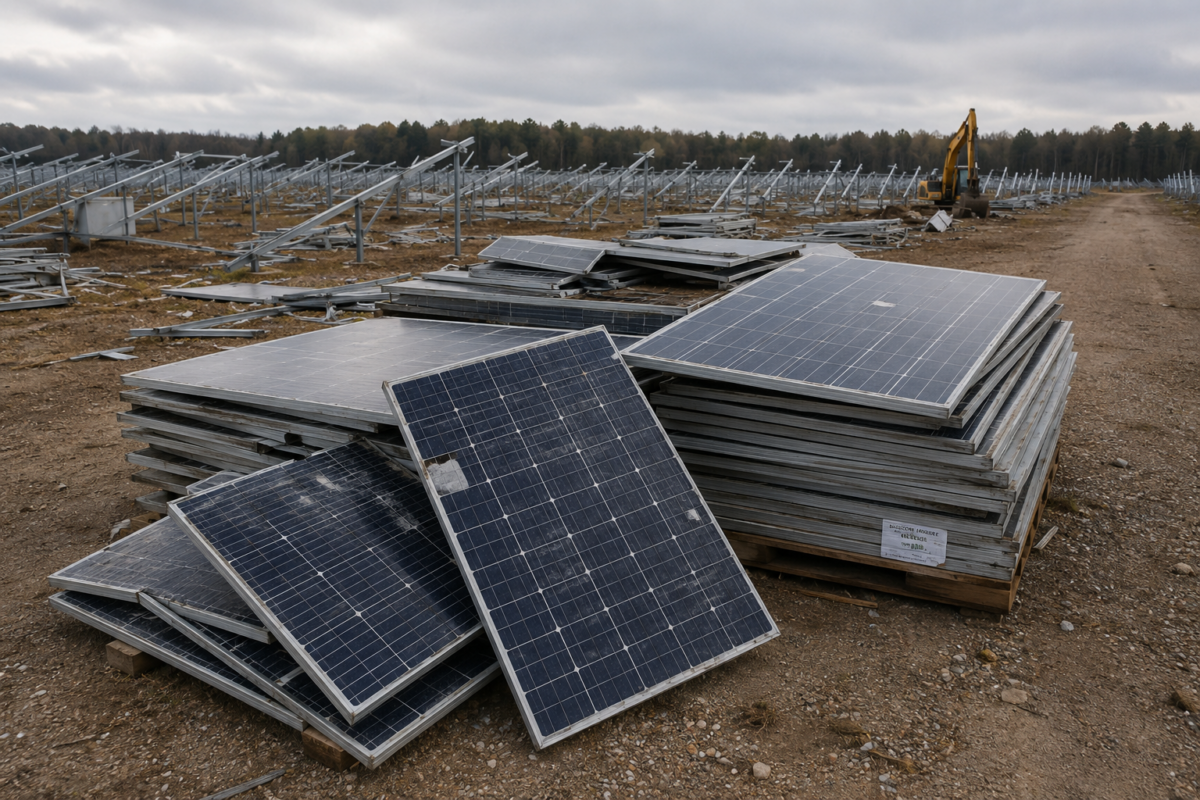
Researchers from TU Wien say binding EU policy targets are essential to make solar panel recycling economically viable, with exports to third countries remaining the cheapest option for member states.
Exporting waste solar panels to third countries will remain the cheapest option for EU member states unless binding targets for recycled content and domestic production are enforced, according to new research from TU Wien.
“Our research identifies the recycling capacity needed to meet legally binding targets at minimal cost, which is a relevant and policy-relevant finding,” the study’s lead author, Sebastian Zwickl-Bernhard, said pv magazine. “However, this does not mean that recycling is economically competitive under market conditions.”
In the study “Capacity planning for solar panel recycling in the EU: optimal country-specific strategies and commodity price sensitivities”, published in Solar energy materials and solar cellsthe researchers modeled cost-optimal recycling strategies for crystalline silicon modules across the European Union under three scenarios: a baseline scenario with no policy restrictions, a scenario with export restrictions based on the EU WEEE Directive, and a full EU policy scenario incorporating the Net-Zero Industry Act (NZIA) and the Critical Raw Materials Act (CRMA).
In the base scenario, all scrap is exported. The introduction of export restrictions – which limit exports to third countries to 15% of waste collected under the WEEE Directive – shifts the dominant treatment option to landfill rather than recycling. Only when the NZIA and CRMA targets are applied will domestic recycling become economically viable.
The cost implications are significant. System-level scrap processing costs increase from €27.5 ($32.0) per tonne in the base case to €383.50 ($446.30) per tonne under the full EU policy scenario. This reflects the infrastructure investments required to meet binding recycled content and domestic sourcing targets.
Italy and Germany emerge as the research’s pioneering recycling markets, each of which will host five large-scale facilities by 2035 under the EU policy scenario. Spain and France are also developing significant capacity, while the Czech Republic only becomes a meaningful recycler under high raw material price scenarios. The analysis shows that there are no small or medium-sized facilities in the cost-optimal solution, but only large-scale factories.
The research shows that temporary stockpiling – storing scrap for later processing rather than immediate treatment – is an important strategy for maintaining facility utilization rates. Scenarios without inventories require 38% more landfill over the modeling horizon as facilities struggle to absorb the irregular inflow of scrap.
Even under the most severe policy scenario, landfilling will remain the dominant treatment option for much of the period to 2035, peaking at 62.6% of annual scrap in 2032. The authors believe that landfill costs will need to rise to around six times current levels before landfilling declines substantially, suggesting that additional fiscal measures such as landfill taxes may be needed to bring outcomes in line with stated policy objectives.
Silver recovery is identified as the key economic driver for the viability of recycling. The model assumes fixed material intensities, which the authors consider a limitation. Decreasing silver content in newer cell architectures could reduce the recoverable value per ton of scrap over time and could lead the study to overestimate the economic attractiveness of recycling for modules that reach end of life in later periods.
“A time frame of less than five years would provide sufficient time to ramp up recycling facilities in Europe,” Zwickl-Bernhard said. “The ideal time frame is determined by factors such as scrap availability. If there is insufficient scrap to achieve a high utilization rate, it is more economical not to recycle. In other words, inventories provide flexibility, resulting in higher facility utilization and lower costs. Strikingly, stockpiling also significantly reduces the need for landfill: scenarios with temporary stocks require much less landfill compared to scenarios without.”
This content is copyrighted and may not be reused. If you would like to collaborate with us and reuse some of our content, please contact: editors@pv-magazine.com.
