

The U.S. solar industry is tracking billions in new factory investments, but upstream bottlenecks and strict trade enforcement are causing active factory production to lag behind the headlines. Solar Energy Industries Association hosted the American Solar and Storage Manufacturing Expo on Capitol Hill, where manufacturers came together to highlight $43.1 billion in announced domestic manufacturing investments since 2022.
The domestic solar production landscape is divided between rising policy milestones and difficult operational realities. The Solar Energy Industries Association organized the US Solar and Storage Manufacturing Expo on Capitol Hill, which brought together manufacturers to highlight $43.1 billion in announced domestic manufacturing investments since 2022.
WData from Mackenzie and InfoLink shows that U.S. module capacity skyrocketed to over 70 GW, a huge jump from just 8 GW before federal manufacturing tax credits took effect.
“American-made solar and storage strengthen our energy security at a crucial time for the country,” said Darren Van’t Hof, interim president and CEO of SEIA. “As global instability underscores the need for reliable, homegrown energy, dozens of manufacturers are investing billions in American factories, workers and supply chains.”
The United States is now a world leader in solar energy production and storage. The US ranks third in the world in solar panel production and second in energy storage system production. The country has been able to do that since last year produces every major part of the solar energy supply chain in your own country.
The figures show that there is sufficient theoretical capacity to meet domestic demand in the short term, but actual production on the factory floor remains well below these figures.
Today, American solar energy production is entering a more demanding phase. The first wave of announcements focused on capacity plans, factory openings and the potential for job creation. The next phase focuses on how production lines are specified, how factories are built and run, how technologies are selected and how the industry defines a credible long-term roadmap.
Designed specifically for the manufacturing side of the industry, Solar Manufacturing USA 2026 brings together the companies building domestic manufacturing, the suppliers enabling factory ramp-ups, the experts benchmarking quality and performance, and the technology voices shaping what comes next.
Market research shows that of the total $43.1 billion in announcements, only $14.5 billion relates to operational facilities. The remainder remains under development, with $22.2 billion in active construction and $6.4 billion in early planning stages. Getting these plants online will require overcoming tough implementation barriers, including long land acquisition timelines, slow local environmental permitting, and longer wait times for grid connections.
Upstream bottleneck
The push for domestic production reveals serious disparities between different steps of the solar supply chain. Although module assembly lines grew rapidly, the upstream components needed to build a solar panel remain scarce in the domestic market.
InfoLink data shows that nominal module capacity reached 73 GW by the end of 2025, but the supporting supply chain is unbalanced:
- Polysilicon: Domestic production from Hemlock Semiconductor and Wacker Chemie remains stable at 40,000 tons, yielding only 21 GW of solar energy production.
- Ingots and Wafers: The active capacity of Hanwha Qcells and Corning produces only 5.3 GW, leaving the rest of the market dependent on imports.
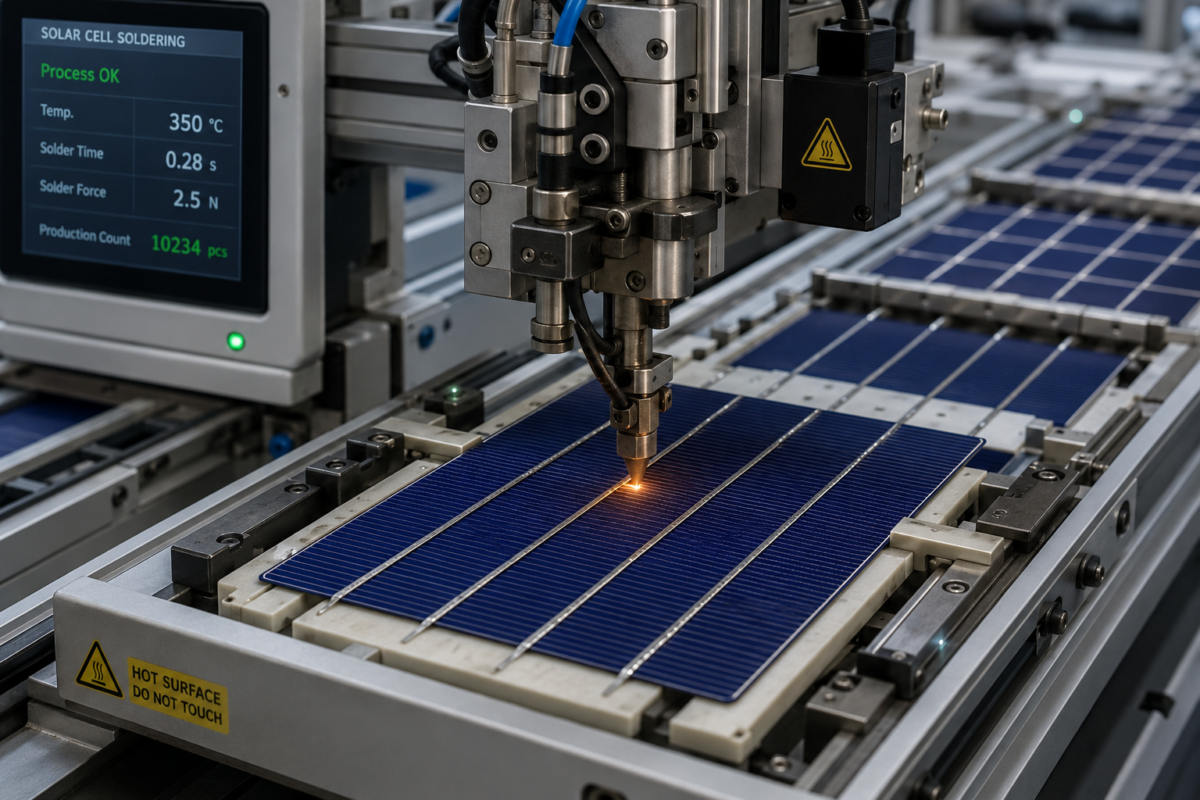
- Solar cells: The production of crystalline silicon cells is only 3 GW. While factories aim to reach 20.5 GW of cell capacity by 2027, the transition from equipment order to commercial production will take 18 to 24 months.
These shortages expose domestic module assemblers to varying trade penalties. The US Department of Commerce has imposed anti-dumping and countervailing duties (AD/CVD) on cell imports from Cambodia, Malaysia, Thailand and Vietnam, while expanding investigations into India, Laos and Indonesia. This situation is forcing module makers to look for cells in alternative locations such as Turkey, Morocco and Kenya to keep their assembly lines running.
Policies are reshaping sourcing
New policy frameworks are changing purchasing choices for developers and manufacturers. Buyers are now focusing heavily on supply chain control and regulatory compliance, rather than just chasing the lowest price per watt.
Strict enforcement of the Uyghur Forced Labor Prevention Act (UFLPA) posed an ongoing operational challenge. U.S. customs officials are holding solar energy components in a high-priority inspection category, causing shipments to be held for extended periods while source documentation is checked. These delays put more strain on project schedules and cash flows than outright component rejections.
At the same time, strict federal rules apply to the lucrative 10% domestic content tax credit. To qualify for the bonus, projects beginning construction must prove that a certain percentage of their total component costs come from U.S. mined, produced or manufactured items. The required domestic content is 50%, increasing to 55% for projects beginning construction.
The 45X Advanced Manufacturing Tax Credit provides a crucial subsidy of $0.07 per watt for U.S.-assembled modules, helping manufacturers navigate tough market conditions. US-made modules sell in the mid to high range of twenty cents per watt, with local production costs often exceeding that market price. This dynamic makes federal tax credits essential to keeping factories profitable.
However, Foreign Enty of Concern (FEOC) guidelines mean that any facility that relies heavily on Chinese components or proprietary technology will lose access to these subsidies. This creates an intellectual property hurdle for domestic cell factories trying to transition to mainstream Tunnel Oxide Passivated Contact (TOPCon) technology, leaving many local lines to instead focus on older passivated emitter rear contact (PERC) production.
Beyond the panel
The implementation challenges of this decade extend beyond silicon wafers and solar cells to include essential system balance equipment and structural components. Utility-scale solar installations require enormous amounts of fabricated steel to build structural tracking systems.
Rising global demand for infrastructure and trade restrictions are creating a tight domestic steel market, extending lead times for piles and torsion tubes. This structural crisis is delaying project completion dates, even as developers secure a stable supply of modules.
The story is similar for heavy electrical infrastructure. The domestic transformer market is facing severe supply constraints, with lead times for critical grid integration hardware reaching up to four years.
As manufacturers walk through the halls of Congress to secure long-term market security, the focus remains strong on structural policy support.
“As demand for electricity increases, solar and storage are essential to providing reliable, low-cost power,” said Dan Shugar, founder and CEO of Nextracker. “Stable policies, predictable permitting, and continued support for domestic production are critical to maintaining America’s energy leadership.”
The solar industry is shifting from a technology-driven market to an industrial-scale race. The final delivery of the project depends on whether the entire production ecosystem can resolve these deep upstream and structural bottlenecks to meet aggregate demand.
This content is copyrighted and may not be reused. If you would like to collaborate with us and reuse some of our content, please contact: editors@pv-magazine.com.
Popular content
