Close Menu
  • News
  • Industry
  • Solar Panels
  • Commercial
  • Residential
  • Finance
  • Technology
  • Carbon Credit
  • More
    • Policy
    • Energy Storage
    • Utility
    • Cummunity
What's Hot

Dutch solar owners asked to switch off during peak periods to ease the distribution crisis

June 7, 2026

The hydrogen flow: Toyota demonstrates its racing prototype on liquid hydrogen

June 7, 2026

Era of electrification exposing Australia’s weakest link

June 6, 2026
Facebook X (Twitter) Instagram
Solar Energy News
Monday, June 8
  • News
  • Industry
  • Solar Panels
  • Commercial
  • Residential
  • Finance
  • Technology
  • Carbon Credit
  • More
    • Policy
    • Energy Storage
    • Utility
    • Cummunity
Solar Energy News
Home - Solar Industry - Global average solar LCOE reached $0.044/kWh in 2023, says IRENA
Solar Industry

Global average solar LCOE reached $0.044/kWh in 2023, says IRENA

solarenergyBy solarenergySeptember 27, 2024No Comments3 Mins Read
Facebook Twitter Pinterest LinkedIn Tumblr Email
Share
Facebook Twitter LinkedIn Pinterest Email

The International Renewable Energy Agency (IRENA) says the result represents a decline of 12% year-on-year. Since the beginning of 2010, this figure has fallen by 90%.

September 27, 2024 Patrick Jowett

According to a report from the International Renewable Energy Agency (IRENA), the globalized weighted average levelized electricity cost (LCOE) of utility-scale solar power plants was $0.044/kWh in 2023.

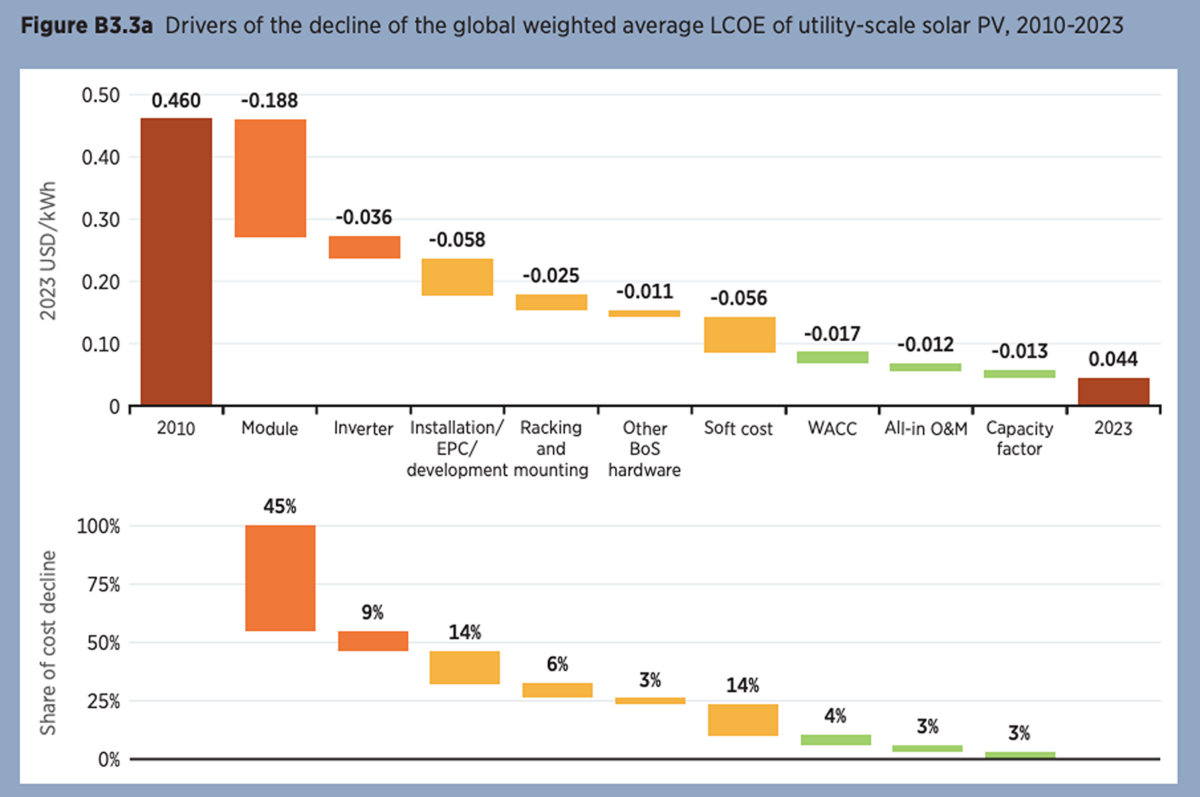
The report says the result represents a 12% year-on-year decline, compared to a 3% year-on-year decline between 2021 and 2022. In 2010, this figure was $0.460/kWh, meaning the weighted average LCOE has fallen by 90% since beginning of the last decade.

IRENA’s report says the “remarkable, sustained and dramatic decline is one of the most compelling stories in the evolution of the power generation sector over the past decade.” It attributes the decline to a rapid decline in installation costs, increasing capacity factors and declining operation and maintenance (O&M) costs.

The decline in solar panel costs would have contributed 45% to the LCOE reduction of utility-scale PV since 2010, with inverters contributing another 9%. Racks, mounting, and other BoS hardware contributed another 9%.

Engineering, procurement and construction costs, installation and development costs and other soft costs accounted for 28% of the LCOE decline, IRENA says, while the remainder of the reduction was attributed to improved financing conditions as markets matured, O&M costs and a higher global weighted average capacity factor, driven by a shift to sunnier markets.

Analysis of selected countries where historical data is available shows that the weighted average LCOE of utility-scale solar fell by 76%, as in the US, to 93%, as in Australia and the Republic of Korea, between 2010 and 2023.

See also  Fischer launches clamp-free mounting system for facade PV systems

The lowest weighted average LCOEs in 2023 were recorded in Australia ($0.034/kWh) and China ($0.036/kWh), with the latter experiencing a 14% year-on-year decline.

The US had a weighted average LCOE of $0.057/kWh for solar in 2023, down 3% year-over-year and 33% above the global weighted average. The Netherlands saw the largest year-on-year decline last year, with a decline of $0.059/kWh in 2023, a decline of 35%.

India’s LCOE rose 26% to $0.048/kWh in 2023, which was the fourth most competitive cost of the year, according to IRENA. Greece had the largest LCOE increase of the countries analyzed, at 42%, followed by Canada (36%) and Germany (28%).

IRENA’s report also highlights that the cost of crystalline solar panels sold in Europe fell by 93% between December 2009 and December 2023.

Meanwhile, the global capacity-weighted average of total installed costs of projects commissioned in 2023 was $758/kW, 86% lower than in 2010 and 17% lower than in 2022.

IRENA also found that the global weighted average capacity factor for new utility-scale solar increased from 13.8% in 2010 to 16.2% in 2023.

“This change is the result of the combined effect of changing inverter load ratios, a shift in average market irradiance and the increased use of trackers – largely driven by the increased adoption of bifacial technologies – which are driving the use of solar energy at more latitudes possible,” the report said.

This content is copyrighted and may not be reused. If you would like to collaborate with us and reuse some of our content, please contact: editors@pv-magazine.com.

See also  Finetuning 2D Dion-Jacobson Perovskites for Fotovoltaic applications

Popular content

Source link

0.044kWh average global IRENA LCOE reached solar
Share. Facebook Twitter Pinterest LinkedIn Tumblr Email
solarenergy
  • Website

Related Posts

Dutch solar owners asked to switch off during peak periods to ease the distribution crisis

June 7, 2026

Letter from China’s PV Industry: Arctech wins 2.1 GW solar deal

June 5, 2026

ComEd starts a new energy pilot with a solar rebate on the roof of a brewery

June 5, 2026
Leave A Reply Cancel Reply

Don't Miss
Commercial & Industrial

Classical radio station orchestrates construction of 89-kW solar project

By solarenergyMay 24, 20240

KMFA Classical 89.5, a classical radio station from Austin, Texas, invested in an 89.64-kWDC rooftop…

Chinese silicon giants have cut production, adding to price concerns – SPE

December 30, 2024

Lion Storage obtains permit for 1.5 GWh battery project in the Netherlands – SPE

June 26, 2024

Ford launches battery storage company and repurposes electric vehicle production capacity – SPE

December 16, 2025
Stay In Touch
  • Facebook
  • Twitter
  • Pinterest
  • Instagram
  • YouTube
  • Vimeo
Our Picks

Dutch solar owners asked to switch off during peak periods to ease the distribution crisis

June 7, 2026

The hydrogen flow: Toyota demonstrates its racing prototype on liquid hydrogen

June 7, 2026

Era of electrification exposing Australia’s weakest link

June 6, 2026

‘Come out from behind your screen, our industry is ultimately about people’

June 6, 2026
Our Picks

Dutch solar owners asked to switch off during peak periods to ease the distribution crisis

June 7, 2026

The hydrogen flow: Toyota demonstrates its racing prototype on liquid hydrogen

June 7, 2026

Era of electrification exposing Australia’s weakest link

June 6, 2026
About
About

Stay updated with the latest in solar energy. Discover innovations, trends, policies, and market insights driving the future of sustainable power worldwide.

Subscribe to Updates

Get the latest creative news and updates about Solar industry directly in your inbox!

Facebook X (Twitter) Instagram Pinterest
  • Contact
  • Privacy Policy
  • Terms & Conditions
© 2026 Tsolarenergynews.co - All rights reserved.

Type above and press Enter to search. Press Esc to cancel.