

James Wakelin, head of sustainability at storage provider Indurent, examines the case for commercial and industrial solar installations, as well as the remaining barriers to widespread adoption.
Recent events have reinforced something that British industry is increasingly familiar with: energy costs are unpredictable.
Over the past year, energy markets have seen sharp moves, driven by a combination of geopolitical events, supply constraints and shifting demand. The numbers tell the story. Wholesale natural gas prices increased by approximately 75% between the end of February and the end of March 20261. For a mid-sized manufacturer or logistics provider with tight margins, fluctuations of that magnitude can have a significant impact.
The question is not whether energy insecurity matters to businesses, but how quickly companies can reduce their exposure to it – and what tools they have available to do so.
British companies remain vulnerable
Britain remains a net importer of energy, with exposure to global energy markets and the international supply chains that support them – a dynamic that reflected in the cost of each kilowatt hour drawn from the grid. For industries such as warehousing, logistics, e-commerce and distribution, price changes can flow through supply chains and ultimately to consumers.
While government support can ease pressures in the short term, building greater resilience over time will likely require a combination of national policies and action from the business community itself.
Industrial roofs are part of the answer
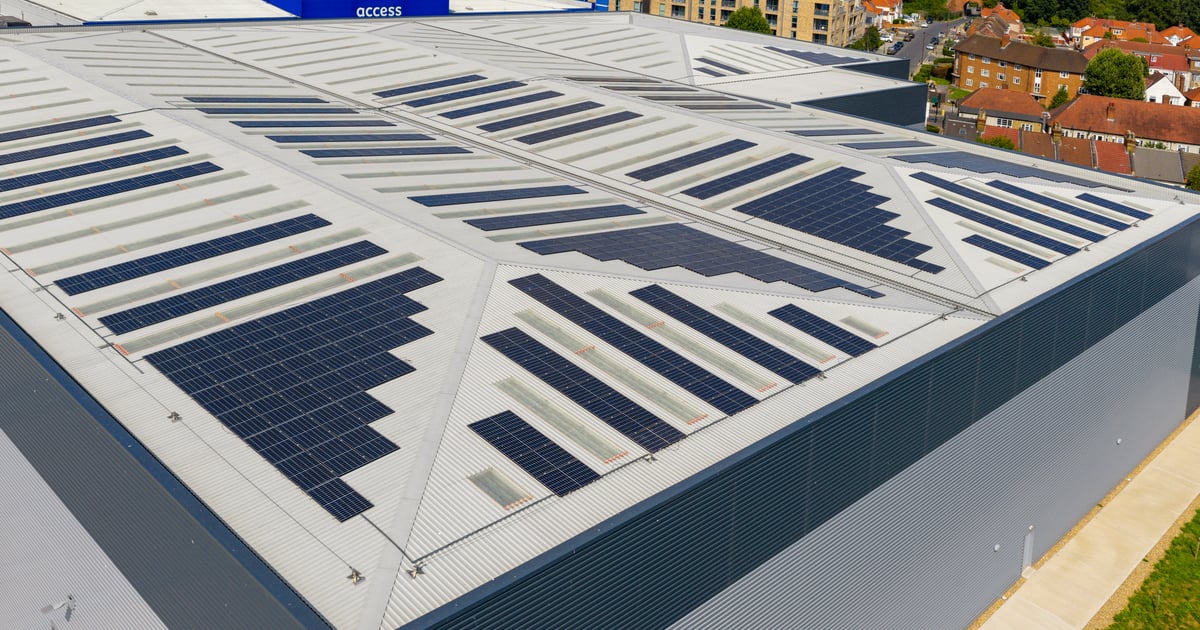
Britain’s commercial roof project represents an important and often overlooked energy opportunity: vast, flat and already connected to the businesses that would consume the power. Unlike ground-mounted solar, it does not compete for land, and unlike offshore wind, it can be built one system at a time.
Research consistently shows that even a fraction of fully utilized rooftops could provide double-digit gigawatts of generation capacity – a meaningful contribution to national demand exactly where it is needed.
This reflects a broader global shift. The IEA’s Global Energy Review 2026 shows that solar energy was responsible for more than a quarter of demand growth last year – the largest source for the first time – underscoring its rapidly increasing role in energy systems worldwide.
Industrial and logistics landlords and developers therefore play a crucial role. Rooftop solar should no longer be treated as an optional retrofit or add-on, but as a standard part of modern industrial development.
At Indurent, solar energy on roofs is increasingly being included in new projects from the start. We are on track to deliver approximately 20 MWp of installed capacity by the end of this year, with the potential to exceed 250 MWp in our portfolio in the long term. That would be approximately equivalent to powering 6,500 households, generating approximately 210 GWh of electricity per year. At current energy prices that equates to around £35-£40 million worth of electricity per year.
The wider opportunities in the UK industrial sector are significantly greater.
This is about costs, control and security – not just sustainability
The economics of rooftop solar energy speak for themselves.
The systems pay back, they pay back quickly, and they keep paying. Rooftop solar can deliver immediate, measurable savings: across our portfolio, customers using on-site generation have achieved at least a 10% reduction in electricity costs, with further increases possible if wholesale prices remain high.
The underlying economics have also changed. The fully installed cost of commercial solar has fallen by approximately 70% over the past decade, and rooftop systems can now typically provide power much more cost-effectively over its entire life cycle than the equivalent power from the grid.
Used strategically, solar energy acts as a financial hedge. Landlords can support customers with greater price visibility and resilience, while both SMEs and large corporations benefit from a more predictable basis for long-term planning.
In a market where energy costs can change quickly, that predictability can become a competitive advantage.
Policy must now catch up with market reality
None of this means the path is frictionless. Real barriers remain, from insurance complexities and grid connection delays to planning processes that have not always kept pace with technology.
However, these challenges are becoming better understood and in many cases can be addressed. The technology is proven, financing is widely available and industry interest continues to grow.
What is needed now is greater coordination. Landlords, developers and users all have a role to play in moving rooftop solar from the exception to the norm. They share the benefits, share the risk and treat every new plan as an opportunity to improve asset performance and support users’ needs over the long term.
The government also has a crucial role to play in accelerating adoption. Targeted measures, including lower business rates for commercial properties installing rooftop solar, could encourage further adoption and stimulate substantial private sector investment. At the same time, providing clearer frameworks and support for local and community energy solutions could support landlords to maximize the potential of rooftop solar generation.
Although these are relatively small levers, they can have a disproportionate impact. Such incentives would send a clear signal that energy resilience is not only an environmental ambition, but also a national economic priority. Ultimately, it is no longer just about decarbonizing the economy. It is about improving competitiveness, strengthening resilience and supporting long-term economic security.
