

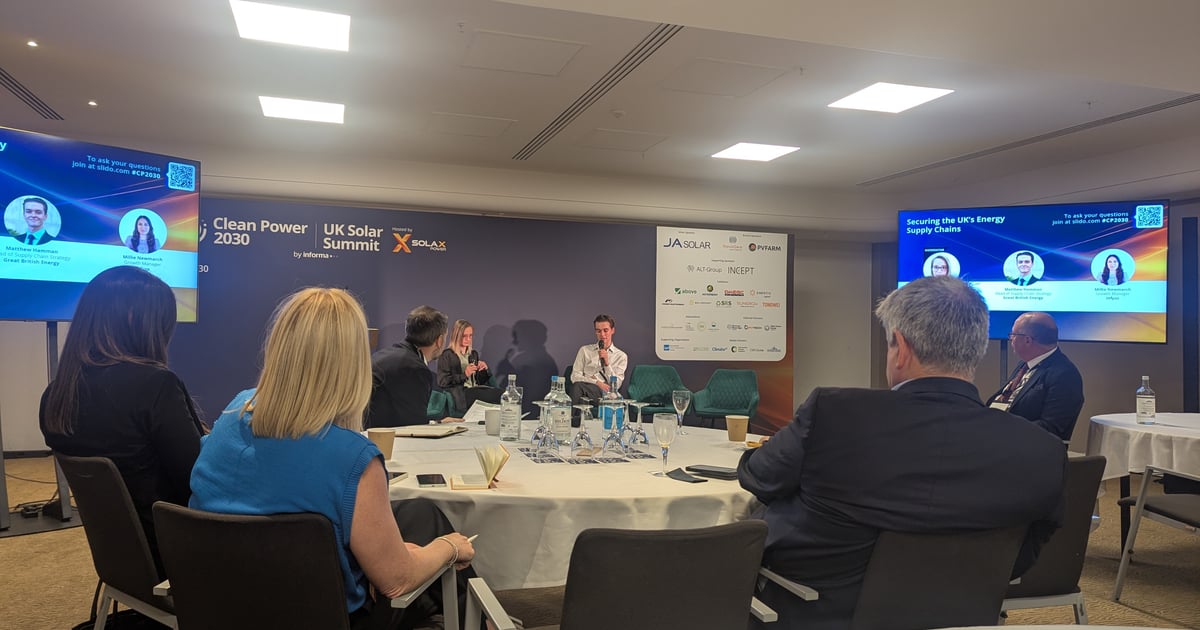
Making the energy transition more ‘tangible’ is a key metric against which the success of strengthening the UK’s clean energy supply chains can be judged.
Strengthening the UK’s clean energy supply chains is a key part of the Clean Power 2030 plan, which was reviewed this morning by DESNZ’s Ben Golding during Solar Media’s Clean Power 2030 Summit. The event is currently taking place in London and Mollie McCorkindale from Solar Media Market Research today spoke to Matthew Hamman, head of supply chain strategy at Great British Energy, about the topic.
Hamman said delivering tangible benefits is an important part of efforts to reduce Britain’s dependence on imports of critical minerals and rare components as part of the energy transition.
“Unless you supply significantly cheaper electricity, people don’t really care where their electricity comes from,” says Hamman. “But if you can build an industry around these sectors… the energy transition becomes more tangible and can deliver real economic benefits for communities.”
For the solar sector in particular, building these industries will most likely take place in what Hamman described as “disruptive technologies.”
“You need to identify areas where Britain can be competitive, and often that is in slightly more disruptive technologies,” he explained. “We are not going to bring solar energy production to our country… however, there are new British companies doing interesting things with perovskite. There are areas in Britain where we have high concentrations of British intellectual property and disruptive technology.”
Although he didn’t mention the company by name, Hamman is likely talking about Oxford PV, the UK-based perovskite specialist that has long been a leader in the European perovskite space; ahead of this year’s Intersolar Europe event, the company announced a new tandem cell, developed in collaboration with the German testing house Fraunhofer ISE.
Beyond ‘Chinese cells in European packaging’
However, McCorkindale noted that there is a difference between building a part completely locally and putting the finishing touches on a product that was sourced and assembled in another country. She criticized the idea that European solar would rely on “Chinese cells in European packaging,” with “Chinese OEMs setting up collection points in Europe and developers thinking they have domestic supply chains.”
Hamman said British businesses must be “realistic” about what is achievable within the country’s borders, both in terms of the opportunities and constraints imposed by the country’s geological and geographical features, but also in terms of Britain’s place in global clean energy supply chains; he called for better cooperation between different parts of the UK’s clean energy supply chain than currently exists.
“We must marry industrial policy with our energy policy, and our energy policy must marry with our research and development (R&D) policy,” he said. “They need to talk to each other.”
McCorkindale cited the European PV inverter sector as an example of how this alignment can deliver tangible benefits. Figures from Solar Media Market Research show that Europe surpassed 100 GW of inverter production capacity earlier this year, and McCorkindale spoke to our colleagues from PV technology about this research earlier this monthand said today that this milestone “proves that localization can work in some areas”.
