

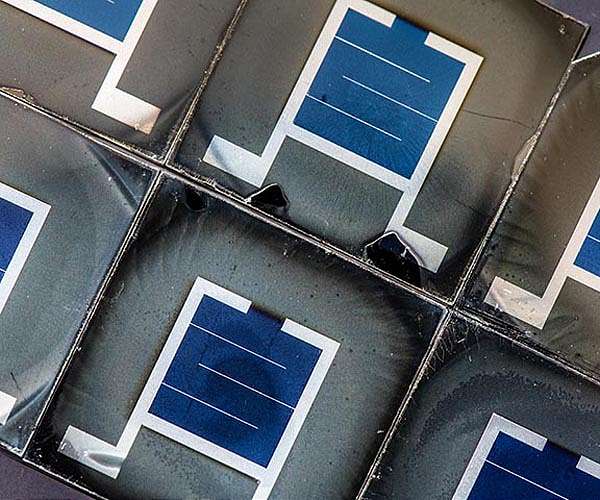
New organic tandem solar cell with four terminals achieves an energy conversion efficiency of 16.94%
ICFO researchers have fabricated a new four-terminal organic solar cell with a tandem configuration with an energy conversion efficiency (PCE) of 16.94%. The new device consists of a highly transparent front cell containing a transparent ultra-thin silver (Ag) electrode of only 7 nm, which ensures efficient operation.
Organic dual-terminal solar cells (OSCs) represent one of the most promising approaches to address the transmission and thermalization losses in single-junction solar cells. These organic solar cells consist of front and rear subcells with varying band gaps, allowing broader absorption and use of the solar spectrum. However, achieving optimal performance in such configurations requires sufficient power balance between the two subcells. Moreover, manufacturing organic tandem solar cells of this type is challenging because they require a robust interconnect layer capable of facilitating efficient charge recombination while maintaining high transparency.
The four-terminal tandem configuration has emerged as a highly efficient alternative strategy in solar cell design. Unlike the two-terminal approach, this configuration features separate electrical connections for the transparent front cell and the opaque back cell. Consequently, the issue of electrical current adjustment is no longer a limiting factor. This arrangement allows greater flexibility in selecting the band gaps of each cell of the tandem, optimizing photon absorption and improving the overall efficiency of solar energy production.
Now, ICFO researchers Francisco Bernal-Texca and Prof. Jordi Martorell describe in a new study published in the Journal Solar RRL the fabrication of a four-terminal organic tandem solar cell that achieved an energy conversion efficiency (PCE) of 16.94% . Central to this achievement is the fabrication of an ultra-thin transparent silver electrode, a crucial component that played a crucial role in optimizing the performance of the tandem solar cell.
To fabricate the new device, the researchers first examined the organic materials intended for the photoactive layer of both cells. They examined the effectiveness of three different mixtures for the front cell, which is designed to collect the high-energy photons. Ultimately, the blend that performed best was chosen, called PM6:L8-BO. For the rear opaque cell, the researchers decided to use the PTB7-Th:O6T-4F mixture, which has a narrow bandgap, making it better suited to absorb the infrared part of the spectrum (low-energy photons).
After choosing the mixtures, the researchers used a numerical approach to design the final structure of the four-tandem OSC. They used the matrix formalism combined with the conventional inverse problem solving methodology to find the optimal performance and final configuration of the solar energy device.
The fabrication of an ultra-thin transparent silver electrode with a thickness of only 7 nm was the key ingredient in the current research. This element was placed at the back of the front cell, allowing good light transmission to power the rear cell. Conventional top Ag electrodes used for transparent solar cell applications typically range in thickness from 9 to 15 nm.
Its production required careful control of laboratory conditions to ensure precision and consistency. The electrode was then stacked with three dielectric layers, alternating between tungsten trioxide (WO3) and lithium fluoride (LiF). This photonic multilayer structure plays a crucial role, as it is positioned between the two cells to allow efficient and uniform light distribution. “This structure exhibits high transmittance in the range of 750-1000 nm and high reflectivity in the range of 500-700 nm,” researchers wrote.
“The development of a transparent silver intermediate electrode is crucial for the efficient operation of the solar cell. This must provide a delicate balance, being transparent enough to allow light to reach the rear cell while maintaining high electrical conductivity to ensure optimal solar cell performance. front cell,” says Francisco Bernal, ICFO researcher and first author of the study. “Being able to fabricate an electrode as small as 7 nm without seeing losses in the front transparent cells is a significant advance in the field of transparent cells.”
The researchers tested the device’s photovoltaic performance under 1 sun illumination with a solar simulator and measured its quantum efficiency. The device achieved an energy conversion efficiency of 16.94%, which would be the highest achieved for a four-terminal organic tandem cell to date. The study authors note that the current official record in efficiency for organic tandems is 14.2% and the last reported PCE for 4-terminal organic tandems is 6.5%.
“Our research includes potential applications in photoelectrochemical cells (PEC), addressing critical electrical requirements such as providing the necessary voltage to exceed existing voltage to drive water splitting or CO2 reduction reactions such as in the SOREC2 project “, explains Prof. Jordi Martorell, researcher at ICFO and SOREC2 project coordinator. “The methodology for the design and implementation of the four-terminal tandem structure could be applied to the design of news systems where adequate distribution of light in the elements is critical to the performance of a given device.”
The researchers are currently turning their focus to refining, tuning and improving the methodology and structural design tailored to applications such as solar fuels, where tandem devices have widespread applicability. By optimizing methodology and design strategies, researchers aim to unlock the full potential of these devices in harnessing solar energy for diverse and sustainable energy conversion processes, such as CO2 conversion and valorization.
Research report:Tandem with four connections, based on a PM6:L8-BO transparent solar cell and a 7nm Ag Layer intermediate electrode
