
Close Menu
  • News
  • Industry
  • Solar Panels
  • Commercial
  • Residential
  • Finance
  • Technology
  • Carbon Credit
  • More
    • Policy
    • Energy Storage
    • Utility
    • Cummunity
What's Hot

The UK government has urged to ensure that plug-in solar is properly regulated

July 22, 2026

Cornwall Insight cuts price ceiling forecast after Burnham’s VAT cut

July 22, 2026

SmartestEnergy, Greentech ink CfD PPA for the Kent solar project

July 22, 2026
Facebook X (Twitter) Instagram
Solar Energy News
Thursday, July 23
  • News
  • Industry
  • Solar Panels
  • Commercial
  • Residential
  • Finance
  • Technology
  • Carbon Credit
  • More
    • Policy
    • Energy Storage
    • Utility
    • Cummunity
Solar Energy News
Home - Technology - The sodium ion battery can be charged in seconds
Technology

The sodium ion battery can be charged in seconds

solarenergyBy solarenergyApril 25, 2024No Comments3 Mins Read
Facebook Twitter Pinterest LinkedIn Tumblr Email
Share
Facebook Twitter LinkedIn Pinterest Email

Researchers at the Korea Advanced Institute of Science and Technology (KAIST) have identified a high-energy, high-performance hybrid sodium-ion battery that can be charged in just seconds. The system integrates anode materials typically used in batteries with cathodes suitable for supercapacitors.

April 25, 2024 Marija Maisch

Sodium-ion energy storage systems have received considerable attention due to their superior safety, raw material costs, and environmental performance compared to ubiquitous lithium-ion batteries. However, the technology is unlikely to challenge the incumbent until costs are reduced by improving technical performance, establishing supply chains and achieving economies of scale.

There are two types of sodium-ion energy storage systems: sodium-ion batteries and sodium-ion capacitors. The former are hampered by their poor rechargeability due to their low power density, while offering relatively high energy density. The latter, on the other hand, exhibit a high power density, but an extremely low energy density. Therefore, combining capacitor-type cathodes and battery-type anodes in SIHES (sodium-ion hybrid energy storage) cells has been an active area of ​​research, bringing together the best of both worlds.

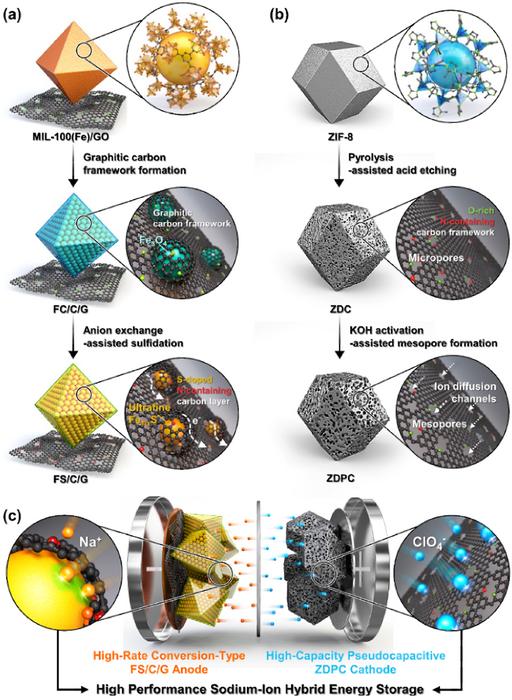
Now KAIST researchers have reported a strategy to realize ultra-high energy density SIHES systems and fast-charging systems. They have used two different metal-organic frameworks for the optimized synthesis of hybrid batteries.

Their approach led to the development of an anode material with improved kinetics through the incorporation of fine active materials into porous carbon derived from metal-organic frameworks. Furthermore, a high-capacity cathode material was synthesized, and the combination of the cathode and anode materials enabled the development of a SIHES system, optimizing the balance and minimizing the differences in energy storage rates between the electrodes.

See also  Battery fire shuts down California highway – SPE

The researchers reported that the newly developed hybrid exceeds the energy density of commercial lithium-ion batteries and exhibits the power density characteristics of supercapacitors.

In fact, the SIHES showed an energy density of 247 Wh/kg and a fast-charging power density of 34,748 W/kg, which exceeded the battery-type responses by more than 100 times. It also demonstrated cycle stability with a Coulomb efficiency of approximately 100% over 5,000 charge-discharge cycles.

The KAIST researchers expect broad applications for their new SIHES technology, ranging from electric vehicles to smart electronic devices and space technologies.

They discussed their findings in “Low Crystallinity Conductive Multivalency Iron Sulfide Embedded S-Doped Anode and Large Area O-Doped Cathode of 3D Porous N-rich Graphitic Carbon Frameworks for High-Performance Sodium-ion Hybrid Energy Storage,” which was recently published in Energy storage materials.

This content is copyrighted and may not be reused. If you would like to collaborate with us and reuse some of our content, please contact: editors@pv-magazine.com.

Source link

battery charged ion seconds sodium
Share. Facebook Twitter Pinterest LinkedIn Tumblr Email
solarenergy
  • Website

Related Posts

Scales of sodium storage

July 21, 2026

Financial close of Fidra Energy’s 500MW battery energy storage

July 20, 2026

Battery storage developers win 81% of planning applications in England

July 17, 2026
Leave A Reply Cancel Reply

Don't Miss
Solar Industry

Clickcon launches Solar PV -Hek for residential, commercial sites

By solarenergySeptember 26, 20250

The German mounting system specialist has developed a new vertical system mounted system that is…

Almost every state was actively pursuing a solar policy by 2025

January 22, 2026

Spain approves new decree to accelerate storage and network modernization – SPE

November 5, 2025

The warming effect of PV on land surface temperature – SPE

May 10, 2024
Stay In Touch
  • Facebook
  • Twitter
  • Pinterest
  • Instagram
  • YouTube
  • Vimeo
Our Picks

The UK government has urged to ensure that plug-in solar is properly regulated

July 22, 2026

Cornwall Insight cuts price ceiling forecast after Burnham’s VAT cut

July 22, 2026

SmartestEnergy, Greentech ink CfD PPA for the Kent solar project

July 22, 2026

Flexibility as an asset

July 22, 2026
Our Picks

The UK government has urged to ensure that plug-in solar is properly regulated

July 22, 2026

Cornwall Insight cuts price ceiling forecast after Burnham’s VAT cut

July 22, 2026

SmartestEnergy, Greentech ink CfD PPA for the Kent solar project

July 22, 2026
About
About

Stay updated with the latest in solar energy. Discover innovations, trends, policies, and market insights driving the future of sustainable power worldwide.

Subscribe to Updates

Get the latest creative news and updates about Solar industry directly in your inbox!

Facebook X (Twitter) Instagram Pinterest
  • Contact
  • Privacy Policy
  • Terms & Conditions
© 2026 Tsolarenergynews.co - All rights reserved.

Type above and press Enter to search. Press Esc to cancel.