

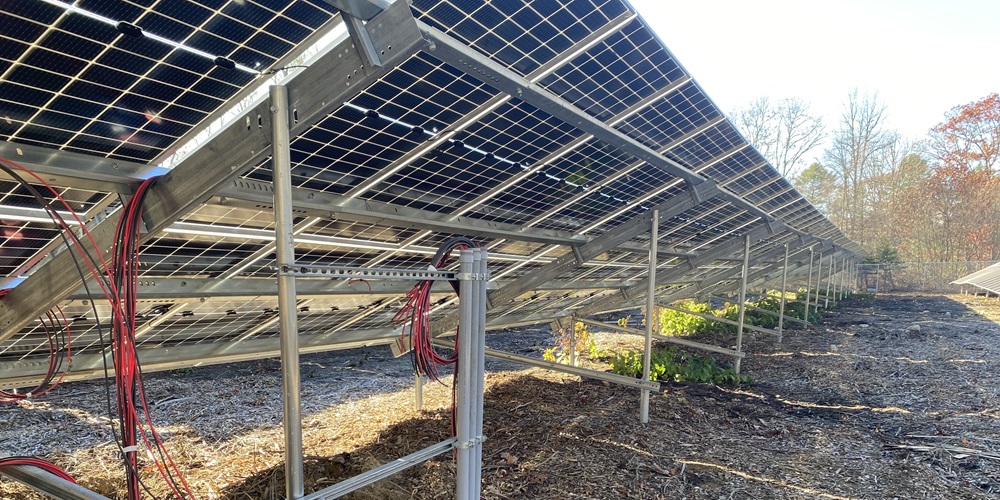
The Office of the President has shifted its focus on solar panels, announcing the elimination of the bifacial solar panel Section 301 tariff exclusion and addressing issues of stockpiling during trade, in addition to advancing the country’s manufacturing base.
The Biden administration has released a fact sheet detailing several solar policy measures, including the elimination of the dual-sided solar panel exemption. This exemption previously allowed certain solar panels to avoid the Trump-era 15% tariff. Reinstating this rate is expected to increase the cost of commercial, industrial and large-scale solar projects by 1% to 2%.
The government also reiterated its focus on the solar energy sector, along with plans to further expand the manufacturing base. This release follows yesterday’s announcement where the government increased import tariffs on Chinese solar cells from 25% to 50%.
At the end of 2022, the The Biden administration imposed tariffs on solar panels from four Southeast Asian countries But postponed its implementation for two years to ensure business continuity. With this delay set to end next month, the White House announced that “the Department of Energy and the Department of Commerce will closely monitor import patterns to ensure that the U.S. market does not become oversaturated” with stockpiles of modules or products that are the result of other unfair practices that could circumvent the ruling.
In response to today’s announcement, Danny O’Brien, President of Corporate Affairs at Qcells, expressed his support: “Today’s announcement is another signal that President Biden is serious about ensuring the long-term success of solar energy production in the United States.”
However, the Solar Energy Manufacturers Association (SEMA) found the action insufficient. “Removing the exemption will reintroduce a 15% tariff, providing important, but unfortunately still insufficient, relief from anti-competitive trade practices until the tariff expires in February 2026.”
SEMA aims to work with the government to ensure that all solar panels from tariff regions in the country are utilized by December 2024. Some estimate that there are currently more than 100 GW of solar panels in stock in the US, where projections of more than 45 GW by the end of 2023.
The fact sheet also indicated that the Treasury Department plans to release additional guidance on the domestic content requirements of the Inflation Reduction Act. It says: “Today’s notice creates a new elective safe harbor that allows clean energy developers to rely on standard cost percentages provided by the Department of Energy to determine bonus eligibility.”
To support the domestic solar panel assembly industry, the limit on solar cell imports will be lowered Section 201 the rates were increased from 5 GW to 7.5 GW. This measure is intended to support the announced 125 GW of production capacity for the assembly of solar modules without hindering the emerging production of solar cells.
Bifacial solar panels, which are mainly used in commercial, industrial and large-scale solar projects, were previously exempt from tariffs. With the elimination of this exemption, the cost of imported bifacial solar panels, which typically range from $0.10-0.25 per watt, will increase by $0.015 to $0.0375 per watt. For commercial projects with installation costs between $1.50 and $2.75 per watt, these increases will result in system price increases of approximately 1-2%. Bifacial panels represent now 98% of all solar panels imported into these sectors.
Due to significant reductions in solar panel prices, which fell from $30-40 per watt two years ago, the impact of these rates remains less severe today. However, the sector continues to face financial uncertainties as the June 2022 tariff deferment nears its end and new AD/CVD cases have recently been filed.
This content is copyrighted and may not be reused. If you would like to collaborate with us and reuse some of our content, please contact: editors@pv-magazine.com.
