

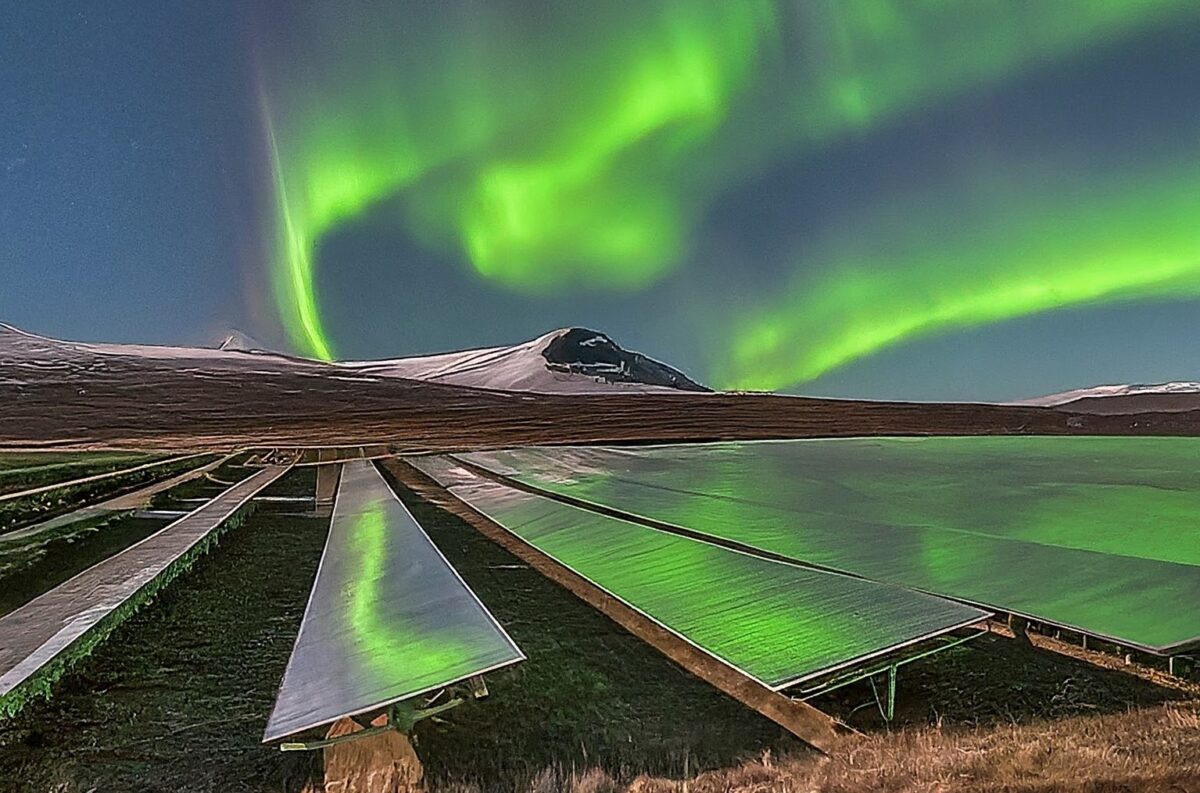
In a new weekly update for pv magazineSolcast, a DNV company, explains that the solar cycle increases Earth’s average annual extraterrestrial radiation, but only by a very small amount. It also explains that while the annual cycle of extraterrestrial radiation produces a steady, predictable and significant change of 3.5% over the seasonal cycle, the peak of the 11-year cycle of solar activity produces a smaller, more sporadic and unpredictable range of solar radiation causes. fluctuations.
The powerful solar storms of May 2024 were a sign of the sun’s increasing activity as it approaches the peak of its eleven-year cycle. These events can disrupt satellites and power grids, highlighting the importance of solar weather monitoring and preparedness.
Predicting solar flares and geomagnetic storms is a challenge. Current technology struggles due to the sun’s constantly changing magnetic field, making it difficult to determine the exact location and intensity of an eruption. However, agencies such as the National Oceanic and Atmospheric Administration (NOAA) in the US and the European Space Agency are working together to monitor solar activity and make predictions based on past observations and real-time data, helping us prepare for potential impacts .
While solar storms are difficult to predict accurately in advance, we do know that this solar cycle is expected to reach its maximum in 2025, meaning more intense solar flares and geomagnetic storms are on the way in the coming months and years.
For solar energy, during strong solar events the potential impacts on electricity grids and the consequences for solar energy technologies such as GPS are very real. Solcast is sometimes asked about the consequences for solar radiation and the production of PV energy. Will we see an increase in insolation at the peak of the 11-year cycle?
The answer is yes, but only slightly. The peak of the solar cycle tends to increase Earth’s average annual extraterrestrial radiation, but only by a very small amount. Extraterrestrial radiation refers to the intensity of sunlight reaching Earth’s upper atmosphere, essentially the amount of solar energy we would receive without any atmospheric interference. This value is often represented by the ‘solar constant’, which has a traditionally accepted average of approximately 1361 W/m². However, this is not a truly constant value. Earth’s orbit around the sun is not perfectly circular, but somewhat elliptical. This means that the distance between the Earth and the Sun varies throughout the year. When Earth is closer to the Sun (perihelion in January), extraterrestrial radiation can peak at about 1410 W/m². Conversely, when the Earth is farthest from the Sun (aphelion in July), the radiant intensity drops to about 1320 W/m². This variation amounts to a roughly 3.5% fluctuation in the intensity of sunlight reaching the top of the atmosphere. This fluctuation is modeled very accurately in the irradiation modeling used by the Solcast APIDNV and other leading organizations in the field of solar energy.
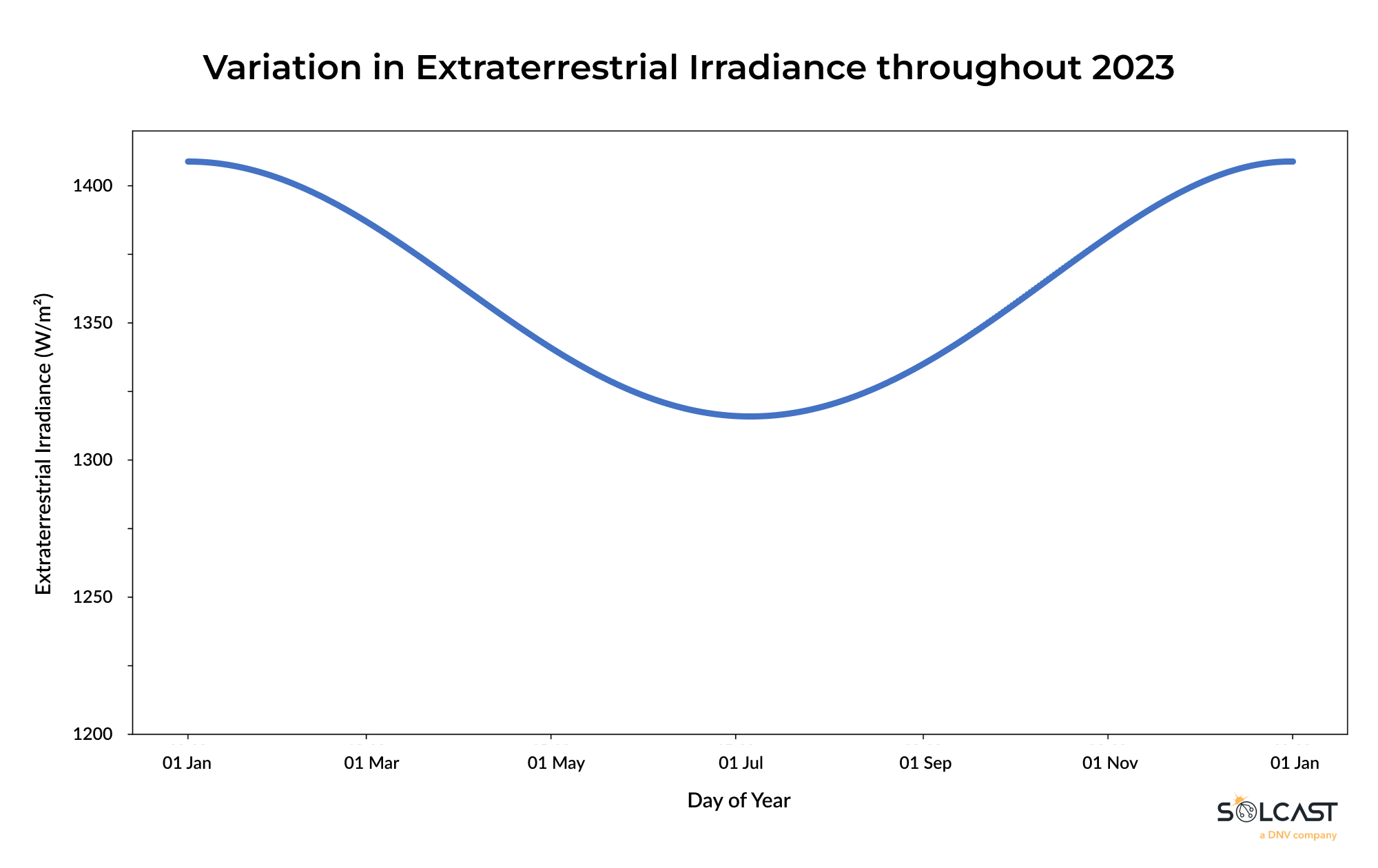
While the annual cycle of extraterrestrial radiation produces a steady, predictable and significant change of 3.5% over the seasonal cycle, the peak of the 11-year cycle of solar activity produces a smaller, more sporadic and unpredictable series of fluctuations.
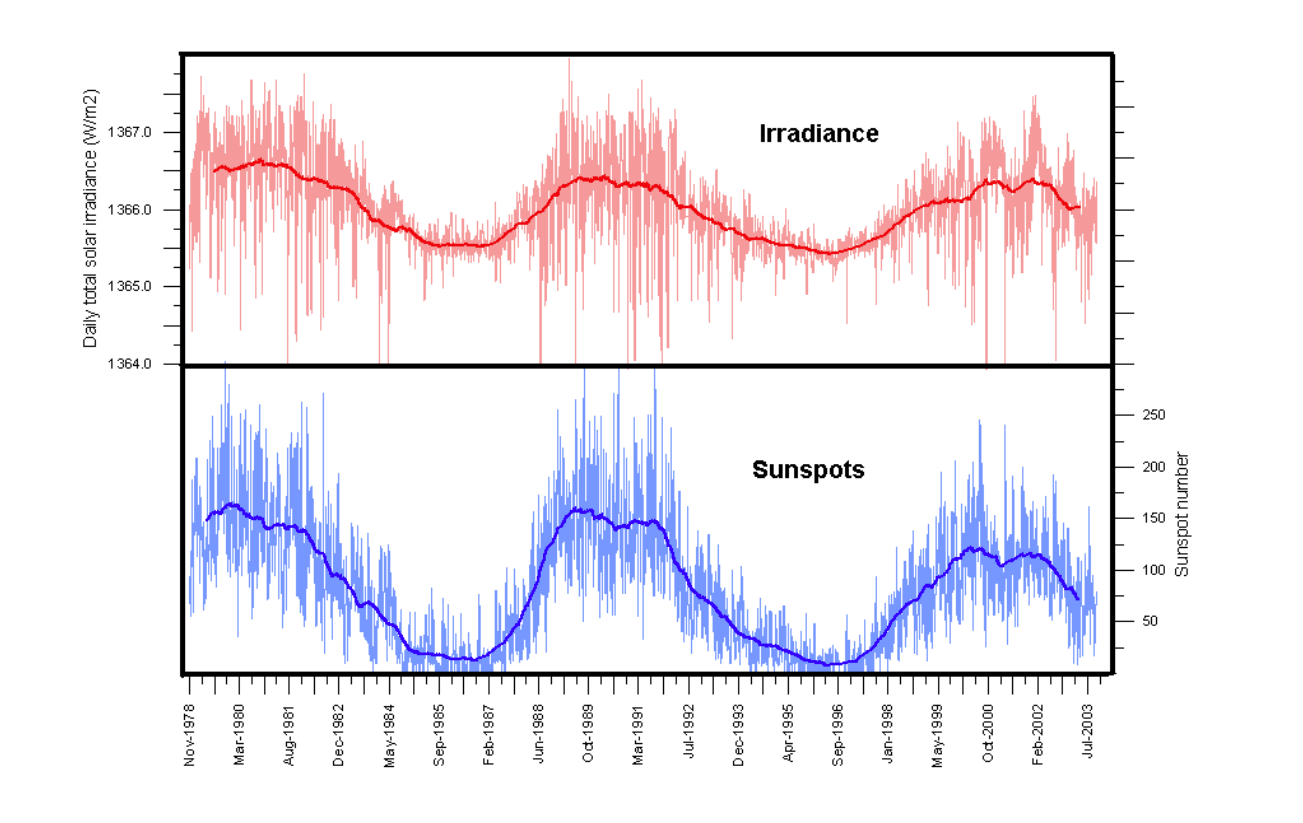
(equivalent to 0.07% clear sky radiation)
Image: NASA
The net result of these increased fluctuations is an increase in extraterrestrial radiation (and therefore the radiation we receive on the ground) of only about 1 W/m² (i.e. only about one-tenth of a percent), averaged over a year. ! The very small magnitude of this effect, together with the random nature of the fluctuations, means that there is little point in even trying to include the effect in solar radiation modeling calculations.
Solcast produces these figures by tracking clouds and aerosols worldwide at a resolution of 1-2 km, using proprietary satellite data AI/ML algorithms. This data is used to drive irradiance models, allowing Solcast to calculate high-resolution irradiance, with a typical deviation of less than 2%, as well as cloud tracking predictions. This data is used by more than 300 companies that manage more than 150 GW of solar energy worldwide.
The views and opinions expressed in this article are those of the author and do not necessarily reflect those of the author pv magazine.
This content is copyrighted and may not be reused. If you would like to collaborate with us and reuse some of our content, please contact: editors@pv-magazine.com.
