

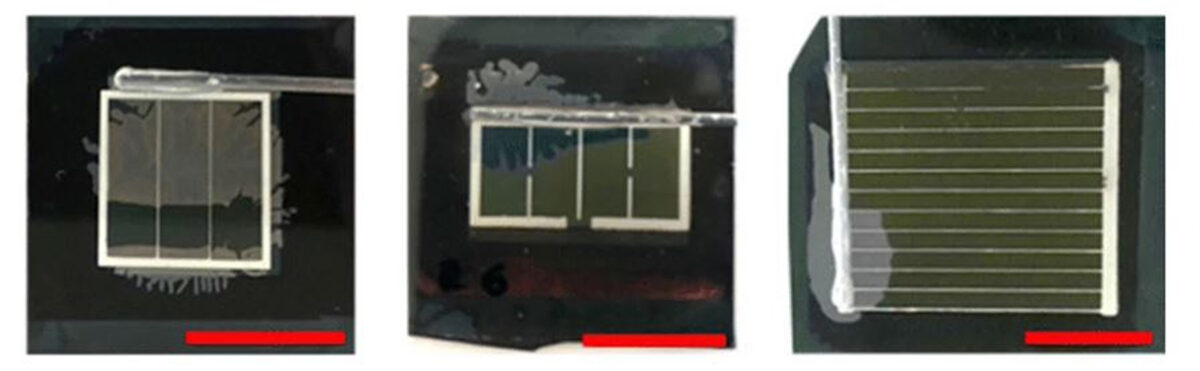
A US research team has investigated the thermomechanical reliability of metal halide perovskite (MHP) modules and cells in an effort to identify the best strategies to improve their stability under thermomechanical stressors. In particular, the scientists discussed film stresses, adhesion of charge transport layers and instability under light and heat.
Scientists from Arizona State University published a paper on solving mechanically based failure mechanisms to make metal halide perovskite (MHP) modules and cells more stable and reliable.
The team claimed that the future of stable and efficient perovskite solar panels lies in understanding the interconnection between different degradation modes, mechanical, thermal and chemical, under the influence of light, heat and humidity.
“We noticed a significant acceleration in failure rates and a shorter lifetime of perovskite solar panels in the field compared to the modules tested in the laboratory,” said the paper’s lead author, Marco Casareto. pv magazine. “Specifically, there is little work on testing modules under multiple environmental stressors, such as both light and thermal fluctuations. We wanted to draw attention to this critical area of research in hopes of accelerating the progress and commercial viability of MHPs.”
“Yes, and we believe these factors are linked, based on a shared underlying mechanism related to the mechanical properties of an MHP module,” study co-author Nick Rolston told pv magazine.
Their paper highlights issues related to the low fracture energy (Gc) of material layers and the bond between layers. “Gc is a material’s resistance to crack propagation, depending on both material/interfacial binding energy and a material’s ability to deform,” the research group explained.
In addition, it discusses the negative impact of film stresses in the perovskite absorber, how scratches remove material introducing even more stress interfaces, and the importance of realistic accelerated degradation tests in the laboratory.
Realistic testing of devices with multiple simultaneous stressors is “critical” to simulate field operation and achieve commercial maturity, the team emphasizes. It was proposed to set a minimum Gc of 1 J/m2 for devices in the laboratory to ensure that modules can withstand processing and packaging steps without mechanical failure, and to reduce the chance of delamination and accelerated degradation.
The researchers propose that “engineering compressive stress” and “tuning layer properties” could improve thermomechanical reliability. They also describe strategies for encapsulation and perovskite solar panel materials (PSM) to increase toughness.
Their findings appear in “Designing metal halide perovskite solar panels for thermomechanical reliability,” published in communication materials.
When asked about the response to the publication, Rolston said: “We haven’t had much feedback since the article first came out; however, we have discussed these results with several MHP startups working to commercialize the technology, as well as the Perovskite PV Accelerator for Commercializing Technologies (PACT),” referring to the U.S. Department of Energy’s multi-year PACT accelerator, led from Sandia National Laboratories.
There is still a long way to go, as Rolston sees it, but there is optimism about the development of MHP PV panels with an operational lifespan comparable to that of existing silicon or cadmium telluride (CdTe), if more effort is done to design for thermomechanical applications. reliability, and not just because of performance.
Looking ahead, Casareto said: “We are currently working to validate our hypothesis of a mechanical failure mechanism. This involved fabricating individual MHP cells without scratching or encapsulation to establish a baseline of how they degrade under thermal cycling after being encapsulated. We will now soon be doing the same with modules to clarify any differences in degradation mechanisms/severities of modules under thermal cycling. We want to investigate the effect of encapsulation, especially at the scribe lines, while a module is thermally cycled to evaluate which properties are most important/favorable for a PSM encapsulant.”
This content is copyrighted and may not be reused. If you would like to collaborate with us and reuse some of our content, please contact: editors@pv-magazine.com.
