

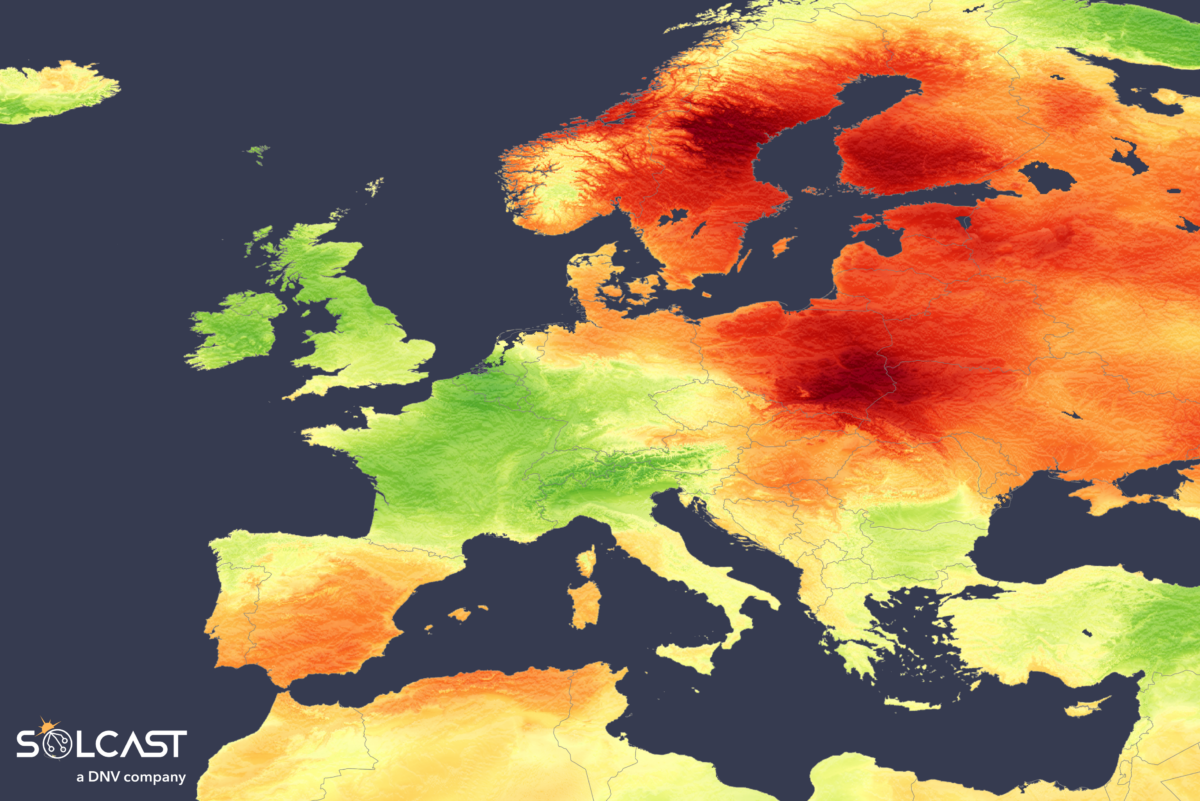
In a new weekly update for pv magazineSolcast, a DNV company, reports that Finland and Sweden, thanks to warm temperatures and relatively sunny skies, had irradiance of up to 30%, unusually resulting in a higher total irradiance than the further south of the United Kingdom and France. Across the Baltic Sea, Poland, the Baltic states and neighboring countries also experienced insolation up to 30% above the long-term average.
In May, Europe experienced a striking contrast in solar radiation, shaped by two dominant weather systems. Persistent high pressure over Scandinavia limited normal convective clouds and rainfall in summer, leaving Eastern Europe with significantly increased insolation, while opposing low-pressure systems over Western Europe dragged onshore clouds from the Atlantic Ocean and North Sea. This combination resulted in a month of widely varying solar conditions, according to analysis using the Solcast API.
Regions including Britain, Ireland, France, southern Germany and northern Italy experienced insolation up to 20% below average. This anomaly was due to the anomalous low pressure over western Europe, which brought moisture from the Atlantic Ocean and the North Sea on land. Combined with surface heating from the summer sun, this created an unstable air mass, leading to convective showers and a wetter, cloudier May than normal. This weather pattern continued into early June, with southern Germany experiencing significant flooding and persistent cloud cover, limiting solar energy production in an area with relatively high residential and utility solar capacity.
Southwestern Spain and southern Portugal benefited from the shielding effect of the Pyrenees against the low pressure in Western Europe, resulting in insolation 10% above the May average. Southern Italy was also protected by the Alps and saw radiation levels around seasonal norms as typical summer convection, driven by Mediterranean moisture, prevailed.
In contrast, large parts of Eastern Europe and Scandinavia enjoyed irradiance 20 to 30% above the long-term average. The high pressure over Scandinavia inhibited the formation of convective clouds and rainfall, attracting a relatively warm and dry continental air mass from Eurasia. This led to warm temperatures and relatively sunny skies. Finland and Sweden in particular had irradiance up to 30%, unusually resulting in a higher total irradiance than the further south of the United Kingdom and France. Across the Baltic Sea, Poland, the Baltic states and neighboring countries also experienced insolation up to 30% above the long-term average. Closer to the Mediterranean, however, insolation in Eastern Europe was closer to typical levels as normal summer convection manifested.
Solcast produces these figures by tracking clouds and aerosols worldwide at a resolution of 1-2 km, using proprietary satellite data AI/ML algorithms. This data is used to drive irradiance models, allowing Solcast to calculate high-resolution irradiance, with a typical deviation of less than 2%, as well as cloud tracking predictions. This data is used by more than 300 companies that manage more than 150 GW of solar energy worldwide.
The views and opinions expressed in this article are those of the author and do not necessarily reflect those of the author pv magazine.
This content is copyrighted and may not be reused. If you would like to collaborate with us and reuse some of our content, please contact: editors@pv-magazine.com.
