
Close Menu
  • News
  • Industry
  • Solar Panels
  • Commercial
  • Residential
  • Finance
  • Technology
  • Carbon Credit
  • More
    • Policy
    • Energy Storage
    • Utility
    • Cummunity
What's Hot

Why the UK solar industry needs to own its safety story

April 23, 2026

Fraunhofer ISE develops colored film technology for patterned solar panels

April 23, 2026

Thermoacoustic heat pumps are on the verge of commercial breakthrough – SPE

April 23, 2026
Facebook X (Twitter) Instagram
Solar Energy News
Thursday, April 23
  • News
  • Industry
  • Solar Panels
  • Commercial
  • Residential
  • Finance
  • Technology
  • Carbon Credit
  • More
    • Policy
    • Energy Storage
    • Utility
    • Cummunity
Solar Energy News
Home - Solar Industry - Intersolar: AP Systems presents single-phase hybrid inverter for photovoltaic balconies
Solar Industry

Intersolar: AP Systems presents single-phase hybrid inverter for photovoltaic balconies

solarenergyBy solarenergyJune 22, 2024No Comments3 Mins Read
Facebook Twitter Pinterest LinkedIn Tumblr Email
Share
Facebook Twitter LinkedIn Pinterest Email

Until now, balcony inverters were usually simple microinverters, with the batteries integrated via MC4 connectors. A hybrid inverter should improve this situation.

June 21, 2024 Marian Willuhn

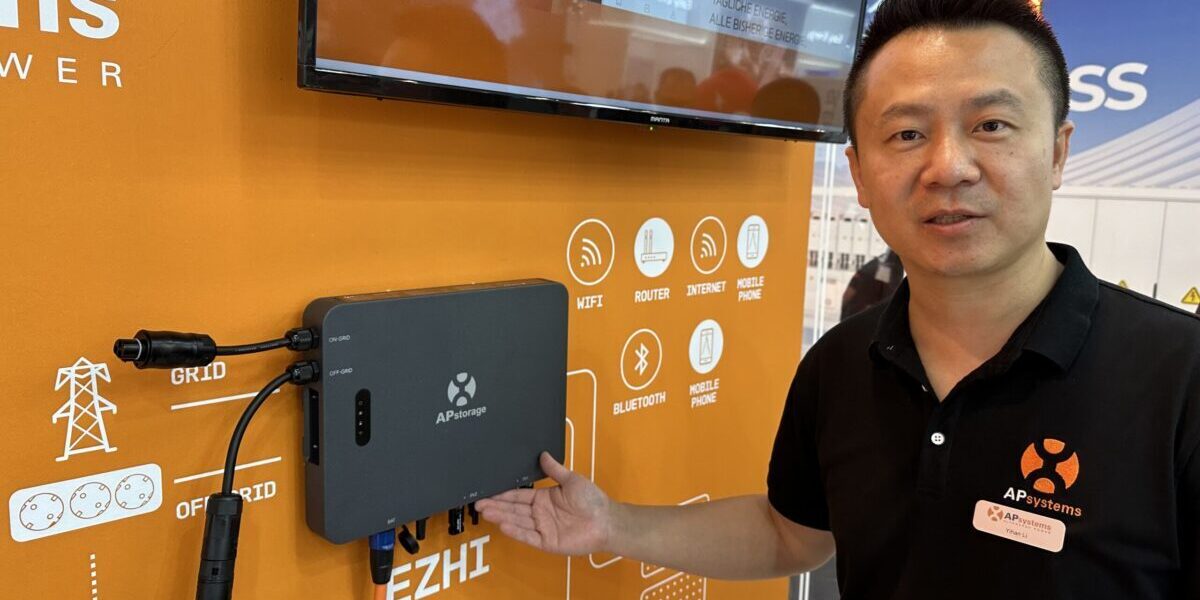
Yihan Li, sales manager of AP Systems for Austria and Germany, will present the manufacturer’s new hybrid inverter at Intersolar.

Image: Marian Willuhn/pv magazine

By pv magazine Germany

AP Systems has unveiled a true hybrid inverter for balconies. In most cases, balcony power installations use microinverters with batteries connected via an MC4 connector, says Yihan Li, sales manager of AP Systems for Austria and Germany.

The EZHI, on the other hand, is a full-fledged, single-phase hybrid inverter. The system can absorb 1,200 W and supply the same amount again, reducing the feed-in to the grid to 800 W. The hybrid inverter stores the difference in a battery. In off-grid mode, the EZHI can continuously supply the household electricity grid with 2,400 W. The switching time to off-grid mode would be less than 10 milliseconds. According to AP Systems, the system uses gallium nitride semiconductors. Despite the low asset class, the return is 96.2%. Gallium nitride semiconductors are still only used in low-power applications.

The inverter can connect modules with a maximum short-circuit current of 25 amperes. The voltage at the DC input can be a maximum of 60 volts per input. What is special is that alternating voltage can also be applied to the input. For example, if you want to retrofit a battery, you can run the old microinverter and simply connect the AC output directly to the hybrid inverter.

See also  Dielectric cover layers improve the reliability of heterojunction solar module

The inverter is certified with protection class IP67 and is therefore ideal for outdoor use. The recommended operating temperature is between minus 40 C and plus 65 C.

The main difference between a conventional balcony inverter and the hybrid solution is that the hybrid inverter has a CAN interface for the battery. This is to ensure better and safer battery operation, says Li. The interface allows the use of only one cable for power transmission and communication with the battery management system. AP Systems does not produce its own battery for balconies, “but we have already tested compatibility with more than 40 manufacturers,” Li adds.

The own app can monitor energy flows and manage self-consumption. Other accessories can be integrated via Wi-Fi and Bluetooth. The manufacturer offers a 12-year warranty on the micro-hybrid inverter.

This content is copyrighted and may not be reused. If you would like to collaborate with us and reuse some of our content, please contact: editors@pv-magazine.com.

Source link

balconies hybrid Intersolar inverter photovoltaic presents SinglePhase systems
Share. Facebook Twitter Pinterest LinkedIn Tumblr Email
solarenergy
  • Website

Related Posts

Fraunhofer ISE develops colored film technology for patterned solar panels

April 23, 2026

Inside PV Manufacturing: Belga Solar’s module factory in Belgium

April 23, 2026

No evidence that PFAS leaks from solar panels, research shows

April 22, 2026
Leave A Reply Cancel Reply

Don't Miss
Residential

Solar in Multi-Generational Homes (2025)

By solarenergyFebruary 19, 20250

The American household is evolving. Recent census data reveals a 30% increase in multi-generational living…

EVLO installs its first U.S. utility-scale BESS in Vermont

August 21, 2024

Jinko files TOPCon patent infringement claim against Toyo, VSUN

December 9, 2024

Ascent Solar secures order for thin-film PV from satellite manufacturer

May 21, 2024
Stay In Touch
  • Facebook
  • Twitter
  • Pinterest
  • Instagram
  • YouTube
  • Vimeo
Our Picks

Why the UK solar industry needs to own its safety story

April 23, 2026

Fraunhofer ISE develops colored film technology for patterned solar panels

April 23, 2026

Thermoacoustic heat pumps are on the verge of commercial breakthrough – SPE

April 23, 2026

The federal court has halted Trump administration orders that hinder solar and wind energy development

April 23, 2026
Our Picks

Why the UK solar industry needs to own its safety story

April 23, 2026

Fraunhofer ISE develops colored film technology for patterned solar panels

April 23, 2026

Thermoacoustic heat pumps are on the verge of commercial breakthrough – SPE

April 23, 2026
About
About

Stay updated with the latest in solar energy. Discover innovations, trends, policies, and market insights driving the future of sustainable power worldwide.

Subscribe to Updates

Get the latest creative news and updates about Solar industry directly in your inbox!

Facebook X (Twitter) Instagram Pinterest
  • Contact
  • Privacy Policy
  • Terms & Conditions
© 2026 Tsolarenergynews.co - All rights reserved.

Type above and press Enter to search. Press Esc to cancel.