
Close Menu
  • News
  • Industry
  • Solar Panels
  • Commercial
  • Residential
  • Finance
  • Technology
  • Carbon Credit
  • More
    • Policy
    • Energy Storage
    • Utility
    • Cummunity
What's Hot

A deep learning model tracks the status of the EV battery with high precision

March 6, 2026

Mitsubishi Electric Trane announces new heat pump line for hydronic heating – SPE

March 6, 2026

Origis is developing a 413 MW solar portfolio in West Texas

March 6, 2026
Facebook X (Twitter) Instagram
Solar Energy News
Friday, March 6
  • News
  • Industry
  • Solar Panels
  • Commercial
  • Residential
  • Finance
  • Technology
  • Carbon Credit
  • More
    • Policy
    • Energy Storage
    • Utility
    • Cummunity
Solar Energy News
Home - Technology - Scientists say concavities in perovskite films can improve the stability of solar cells – SPE
Technology

Scientists say concavities in perovskite films can improve the stability of solar cells – SPE

solarenergyBy solarenergyJuly 22, 2024No Comments2 Mins Read
Facebook Twitter Pinterest LinkedIn Tumblr Email
Share
Facebook Twitter LinkedIn Pinterest Email

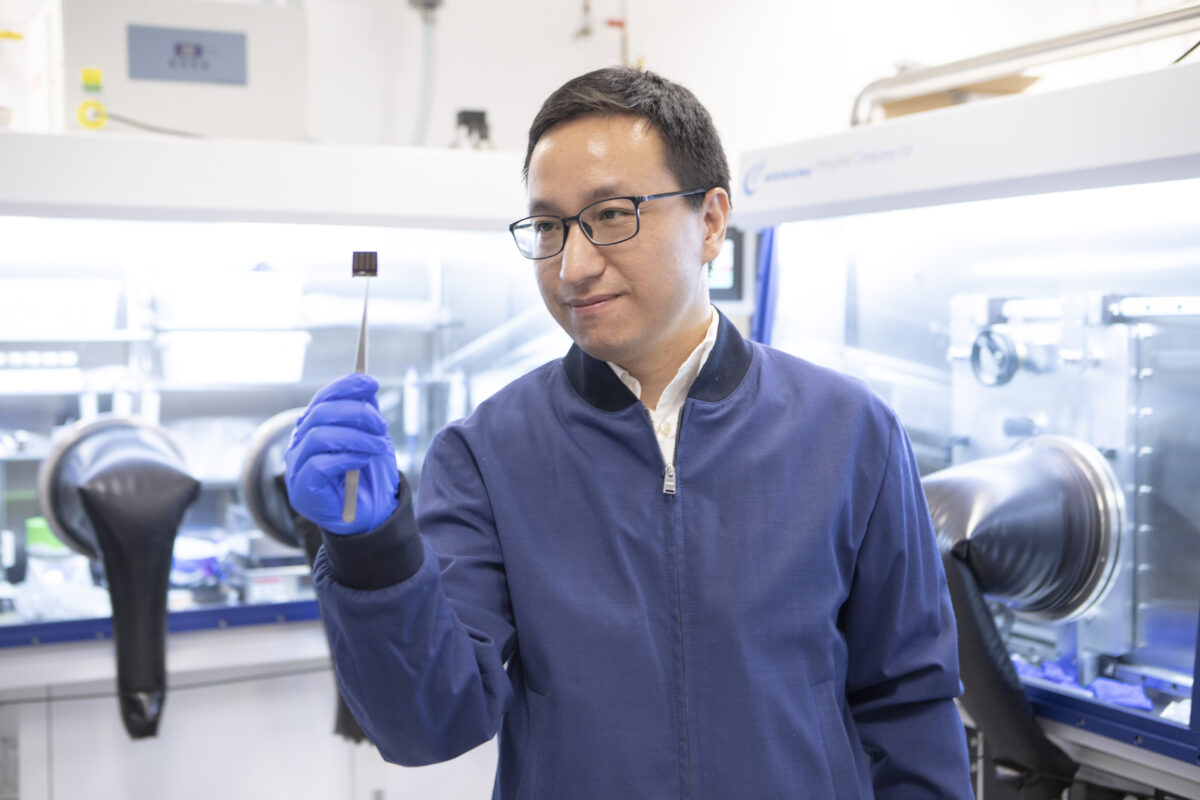
Researchers from the Hong Kong University of Science and Technology (HKUST) have gained insight into the microstructure of perovskite. After removing the grain surface concavities in the crystalline grains of perovskite, they fabricated a solar cell with improved efficiency maintenance under standardized thermal cycling, moist heat, and maximum power tracking tests.

July 22, 2024 Patrick Jowett

Image: School of Engineering of the Hong Kong University of Science and Technology

Scientists from the HKUST’s School of Engineering have revealed the existence and impact of surface voids on individual crystal grains of perovskite thin films.

They claimed in “Elimination of grain surface concavities for improved perovskite thin film interfaces” – recently published in Nature energy – that the concavities in perovskite materials “are caused by grain coalescence-induced biaxial tensile stress and thermal coarsening-induced grain boundary grooves.”

The scientists said the concavities break structural continuity at the perovskite film interface and limit the efficiency and stability of perovskite cells. A statement from HKUST explains that while perovskite solar cells have the potential to replace existing silicon cells in many applications, their long-term stability under light, humidity and thermomechanical conditions remains a barrier to commercialization.

To fully investigate the impact of grain surface concavities, the team removed them by using a surfactant molecule, tridecafluorohexane-1-sulfonic acid potassium, to manipulate the voltage evolution and ion diffusion during perovskite film formation.

In the research paper, the researchers document how their resulting perovskite solar cells exhibited improved energy conversion efficiency and increased energy conversion efficiency maintenance under ISOS standardized thermal cycling (300 cycles), moist heat (660 hours) and maximum power point tracking (1,290 hours). ) to test.

See also  Skyven Technologies puts a steam-generating, industrial heat pump into use – SPE

“Structure and geometry of individual crystalline grains are the origin of the performance of perovskite semiconductors and solar cells,” said Prof. Zhou Yuanyuan, the corresponding author of the research paper. “By revealing the grain surface concavities, understanding their effects and using chemical engineering to tailor their geometry, we are pioneering a new way to make perovskite solar cells with efficiency and stability at their limits.”

Zhou said the team was “intrigued by the surface cavities of perovskite grains,” observed by atomic force microscopy, because cavities are typically hidden beneath the film bottom and are often overlooked.

This content is copyrighted and may not be reused. If you would like to collaborate with us and reuse some of our content, please contact: editors@pv-magazine.com.

Popular content
Source link

cells concavities films improve perovskite scientists solar SPE stability
Share. Facebook Twitter Pinterest LinkedIn Tumblr Email
solarenergy
  • Website

Related Posts

Mitsubishi Electric Trane announces new heat pump line for hydronic heating – SPE

March 6, 2026

Origis is developing a 413 MW solar portfolio in West Texas

March 6, 2026

New Jersey expands state community solar program by 3 GW

March 6, 2026
Leave A Reply Cancel Reply

Don't Miss
News

Reading, Pennsylvania, starts working on sustainability portfolio with 1.78 MW Solar

By solarenergyMarch 8, 20250

The City of Reading, Pennsylvania, has announced the switch to the construction phase as part…

IEA-PVPS shares guidance on technical KPIs for PV systems – SPE

January 2, 2025

Solarwatt presents new residential battery – SPE

November 22, 2024

India completes tender for 1.2 GW renewable energy plus storage at $0.069/kWh – SPE

February 8, 2026
Stay In Touch
  • Facebook
  • Twitter
  • Pinterest
  • Instagram
  • YouTube
  • Vimeo
Our Picks

A deep learning model tracks the status of the EV battery with high precision

March 6, 2026

Mitsubishi Electric Trane announces new heat pump line for hydronic heating – SPE

March 6, 2026

Origis is developing a 413 MW solar portfolio in West Texas

March 6, 2026

New Jersey expands state community solar program by 3 GW

March 6, 2026
Our Picks

A deep learning model tracks the status of the EV battery with high precision

March 6, 2026

Mitsubishi Electric Trane announces new heat pump line for hydronic heating – SPE

March 6, 2026

Origis is developing a 413 MW solar portfolio in West Texas

March 6, 2026
About
About

Stay updated with the latest in solar energy. Discover innovations, trends, policies, and market insights driving the future of sustainable power worldwide.

Subscribe to Updates

Get the latest creative news and updates about Solar industry directly in your inbox!

Facebook X (Twitter) Instagram Pinterest
  • Contact
  • Privacy Policy
  • Terms & Conditions
© 2026 Tsolarenergynews.co - All rights reserved.

Type above and press Enter to search. Press Esc to cancel.