
Close Menu
  • News
  • Industry
  • Solar Panels
  • Commercial
  • Residential
  • Finance
  • Technology
  • Carbon Credit
  • More
    • Policy
    • Energy Storage
    • Utility
    • Cummunity
What's Hot

Tesla launches three-phase Powerwall 3P – SPE

April 23, 2026

Why the UK solar industry needs to own its safety story

April 23, 2026

Fraunhofer ISE develops colored film technology for patterned solar panels

April 23, 2026
Facebook X (Twitter) Instagram
Solar Energy News
Thursday, April 23
  • News
  • Industry
  • Solar Panels
  • Commercial
  • Residential
  • Finance
  • Technology
  • Carbon Credit
  • More
    • Policy
    • Energy Storage
    • Utility
    • Cummunity
Solar Energy News
Home - Solar Industry - Typhoon, monsoon and record heat wave impacted radiant radiation across Asia in July
Solar Industry

Typhoon, monsoon and record heat wave impacted radiant radiation across Asia in July

solarenergyBy solarenergyAugust 9, 2024No Comments3 Mins Read
Facebook Twitter Pinterest LinkedIn Tumblr Email
Share
Facebook Twitter LinkedIn Pinterest Email

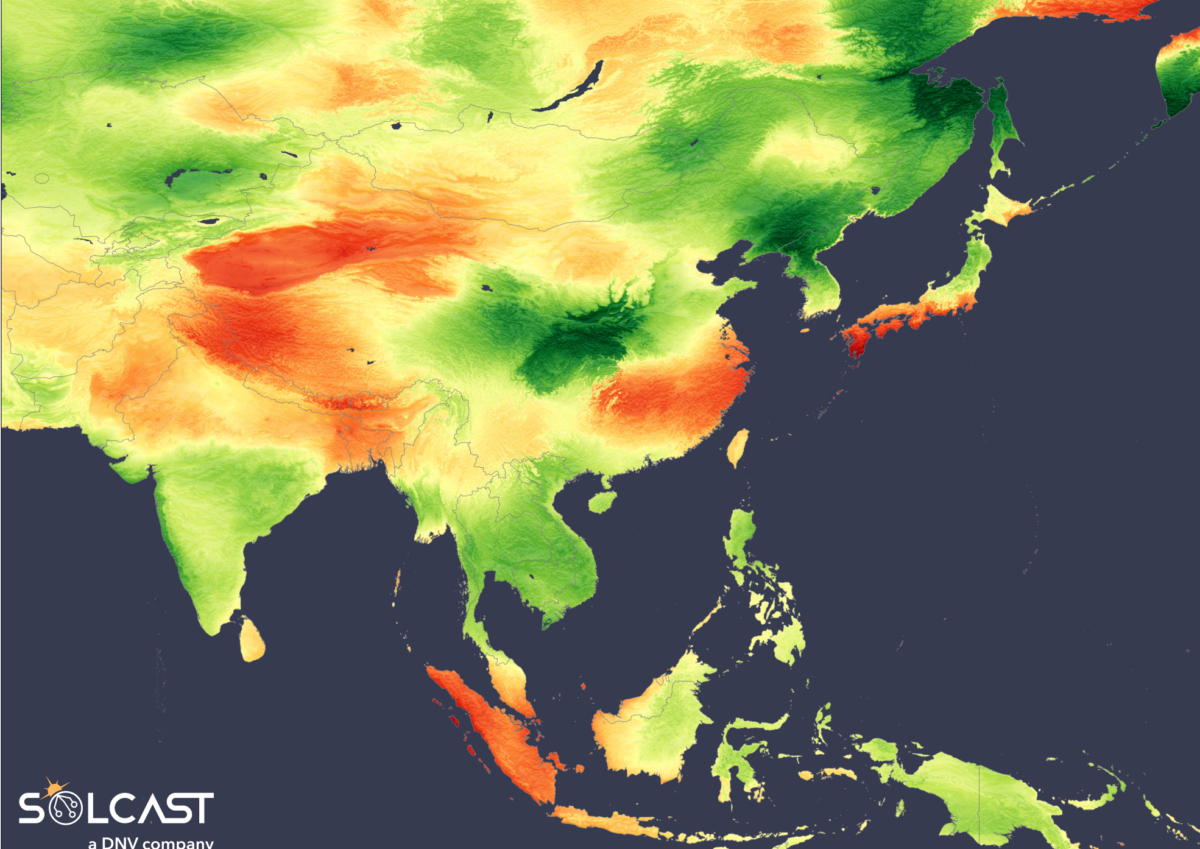
In a new weekly update for pv magazineSolcast, a DNV company, reports that various weather conditions in July resulted in varying levels of insolation across Asia. While a typhoon in the Philippines and a monsoon in India had a negative impact on insolation, China and Japan delivered the warmest July on record thanks to a strong subtropical ridge.

August 9, 2024 Solcast

Various weather conditions in Asia caused varying effects on solar energy in July. Typhoon Gaemi led to reduced irradiation in the Philippines and a record-breaking monsoon season in India saw average irradiation fall by 10% in most of the country. Meanwhile, parts of China and Japan saw increased insolation due to a strong subtropical ridge, according to analysis using the Solcast API.

In addition to extreme winds that can destroy energy infrastructure, typhoons also bring heavy rain and cloud cover, leading to reduced insolation. Typhoon Gaemi was no exception, impacting radiation levels in the Philippines in mid-July. Monthly average irradiation decreased by 10% compared to long-term averages in July.

Gaemi originated over the Pacific Ocean west of the Philippines, in an area with warm sea surface temperatures 1 to 2 °C above the July average.

Typhoon Gaemi moved northwest under the influence of a mid-atmospheric pressure ridge, passing over the Philippines and then hitting Taiwan before weakening over Fujian Province in China. Apart from the typhoon’s impact on irradiance along its path, Taiwan and much of China saw increased sunshine in the first half of the month, with less than half of the average rainfall leading to average or above-average irradiance in a much of eastern China.

See also  The Chinese Haitian group will acquire Heraeus' PV activities for $68.6 million

India experienced an above-average monsoon season, with the southwest monsoon spreading across the subcontinent on July 2, about a week earlier than normal. This early start led to above-normal rainfall in July, as moist southwesterly winds brought significant precipitation. Some regions saw daily rainfall averages of up to 20 mm, almost double the usual amount, resulting in a 10% decrease in insolation in the south of the country. The country’s west coast was particularly hard hit, seeing the greatest reduction in radiation intensity, and Delhi recorded a nearly 90-year record of 280mm of rainfall in a single day in June.

In contrast, China and Japan recorded the warmest July on record, due to an abnormally strong subtropical ridge. These atmospheric conditions reduced cloud cover and led to increased sunshine, resulting in irradiance anomalies of more than 15%. Temperatures soared above 38 degrees Celsius across Japan, while Hong Kong experienced a monthly average minimum temperature of 28 degrees Celsius.

Solcast produces these figures by tracking clouds and aerosols worldwide at a resolution of 1-2 km, using proprietary satellite data AI/ML algorithms. This data is used to drive irradiance models, allowing Solcast to calculate high-resolution irradiance, with a typical deviation of less than 2%, as well as cloud tracking predictions. This data is used by more than 300 companies that manage more than 150 GW of solar energy worldwide.

The views and opinions expressed in this article are those of the author and do not necessarily reflect those of the author pv magazine.

This content is copyrighted and may not be reused. If you would like to collaborate with us and reuse some of our content, please contact: editors@pv-magazine.com.

See also  How much agrivoltaic sun protection is sufficient

Source link

Asia heat impacted July monsoon radiant radiation record Typhoon Wave
Share. Facebook Twitter Pinterest LinkedIn Tumblr Email
solarenergy
  • Website

Related Posts

Fraunhofer ISE develops colored film technology for patterned solar panels

April 23, 2026

Thermoacoustic heat pumps are on the verge of commercial breakthrough – SPE

April 23, 2026

Inside PV Manufacturing: Belga Solar’s module factory in Belgium

April 23, 2026
Leave A Reply Cancel Reply

Don't Miss
Solar Industry

New research sheds light on passivation-related defects in heterojunction solar cells

By solarenergyNovember 27, 20250

Korean researchers revealed that efficiency losses in heterojunction solar cells are due to two coexisting…

Coalitional game theory to improve P2P trading in energy communities – SPE

May 24, 2024

Sunrun’s solar and storage VPP supports California’s grid with 48 MW per night during heat waves

July 20, 2024

Toyota dealer in Connecticut installs solar carport with C-PACE financing

February 18, 2026
Stay In Touch
  • Facebook
  • Twitter
  • Pinterest
  • Instagram
  • YouTube
  • Vimeo
Our Picks

Tesla launches three-phase Powerwall 3P – SPE

April 23, 2026

Why the UK solar industry needs to own its safety story

April 23, 2026

Fraunhofer ISE develops colored film technology for patterned solar panels

April 23, 2026

Thermoacoustic heat pumps are on the verge of commercial breakthrough – SPE

April 23, 2026
Our Picks

Tesla launches three-phase Powerwall 3P – SPE

April 23, 2026

Why the UK solar industry needs to own its safety story

April 23, 2026

Fraunhofer ISE develops colored film technology for patterned solar panels

April 23, 2026
About
About

Stay updated with the latest in solar energy. Discover innovations, trends, policies, and market insights driving the future of sustainable power worldwide.

Subscribe to Updates

Get the latest creative news and updates about Solar industry directly in your inbox!

Facebook X (Twitter) Instagram Pinterest
  • Contact
  • Privacy Policy
  • Terms & Conditions
© 2026 Tsolarenergynews.co - All rights reserved.

Type above and press Enter to search. Press Esc to cancel.