Market pressures in the solar and storage sectors often favor low-cost solutions, but long-term success depends on balancing price, quality and reliability for assets designed to last for decades. Numerous examples, from low-quality silicon modules to hydrogen and redox power storage in homes, show how technically ambitious products can fail if cost, complexity or sustainability are misjudged.
It is a well-known reality in the market: the best product does not always win. Often the cheapest option wins. No matter how advanced a development or how well thought out the concept, a product has little chance of long-term success if it is too expensive or too complex to exploit. That said, the lowest-priced product doesn’t automatically dominate either. In solar technology, the balance between price, quality and ease of use determines whether a product becomes a bestseller. Photovoltaic systems are designed and installed for a lifespan of more than 20 years.
From this perspective, manufacturers must equip solar panels with higher quality materials and thicker glass, while inverters and batteries must use more durable electronic components. However, the continued decline in market prices has created intense pressure that limits product quality. Costs are reduced and optimizations are applied at every stage to make products cheaper and lighter. More and more units are packed in one container to reduce shipping costs. In many cases, it only becomes clear after years of use whether products deliver on their promises or whether compromises have gone too far.
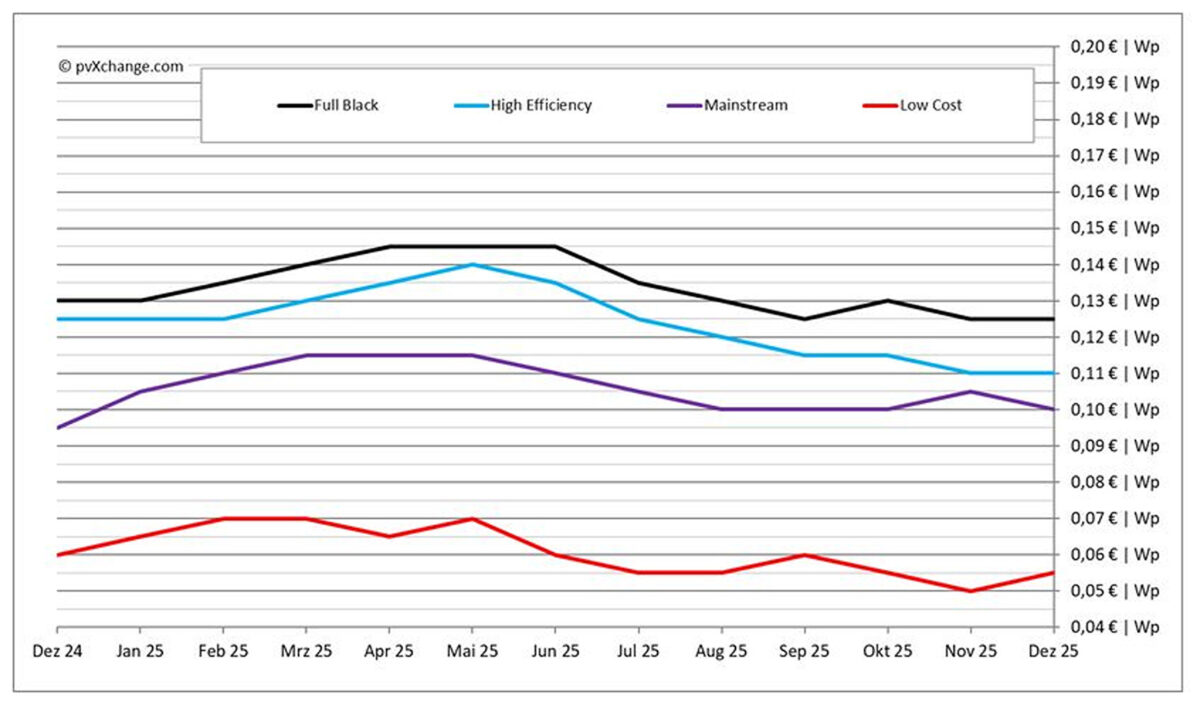
Module prices showed little movement towards the end of the year, indicating that the market may have reached a level where further reductions are difficult. Isolated deviations from the downward trend are largely the result of urgent sales or stock clearances and do not indicate a structural shift. Given the significant losses that Asian manufacturers have absorbed for years, many expect an eventual upward price correction. The timing and mechanisms remain unclear. Higher module prices could allow manufacturers to improve quality again, but no major supplier is willing to take the first step. Large Chinese producers in particular fear losing their hard-won market share.
Only diversified conglomerates that do not rely solely on the solar energy sector, or smaller niche suppliers that serve a defined customer base, can afford to price products above the general market level reflected in industry indices. The failures of Meyer Burger and SunPower, among others, show how difficult it is to sustain large-scale module production if production costs are not in line with prevailing market prices. This reality underscores a recurring challenge for system planners and buyers: an abundance of products, but too few reliable choices.
Experience shows that a conservative approach to selecting components and system concepts is often advisable. While innovation in the solar energy sector is essential and often leads to major advances in energy generation, it also comes with significant risks. For long-lived, capital-intensive assets such as power plants, component failures after just a few years – or the disappearance of manufacturers and guarantors just as problems arise – can have serious consequences.
There is no shortage of warning examples. A prominent case is the brief rise of so-called solar silicon, or metallurgical silicon, in the early 2010s. At the time, strong growth in renewable energy created a shortage of polysilicon byproducts from semiconductor production. In response, researchers developed less pure silicon using simpler and cheaper production processes. In the era of polycrystalline modules, with a typical efficiency of around 15 percent, these lower performance products seemed commercially viable at the right price.
In practice, however, modules made with these cells, marketed by Canadian Solar as ‘E-modules’, deteriorated much faster than conventional products. Energy yields fell well below expectations, forcing manufacturers to replace modules after just a few months of use. The episode ultimately led to significant losses and a quick end to the trend.
Some of the most recent examples of ambitious but market-incompatible product developments can be found in the energy storage sector. An example of this is the year-round residential hydrogen storage system Picea, developed by the now bankrupt company HPS. In this system, excess solar energy is converted into hydrogen via an electrolyzer and stored outdoors in pressurized gas bottles. When solar energy generation is insufficient, the hydrogen is converted back into electricity and heat using a fuel cell. Although the system is technically advanced, it is disproportionately expensive, limiting its appeal to a small group of self-sufficiency enthusiasts with significant purchasing power. Electrochemical storage systems, on the other hand, are significantly more economical and, when scaled appropriately, can also enable near-complete energy independence.
Another example of unconventional storage technologies are residential-scale redox flow batteries. On a utility scale, redox power systems are a proven and cost-effective solution. However, Prolux Solutions sought to adapt the technology for use in single-family homes. In practice, the challenges associated with circulating liquid electrolytes appear to have been underestimated, leading to leaks within months of use. The high maintenance costs expected for a large number of small installations ultimately led the company to announce that by the end of 2025, the limited number of deployed systems would be retired or replaced with established lithium iron phosphate (LFP) technology.
In some cases, multiple development cycles are required before a concept is sufficiently mature or before market conditions evolve to make it viable. Hybrid collectors – which combine photovoltaic and solar thermal generation – are a clear example. From a physical perspective, the concept presents an inherent contradiction: excess heat reduces electrical output, necessitating continuous heat dissipation, but when this happens, there is often insufficient thermal energy left for efficient heating applications. Over the past two decades, this principle has been repeatedly revised, spawning countless venture-backed companies, all of which ultimately failed. The breakthrough came when developers ditched the expensive insulation at the rear and instead combined the collectors with heat pumps that could utilize heat at low temperatures.
A useful indicator that a new technology can gain lasting traction is the presence of multiple companies pursuing a similar approach and bringing it to market. When several startups with similar solutions succeed in attracting international investors, this indicates a development with real long-term potential. Once such products achieve meaningful market penetration, they deserve more attention. At that stage, the risk of failure is significantly reduced – at least until the next disruptive technology emerges.
Prices December 2025, including changes from the previous month (as of December 15).
 About the author: Martin Schachinger studied electrical engineering and has been active in the field of photovoltaics and renewable energy for almost 30 years. In 2004, he founded the online trading platform pvXchange.com. The company has standard components in stock for new installations and solar panels and inverters that are no longer produced.
The views and opinions expressed in this article are those of the author and do not necessarily reflect those of the author pv magazine.
This content is copyrighted and may not be reused. If you would like to collaborate with us and reuse some of our content, please contact: editors@pv-magazine.com.
Popular content