

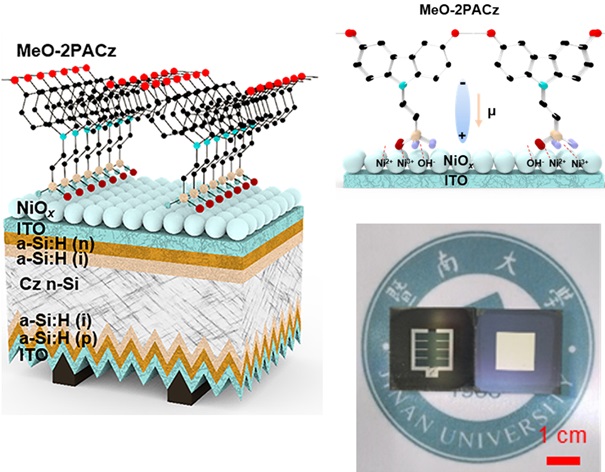
An international research team has designed a two-terminal perovskite-silicon tandem solar cell that uses novel hybrid interconnected layers to reduce recombination losses in the top perovskite device. The tandem cell achieved an impressive fill factor of 81.8%, which the scientists say is the highest value reported to date for this cell technology.
A group of researchers led by Jinan University in China has developed a two-terminal (2T) perovskite-silicon tandem solar cell based on special hybrid interconnected layers (ICLs) that require direct contact between the perovskite absorber and transparent conductive oxide (TCO) prevent. .
“Typical self-assembled monolayers (SAMs) directly on the transparent conductive oxide (TCO) recombination layer exhibit poor uniformity and compactness, resulting in significant current leakage losses and poor reproducibility of tandem solar cells,” said the study’s corresponding author Yousheng Wang. , told pv magazine. “To address this problem, we proposed a sputtered nickel oxide (NiOx) as the seed layer of SAMs to build the hybrid interconnected layers. The sputtering treatment technique ensures easy coating on a complex substrate and high reproducibility.”
According to Wang, NiOx materials can further increase the coupling of SAM molecules with the substrate. Thus, the hybrid ICLs could improve the uniformity of the interface between the TCO and the SAM based on MeO-2PACz, also known as [2-(3,6-Dimethoxy-9H-carbazol-9-yl)ethyl]phosphonic acid, and reduce the leakage current. “A good energy level match between perovskite and hybrid ICLs was then established, which is beneficial for carrier extraction and transport,” he added. “The hybrid ICLs further reduce interface defects and bulk defects.”
The scientists built the tandem cell with a silicon heterojunction device at the bottom and a 19.73% efficient inverted perovskite solar cell at the top with an energy bandgap of 1.71 eV, integrating the ICLs. The latter is designed with a substrate of indium tin oxide (ITO), a hole transport layer (HTL) of nickel (II) oxide (NiOx), the MeO-2PACz SAM, a perovskite absorber doped with 2-phenylethylammonium iodide (PEAI), an electron transport layer (ETL) based on a buckminsterfullerene (C60), a transparent back contact made of indium zinc oxide (IZO), and a silver (Ag) metal contact.
The performance of the tandem device was analyzed and compared with that of a reference cell based on a NiOx HTL but without the MeO-2PACz SAM. The latter achieved a current conversion efficiency of 22.27%, an open-circuit voltage of 1.75 V, a short-circuit current density of 17.85 mA cm−2and a fill factor of 71.15%. The first achieved an efficiency of 28.47%, an open-circuit voltage of 1.88 V, a short-circuit current density of 18.25 mA cm−2and a fill factor of 81.8%.
The group highlighted that the tandem cell fill factor is currently one of the highest in the scientific literature for perovskite-silicon devices. “It turns out that NiO’s hybrid ICLsX/MeO-2PACz significantly reduces current leakage and non-radiative recombination losses by avoiding direct contact between perovskites and TCO,” it further explains. “Our results provide an effective method to improve the uniformity and reduce the leakage current of the MeO-2PACz coating on the substrate.”
The solar cell was presented in the newspaper “Hybrid interconnected layers reduce current leakage losses in perovskite/silicon tandems with a fill factor of 81.8%”, published in Cell reports Natural Sciences. The research group consisted of academics from the German Forschungszentrum Jülich GmbH, as well as from Wuyi University and the University of Macau in China.
This content is copyrighted and may not be reused. If you would like to collaborate with us and reuse some of our content, please contact: editors@pv-magazine.com.
