

Researchers in Spain have conducted a comparative analysis of annual solar hydrogen production for direct and indirect configurations and found that indirect systems not only produce more hydrogen, but also exhibit greater resilience to module power losses.
Scientists from Spain’s Technical University of Madrid have conducted a comparative study of direct and indirect coupling configurations for PV and electrolyzers in green hydrogen (H2) production. The research was based on numerical simulations carried out with the software MATLAB, with weather conditions based on a typical meteorological year in Madrid.
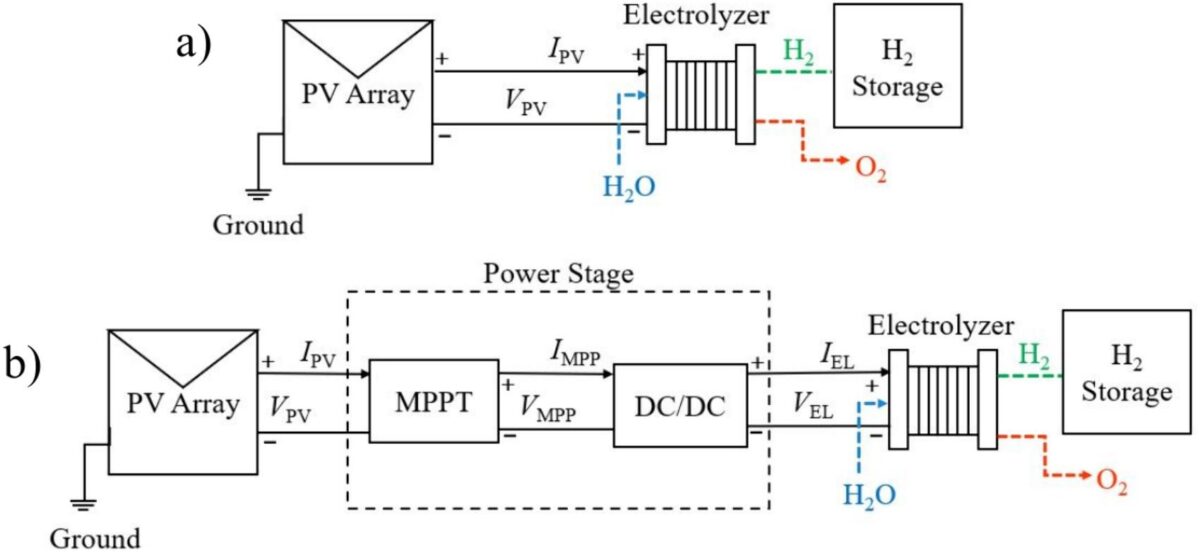
PV powered hydrogen systems where the input of the electrolyzer is connected to the electrical output of the PV generator without an intermediate power stage are often referred to as a direct coupling configuration. Indirect configuration systems, on the other hand, contain electronics to control the PV generator at its maximum power and use Maximum Power Point Tracking (MPPT), which maximizes PV energy generation as weather conditions vary, with a DC-DC converter that matches the output power supplied by the MPPT to the input power of the electrolyzer.
“The indirect configuration includes a power stage (PS) with a maximum power point tracker and a DC-DC converter, which maintains optimal power transfer from PV to electrolyzers, but incurs losses at the PS. The direct configuration avoids these losses, but requires a specific design of the PV generator to achieve high electrical transfer,” the scientists said, pointing to the main advantages and disadvantages of each configuration.
“In defense of direct coupling, several authors argue that this configuration could be sufficiently good to allow the electrolyzer to operate near the MPP if the PV array and electrolyzer are properly designed; Others state that direct coupling configuration is economically advantageous because the costs of electronic coupling systems are completely avoided.”
The research group performed a series of simulations on an experimental setup consisting of a 100 W solar panel and a proton exchange membrane (PEM) electrolyzer with a maximum current density of 4 A-cm2. In the case of the indirect system, the efficiency of the DC-DC converter is assumed to be 95%, while in the case of the direct system, the number of solar cells connected in series and the cell area are optimized while maintaining the power of the PV . module for a fair comparison.
“The presence of the MPPT ensures that the PV module operates on its MPPT under all meteorological conditions, unlike the direct coupling configuration, which only operates near MPPT for a sparse range of global irradiance and temperature., even if the number of cells is optimized,” the group explains.
“This higher PV power also translates into a greater amount of electrical energy transferred to the electrolyzer and therefore greater H2 production.”
Through this analysis, the scientists discovered that thanks to the PS, the indirect coupling configuration can inject 223 kWh per year of electrical energy, which is 39.4% more than the direct configuration, into the electrolyzer. This would be enough to produce 5.79 kg of H2 per year, which would be 37.5% more than the amount produced with the direct coupling system.
The direct system was also found to achieve an energy efficiency of 5%, while the indirect system showed an efficiency of 6.9%.
In addition, the scientists also assessed which system is more resistant to power losses of modules. If it were to lose one of the twenty cells in the PV module, the direct system would lose 18.3% of its H2 production, while the indirect system would only lose 5%. With a loss of seven cells, the direct system will stop producing H2, while the indirect system will still produce it, albeit at a 37% lower capacity.
Furthermore, the academics found that only when the efficiency of the DC-DC converter drops below 73% will it produce less H2 than the directly coupled system. “For a DC-DC converter design to be considered valid, its efficiency must be higher than 90%, so a scenario with efficiency and H2 production as low as with the direct coupling is unlikely to occur,” the researchers stressed. researchers.
Their findings can be found in the study “Optimization of hydrogen production: a comparative study of direct and indirect coupling between photovoltaic solar energy and electrolyzer”, published in Energy conversion and management.
This content is copyrighted and may not be reused. If you would like to collaborate with us and reuse some of our content, please contact: editors@pv-magazine.com.
