Scientists in South Africa conducted large-scale research into the effect of wind loads on mounting rails for PV panels for more than 100 days. Compared to standard design codes, they found lower combined wind load coefficients. Maximum loads occurred with easterly wind direction.
A group of researchers from South Africa have conducted a large-scale field measurement of the wind load effects on the mounting rail of a single-axis PV tracker. The data was collected over 109 days in the Western Cape province of South Africa via two instrumented PV module mounting rails. Actual results were also compared to ASCE 7-22 estimates, the American Society of Civil Engineers standard for design loads.
“Large-scale experiments such as these are important to provide a reference or targets for future research using wind tunnel modeling or simulation,” said the corresponding author, Johannes Hendrik Koekemoer, told pv magazine.
“The current study considers the effects of wind loading in a cold-formed omega-type steel mounting rail. The rail is connected to the torsion tube at mid-span and bolted to the PV modules at each end with a total of four anchor bolts,” the academics said. “The inherent large surface areas and lightweight supporting structures ensure that wind load considerations determine the structural design of large PV installations. This is further compounded by the fact that PV installations are typically located in flat, exposed locations that are associated with higher wind loads.”
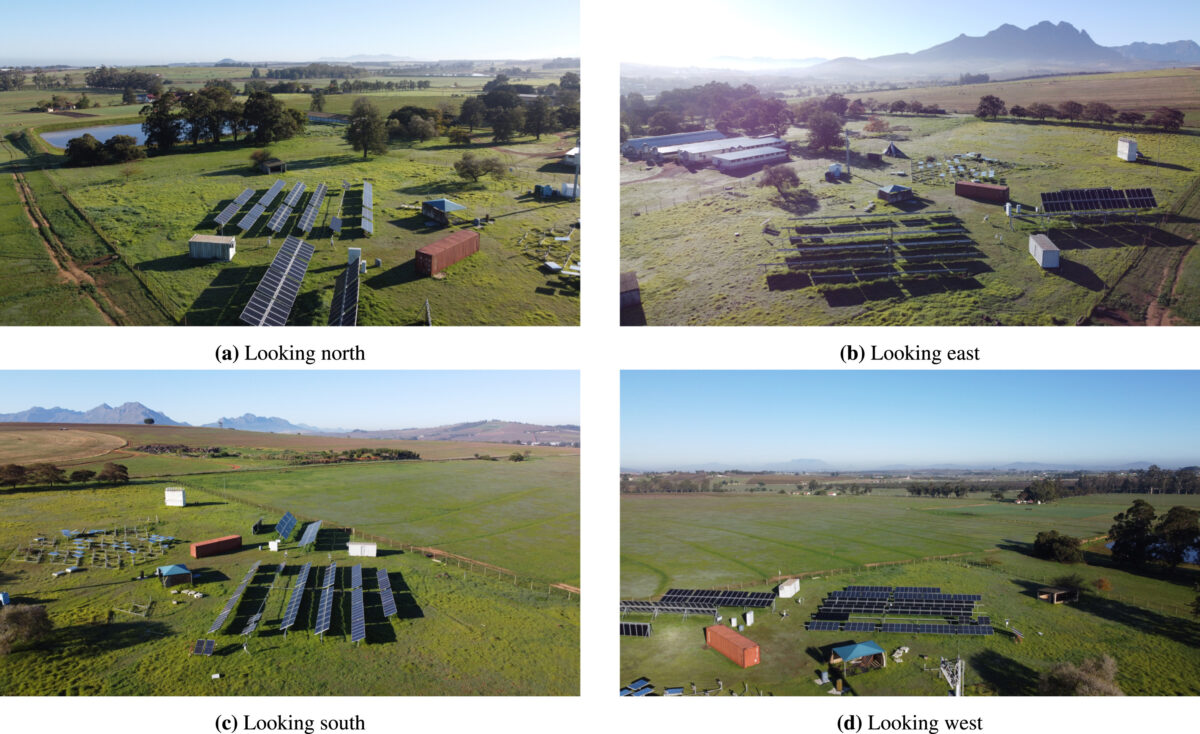
The measurement took place between December 2022 and March 2023 at a site dedicated to a variety of PV-related experiments with a wind exposure category C according to ASCE 7-22. This field consisted of six PV rows, approximately 32 m long and spaced 5 m apart, using a circular torsion tube with a hollow cross-section of 101 mm by 3 mm, connected to a central swing arm drive system. Torsion tubes were mounted on polymer bearings connected to circular posts with hollow cross-sections of 76 mm by 4 mm.
While five of the rows participated in different studies, the mentioned measurements were performed in one row. It consisted of two instrumented rails with two PV arrays installed in different positions. The PV on rail A had a length of 2.108 m, a width of 1.048 m and a mass of 24.3 kg and was located at the exposed outer edge of the array; while rail B had a length of 2.037 m, a width of 1.005 m and a mass of 25 kg, and was located inwards from the edge of the range. Both had tilt angles from −55∘ to +55∘.
Image:
Stellenbosch University, Journal of Wind Engineering & Industrial Aerodynamics, CC BY 4.0
“The frequency content of measured loads showed a contribution of the fundamental torsional mode at 3.5 Hz (𝜁1 = 0.5%) and the secondary bending mode at 4.7 Hz (𝜁2 = 0.2%) to the measured response of rails A and B,” the study said. group stated. “Although the torsional response between both rails was similar, rail B showed a significantly higher bending mode response compared to rail A. This was likely due to the position of rail B on the torsion tube, where the bending mode can be more easily excited. ”
The scientists also found that maximum loads occurred in easterly wind directions when the measured row was more exposed than in westerly wind directions. The measurements also showed that the dominant wind direction was south and that this direction is favorable because it is not perpendicular to the axis of rotation. “However, high wind speed events can still occur in more critical, non-dominant wind directions, as evidenced by the maximum measured wind speed in this study,” she added.
The experimental results were compared to coefficients for fixed-tilt systems from ASCE 7-22. “For normal forces, the maximum static coefficients for rails A and B were between 2.0 and 2.1, which is lower than the code values between 2.4 and 4.6. The corresponding dynamic coefficient was between 0.7 and 1.0, which is within the code range of 0.4 to 1.5,” the researchers explain. “The experimental static moment coefficients ranged between 0.36 and 0.40, and compare favorably with code values ranging between 0.29 and 0.64. The dynamic part indicated values between 0.22 and 0.23 for the experiment, compared to code values ranging from 0.29 to 0.64.”
Their findings were presented in “Field measurements of wind load effects in a single-axis photovoltaic tracker mounting rail”, published in the Journal for wind technology and industrial aerodynamics. Academics from Stellenbosch University and the South African division of sustainable energy systems company Scatec conducted the research.
This content is copyrighted and may not be reused. If you would like to collaborate with us and reuse some of our content, please contact: editors@pv-magazine.com.
Popular content