
Close Menu
  • News
  • Industry
  • Solar Panels
  • Commercial
  • Residential
  • Finance
  • Technology
  • Carbon Credit
  • More
    • Policy
    • Energy Storage
    • Utility
    • Cummunity
What's Hot

Dutch solar owners asked to switch off during peak periods to ease the distribution crisis

June 7, 2026

The hydrogen flow: Toyota demonstrates its racing prototype on liquid hydrogen

June 7, 2026

Era of electrification exposing Australia’s weakest link

June 6, 2026
Facebook X (Twitter) Instagram
Solar Energy News
Sunday, June 7
  • News
  • Industry
  • Solar Panels
  • Commercial
  • Residential
  • Finance
  • Technology
  • Carbon Credit
  • More
    • Policy
    • Energy Storage
    • Utility
    • Cummunity
Solar Energy News
Home - Policy - A British study shows that azimuthal trackers improve the performance of floating PV – SPE
Policy

A British study shows that azimuthal trackers improve the performance of floating PV – SPE

solarenergyBy solarenergyJanuary 2, 2026No Comments3 Mins Read
Facebook Twitter Pinterest LinkedIn Tumblr Email
Share
Facebook Twitter LinkedIn Pinterest Email

A team from the University of Exeter has tested single-axis floating solar tracking systems at twelve sites in Britain. This showed that azimuthal tracking provides the greatest energy gain and the lowest levelized energy costs (LCOE).

January 2, 2026
Lior Kahana

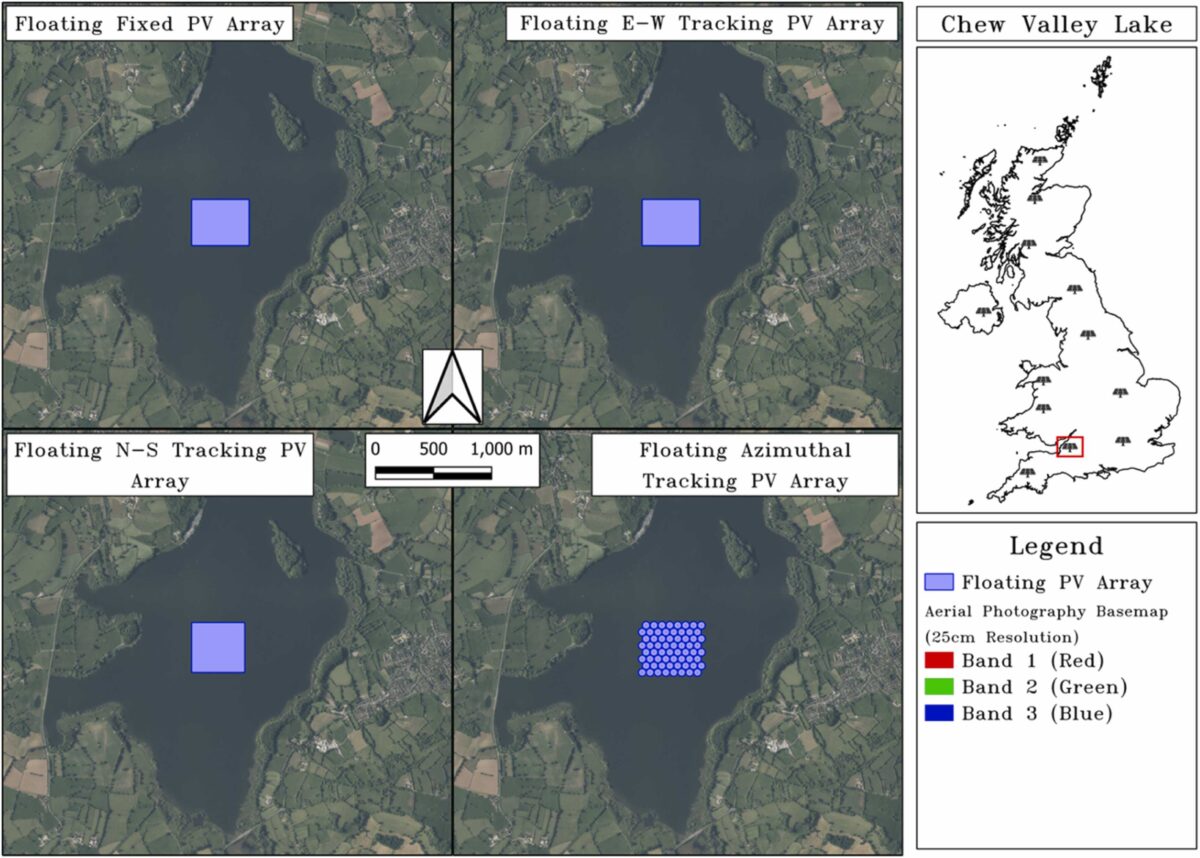
Researchers from the University of Exeter compared east-west (EW), north-south (NS) and azimuthal single-axis tracking floating PV systems, simulating 10 MWp installations on lakes and reservoirs from northern Scotland to southern Cornwall, UK. Systems with a fixed tilt are included as a reference. Azimuthal tracking rotates a fixed-tilt array, similar to a turntable.

“While Britain continues to prioritize wind energy, this research shows that floating solar is now competitive with other sea-based renewable technologies,” said corresponding author Aritra Ghosh. pv magazine. “The analysis covers twelve lakes in Great Britain, ranging from northern Scotland to southern Cornwall, and provides a clear picture of regional performance.”

Using PVsyst, 10 MWp FPV configurations were simulated with single-axis EW, NS and azimuthal tracking, along with fixed-tilt systems as reference. Six of these were in England, three in Scotland, two in Wales and one in Northern Ireland. They all used 23,040 440W monofacial half-cell modules, with 128 89kW inverters. The arrays in the azimuthal case were 32.7 m in diameter, with a distance of 1.8 m between adjacent circular arrays. In both the azimuthal and reference cases, the tilt angles of the modules were optimized for each location.

“The benefit of single-axis tracking is greatest for locations at higher latitudes, due to the more significant reduction in shadow losses,” the researchers said. “Single-axis azimuthal tracking provided the highest specific production benefit of any tracking system, with a 26.9% increase over fixed FPV, compared to maximums of 9.1% and 20.2% for EW and NS single-axis tracking systems, respectively.”

See also  Magtel wins € 500 million Spain -Control for 289 MW Pumped Hydro with solar energy -PV Magazine International
Map of LCOE

Image: University of Exeter, Energy 360, CC BY 4.0

The team also conducted an economic analysis of all systems in twelve lakes and reservoirs. In their study, they assumed an initial investment of $12.9 million for a fixed FPV system, while a single-axis FPV requires an initial investment of $14.1 million. Among other variables, they assumed both systems had a 30-year lifespan and a levelized operating expense of $155,000. The real discount rate was set at 5.1% and inflation at 2.5%.

“The most striking finding comes from the single-axis azimuthal tracking, which delivered the lowest levelized cost of energy (LCOE), ranging from 8.80 c/kWh to 10.82 c/kWh at the surveyed locations in the UK,” Ghosh said.

He added that “the UK FPV results are unexpectedly competitive, especially given the country’s lower solar radiation. These findings suggest that floating solar – especially when combined with tracking – can play a meaningful role alongside wind in the UK marine renewable energy mix, providing a scalable and cost-effective pathway for further clean energy deployment.”

The researchers presented their results in “Investigating fixed and east-west, north-south and azimuthal single-axis tracking for floating solar photovoltaics (Floatovoltaics) in the UK”, which was recently published in Energy 360.

This content is copyrighted and may not be reused. If you would like to collaborate with us and reuse some of our content, please contact: editors@pv-magazine.com.

Popular content

Source link

azimuthal British floating improve performance shows SPE Study trackers
Share. Facebook Twitter Pinterest LinkedIn Tumblr Email
solarenergy
  • Website

Related Posts

Dutch solar owners asked to switch off during peak periods to ease the distribution crisis

June 7, 2026

The hydrogen flow: Toyota demonstrates its racing prototype on liquid hydrogen

June 7, 2026

Era of electrification exposing Australia’s weakest link

June 6, 2026
Leave A Reply Cancel Reply

Don't Miss
Energy Storage

Clivet launches water-cooled multifunctional heat pump – SPE

By solarenergySeptember 25, 20240

The Italian manufacturer said its new multipurpose reversible heat pump has a seasonal coefficient of…

Sunrun Home Energy Storage -owners will help PG&E again this year with Load -Relief

March 25, 2025

Tongwei Drops is planning to acquire Runergy

February 18, 2025

Charging inner equipment with light from lamps and LEDs

June 27, 2025
Stay In Touch
  • Facebook
  • Twitter
  • Pinterest
  • Instagram
  • YouTube
  • Vimeo
Our Picks

Dutch solar owners asked to switch off during peak periods to ease the distribution crisis

June 7, 2026

The hydrogen flow: Toyota demonstrates its racing prototype on liquid hydrogen

June 7, 2026

Era of electrification exposing Australia’s weakest link

June 6, 2026

‘Come out from behind your screen, our industry is ultimately about people’

June 6, 2026
Our Picks

Dutch solar owners asked to switch off during peak periods to ease the distribution crisis

June 7, 2026

The hydrogen flow: Toyota demonstrates its racing prototype on liquid hydrogen

June 7, 2026

Era of electrification exposing Australia’s weakest link

June 6, 2026
About
About

Stay updated with the latest in solar energy. Discover innovations, trends, policies, and market insights driving the future of sustainable power worldwide.

Subscribe to Updates

Get the latest creative news and updates about Solar industry directly in your inbox!

Facebook X (Twitter) Instagram Pinterest
  • Contact
  • Privacy Policy
  • Terms & Conditions
© 2026 Tsolarenergynews.co - All rights reserved.

Type above and press Enter to search. Press Esc to cancel.