Researchers from Miyazaki University in Japan have published a technical background paper on testing protocols to address the unique challenges of vehicle-integrated photovoltaic (VIPV) modules. It contains the background of a new numerical probability model that includes shading, partial shading, dynamic shading, uneven terrain and the curvatures of modules.
Researchers from Miyazaki University in Japan have published a report on progress on reproducible testing and protocols that address the challenges of measuring the performance of curved vehicle-integrated photovoltaic (VIPV) modules.
In the study “Testing and assessment of vehicle-integrated solar photovoltaics: scientific background”, published in Solar energy materials and solar cells, The research team said its work focused on the unique aspects of VIPV modules, such as curvature and irradiation impact caused by shading, partial shading, dynamic shading and uneven terrain conditions.
“The standard calculation for PV systems is often based on simplified assumptions, such as the absence of shadows, flat terrain, static installations and uniform solar radiation,” said co-corresponding author Kenji Araki. pv magazine. “However, these assumptions do not accurately reflect real-world conditions. It is essential to take into account actual imperfections, including the presence of shadows, uneven terrain, movable PV systems and non-uniform solar radiation. Although these factors are not often discussed, in practice they have a significant impact on the performance of PV systems.”
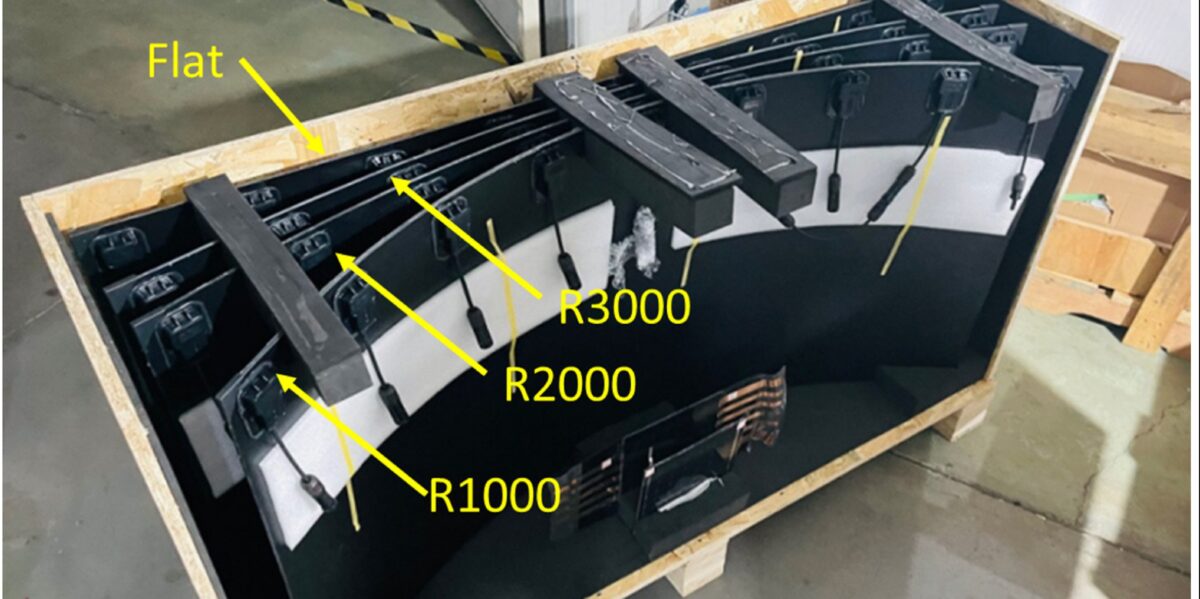
The team conducted initial testing of new protocols and validations in geographically diverse laboratories and research institutes, as well as solar simulator testing applying agreed protocols using the same calibration data, as well as blind testing. For round-robin testing, Nanjing AGG Energy, China, supplied glass-covered rigid modules, including four levels of radius of curvature.
The group identified at least eight key differences that need to be addressed to achieve accurate models and measurements for VIPV products. For example, use a local coordinate system that includes 3D rotation, capturing the shadow areas for vehicle doors, hood, bumper and rear window.
Vector calculations are needed based on a shadow matrix, rather than the shadow ratio or angle. Tensor shapes, 4-Tensor, are used for the angular response to the incident light, instead of the Lambartian curve, and instead of cosine loss through angles of the PV panel, differential geometry description is used using vector expression of a unit element, noted the researchers.
Some of the differences are summarized by Araki. “In the new model, a shadow matrix takes into account non-uniform shadows in the hemispheric sky. “The classical analysis, on the other hand, is based on a scalar shading ratio,” he explained, adding that the new method considers solar cells with curved surfaces and analyzes them using principles of differential geometry, “unlike the classical calculation, which assumes that solar cells have a flat surface.”
In addition, the new model uses ray tracing “done in vector form” instead of using a cosine approximation, and instead of representing the angular response and angle of incidence modification (IAM) as curves based on the angle of incidence, “the new calculation as four tensors.”
Looking ahead, the researchers plan to develop a ‘fuel economy estimation tool’ for trucks and buses with PV panels. Validation based on monitoring 130 trucks is ongoing so far, Araki said. In addition, other projects are planned to address the challenges in testing modules developed for agricultural voltaics, building integrated PV, as well as alpine PV and aircraft-integrated PV, such as high-altitude pseudo-satellites (HAPS) .
The research work is the result of the collective contribution of members of the IEC TC82 PT600 initiative which aims to establish standards for VIPV systems.
This content is copyrighted and may not be reused. If you would like to collaborate with us and reuse some of our content, please contact: editors@pv-magazine.com.
Popular content