
Close Menu
  • News
  • Industry
  • Solar Panels
  • Commercial
  • Residential
  • Finance
  • Technology
  • Carbon Credit
  • More
    • Policy
    • Energy Storage
    • Utility
    • Cummunity
What's Hot

Dutch solar owners asked to switch off during peak periods to ease the distribution crisis

June 7, 2026

The hydrogen flow: Toyota demonstrates its racing prototype on liquid hydrogen

June 7, 2026

Era of electrification exposing Australia’s weakest link

June 6, 2026
Facebook X (Twitter) Instagram
Solar Energy News
Monday, June 8
  • News
  • Industry
  • Solar Panels
  • Commercial
  • Residential
  • Finance
  • Technology
  • Carbon Credit
  • More
    • Policy
    • Energy Storage
    • Utility
    • Cummunity
Solar Energy News
Home - Solar Industry - Agrivoltaic energy can help lettuce survive extreme heat
Solar Industry

Agrivoltaic energy can help lettuce survive extreme heat

solarenergyBy solarenergyJanuary 30, 2026No Comments3 Mins Read
Facebook Twitter Pinterest LinkedIn Tumblr Email
Share
Facebook Twitter LinkedIn Pinterest Email

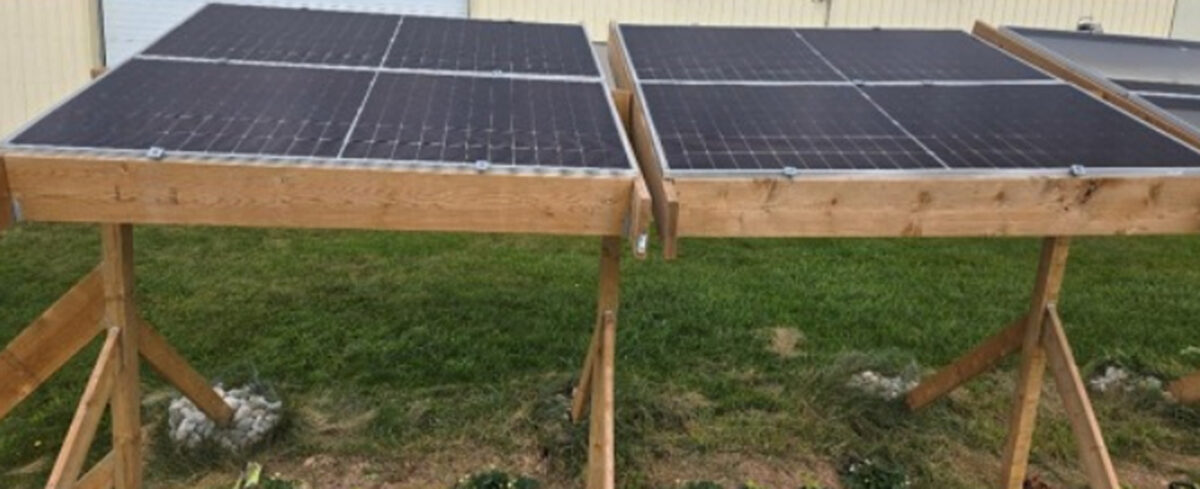
Scientists have grown organic romaine lettuce under thirteen different types of PV modules, in an unusually hot Canadian summer. Their analysis showed that lettuce yield increased by more than 400% compared to unshaded control plants.

January 30, 2026
Lior Kahana

A research group from Canada’s Western University has investigated the performance of organic romaine lettuce, a heat-sensitive crop, under a wide range of agrivoltaic conditions. The test was conducted in London, Ontario, in the summer of 2025, during 18 days of temperatures above 30 C.

“Our study investigates how agrivoltaic systems can be adapted to optimize crop growth, especially under extreme heat, while contributing to sustainable energy generation,” said corresponding researcher Uzair Jamil. pv magazine.

“This becomes especially relevant in the context of climate change, where we are experiencing extreme temperatures around the world,” Jamil added. “We investigated the performance of organic romaine lettuce under thirteen different agrivoltaic configurations – ranging from crystalline silicon PV to thin-film colored modules (red, blue, green) – in outdoor stress conditions at high temperatures.”

More specifically, the experiment included c-Si modules with a transparency rate of 8%, 44%, and 69%; blue c-Si modules with transparency of 60%, 70% and 80%; green c-Si modules with transparency of 60%, 70% and 80%; and red c-Si modules with 40%, 50%, 70% and 80% transparency.

All agricultural voltaics had a leading edge height of 2.0 m and a trailing edge height of 2.8 m, and the modules were oriented southward at 34◦. Pots of organic romaine lettuce were placed under all configurations, along with three pots fully exposed to ambient sunlight without shade, which were used as controls.

See also  The Californian winery carries out all activities on floating solar energy and on the roof – SPE

In addition to measurements against the control, the scientific group compared the results with the national average yield per pot for 2022, which included fewer days with high temperatures and was therefore considered typical. These data points come from agricultural census data, which also later allowed the researcher to make national projections of their results.

“Lettuce yields increased by over 400% compared to unshaded control plants, and by 200% compared to national average yields,” Jamil said of the results. “60% transparent blue Cd-Te and 44% transparent crystalline silicon PV modules delivered the highest productivity gains, demonstrating the importance of both shade intensity and spectral quality in stimulating plant growth.”

Jamil added that if agrivoltaics were scaled up to protect Canada’s entire lettuce crop, 392,000 tonnes of lettuce could be added.

“That translates into revenues of CAD62.9 billion ($46.6 billion) over 25 years,” he said. “If scaled up across Canada, the agrivoltaic sector could also reduce CO2 emissions by 6.4 million tonnes over 25 years, making it a key player in reducing the agricultural sector’s carbon footprint.”

The results of the research work were presented in “Improving heat stress tolerance in organic romaine lettuce using crystalline silicon and red, blue and green colored thin-film agrivoltaic systems”, published in Solar energy.

This content is copyrighted and may not be reused. If you would like to collaborate with us and reuse some of our content, please contact: editors@pv-magazine.com.

Popular content

Source link

agrivoltaic Energy extreme heat lettuce survive
Share. Facebook Twitter Pinterest LinkedIn Tumblr Email
solarenergy
  • Website

Related Posts

Britain’s next energy dependency is already taking shape

June 5, 2026

ComEd starts a new energy pilot with a solar rebate on the roof of a brewery

June 5, 2026

Malaysia expects to reach 29.7 GW of solar energy by 2035

June 5, 2026
Leave A Reply Cancel Reply

Don't Miss
Technology

Research shows that ground reflectors with a high albedo increase the yield of bifacial solar power plants by up to 4.5% – SPE

By solarenergyMay 9, 20240

Tests conducted by Canadian researchers at the NREL test field in Colorado have shown that…

CS Energy Commissions Three Tesla Megapack Bess projects in New York

February 9, 2025

UL establishes a fire safety test protocol for residential energy storage systems

June 29, 2024

‘Tackling the gender gap requires a bottom-up approach, starting with recognition and regulation’ – SPE

June 8, 2024
Stay In Touch
  • Facebook
  • Twitter
  • Pinterest
  • Instagram
  • YouTube
  • Vimeo
Our Picks

Dutch solar owners asked to switch off during peak periods to ease the distribution crisis

June 7, 2026

The hydrogen flow: Toyota demonstrates its racing prototype on liquid hydrogen

June 7, 2026

Era of electrification exposing Australia’s weakest link

June 6, 2026

‘Come out from behind your screen, our industry is ultimately about people’

June 6, 2026
Our Picks

Dutch solar owners asked to switch off during peak periods to ease the distribution crisis

June 7, 2026

The hydrogen flow: Toyota demonstrates its racing prototype on liquid hydrogen

June 7, 2026

Era of electrification exposing Australia’s weakest link

June 6, 2026
About
About

Stay updated with the latest in solar energy. Discover innovations, trends, policies, and market insights driving the future of sustainable power worldwide.

Subscribe to Updates

Get the latest creative news and updates about Solar industry directly in your inbox!

Facebook X (Twitter) Instagram Pinterest
  • Contact
  • Privacy Policy
  • Terms & Conditions
© 2026 Tsolarenergynews.co - All rights reserved.

Type above and press Enter to search. Press Esc to cancel.